
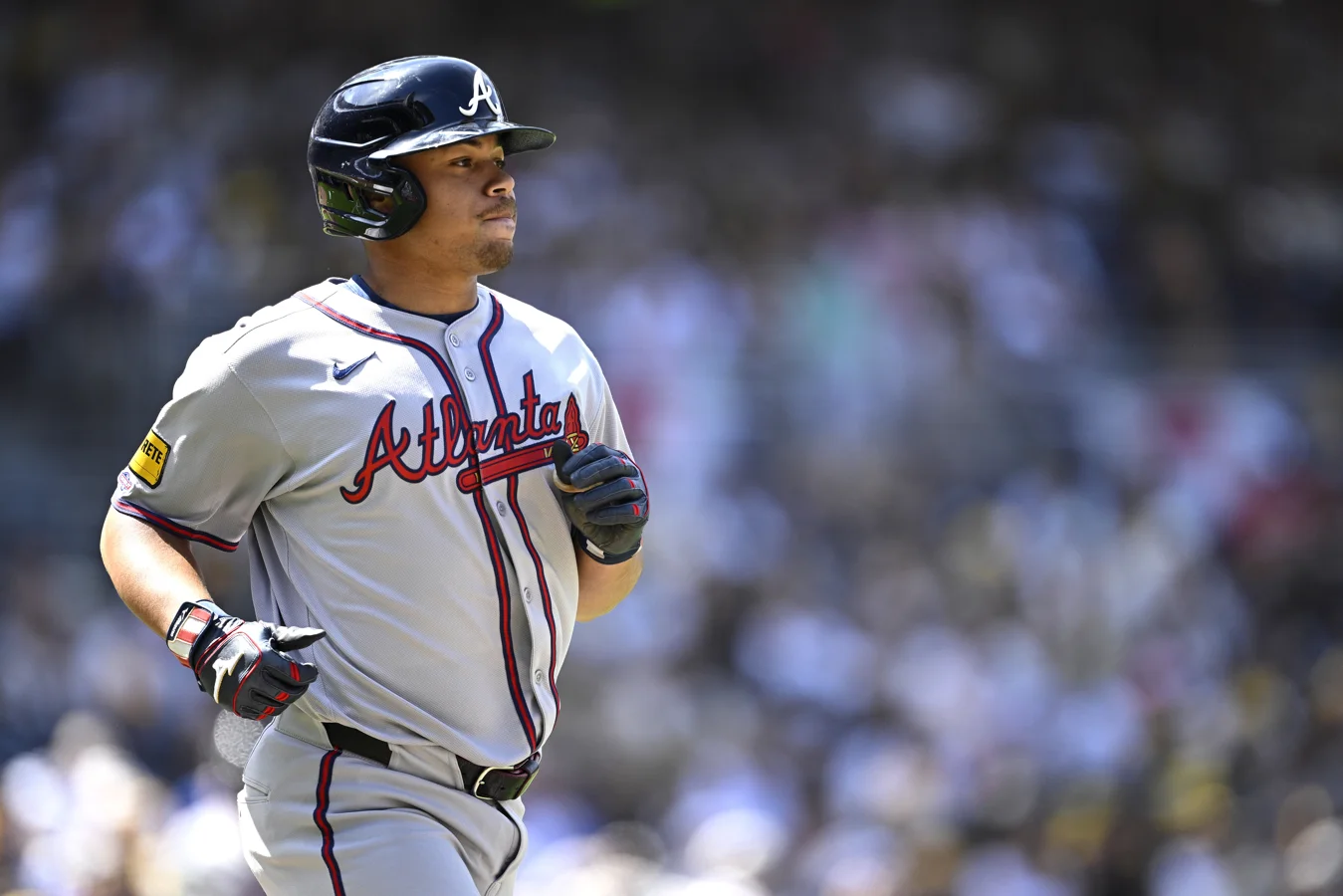

The Atlanta Braves have long favored a two–catcher strategy, utilizing players like Travis d’Arnaud, William Contreras, and Sean Murphy to maintain depth behind the plate. Heading into the 2025 season, Sean Murphy was expected to be the everyday catcher after securing a long-term deal. However, rookie <a href=”https://www.buzzineintl.com/tag/drake-baldwin/”>Drake Baldwin‘s rapid rise forced the Braves to reconsider their plans for the catching duties, creating a dynamic timeshare that could shape the team‘s future.
Baldwin, a third-round pick out of Missouri State, climbed quickly through the Braves’ minor league system, boasting a combined slash line of .272/.379/.428 with an .807 OPS over two and a half seasons. As Baseball’s No. 17 overall prospect entering 2025, Baldwin earned a spot on the Opening Day roster, challenging Murphy’s role despite the latter being under contract for at least three more years.
Current Distribution of Playing Time Between Baldwin and Murphy
Murphy’s cracked rib during spring training granted Baldwin the opportunity to assume the everyday catching role early in the season. Although Baldwin initially struggled with unusually poor batting average on balls in play (BABIP), he quickly established himself. After Murphy returned following a nine-game absence, he resumed his starting role, beginning April with a lead in starts at 15 to Baldwin’s 9.
However, May brought a more balanced split, with Murphy starting 11 games and Baldwin 8. Over the past 10 games, they have shared starts evenly. Both catchers have performed well offensively, with Murphy posting an .828 OPS and 129 weighted runs created plus (wRC+), and Baldwin exceeding that with a .930 OPS and 158 wRC+.
Defensively, Murphy remains strong, contributing 2 Blocks Above Average, a 25% caught stealing rate, and an average pop time of 1.96 seconds. Baldwin has also shown impressive defensive tools, ranking in the 82nd percentile for pitch framing according to Statcast and displaying a near-identical pop time of 1.95 seconds. However, he has allowed four stolen bases out of 29 attempts and ranks low in blocking skills, indicating areas for growth.
Manager Brian Snitker has sought to maximize their value by rotating them in the catcher‘s spot while keeping Marcell Ozuna in the designated hitter role. Often, the catcher not starting is utilized as a pinch hitter, preserving their offensive impact on the lineup.
Why Baldwin’s Offensive Impact is Driving the Shared Catching Role
Baldwin’s offensive numbers have made it clear the Braves cannot afford to sideline his bat. Leading the team in batting average (.337), slugging percentage (.551), OPS (.930), weighted on-base average (.403), and wRC+ (158), Baldwin ranks third in fWAR with 1.3 despite limited plate appearances. This remarkable productivity has accelerated a move toward a more balanced timeshare with Murphy.
The shift is logical given Baldwin’s May performance and his outsized offensive contributions. While Murphy remains a highly capable player whom some fans may undervalue, Baldwin’s numbers earn him a larger share of playing time—potentially a 60/40 split favoring Baldwin, or even closer to equal. Having two strong catchers sharing duties grants the Braves a strategic advantage both offensively and defensively.
The Debate Over Trading Sean Murphy
Among Braves fans, discussions have emerged about trading Murphy to give Baldwin an everyday role. However, two main arguments caution against this approach. First, Baldwin is still a rookie with fewer than 100 career plate appearances, making it premature to rely on him fully without fallback options. The Braves’ catching depth beyond him includes James McCann, Sandy León, and Jason Delay, none of whom offer comparable upside.
Second, Murphy provides outstanding value, earning an affordable $15 million annually through 2028 with a $15 million club option for 2029, his age-34 season. This salary figure represents excellent value for an All-Star caliber catcher in his prime.
That said, the Braves now possess greater roster flexibility to entertain trade opportunities if the right offer appears. General manager Alex Anthopoulos has more leverage in potential moves, but any trade of Murphy will require significant return due to his talent and contract status. The team wants to remain competitive now and in the future, making Murphy an asset not easily moved.
Considering Position Changes to Keep Both Players in the Lineup
Another idea gaining traction is moving either Baldwin or Murphy to the outfield to maximize offensive output by having both bats in the daily lineup. Baldwin’s athletic profile suggests he could potentially adapt to an outfield role. However, neither player has experience outside catcher at the major or minor league levels. Murphy has some past first base experience from college, but Baldwin has played exclusively behind the plate.
Introducing such a positional change this season carries significant risk. Requiring Baldwin to learn outfield duties mid-season might hinder his development and impact his performance. The Braves have a history of experimenting with catchers in the outfield, such as Chipper Jones, Evan Gattis, Jorge Soler, and Marcell Ozuna, but it remains a gamble rather than an ideal solution. For now, the organization appears reluctant to disrupt Baldwin’s progress by forcing a position switch.
Outlook for the Braves’ Catching Situation Moving Forward
Baldwin’s early career performance is tantalizing for analysts and fans alike. Though still in a small sample size, his Statcast profile ranks him among elite hitters with significant promise. His emergence has effectively compelled the Braves to split playing time evenly with a proven, $73 million veteran like Murphy.
Managing the timeshare presents challenges but also reflects a favorable dilemma—having two talented catchers pushing each other for playing time. This dynamic strengthens the Braves’ roster depth and provides strategic flexibility heading into the future. For now, fans should appreciate the potent duo the Braves have behind the plate, with Baldwin earning his share of the spotlight alongside Murphy.
As the season progresses, how the Braves balance their catching rotation will be a key narrative, potentially shaping lineup construction and long-term roster decisions in Atlanta’s pursuit of sustained success.