
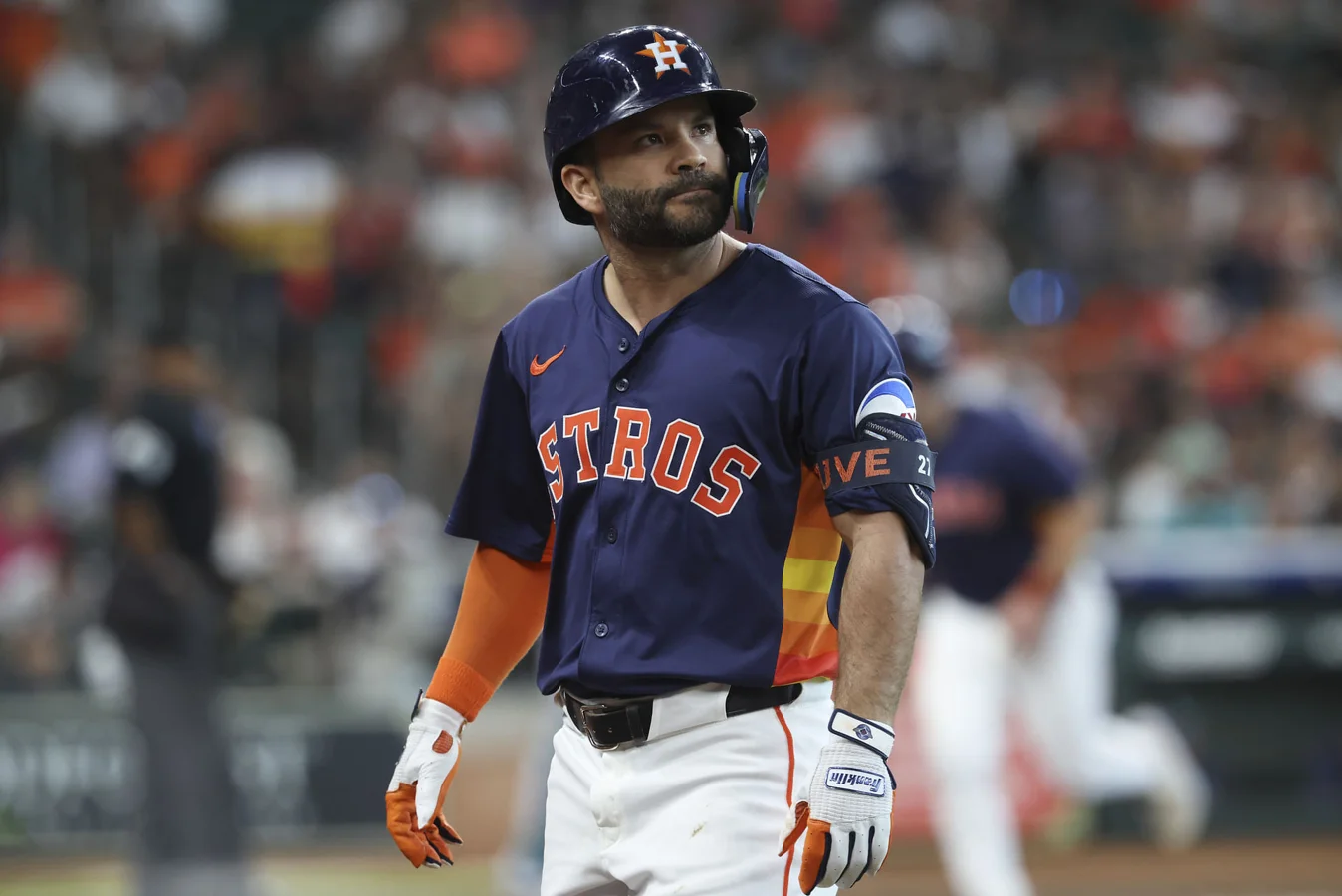

Jose Altuve of the Houston Astros has captured widespread attention with an extraordinary .370 batting average on first pitches, a statistic that stands out across Major League Baseball. However, Mike Stanton, a former New York Yankees All-Star and MLB analyst, challenges the accuracy of this metric, arguing that it does not fully capture Altuve’s overall performance in these situations and can be misleading.
Mike Stanton Explains Limitations of the First-Pitch Batting Average
Altuve’s .370 average on first pitches only accounts for balls that are put in play immediately, ignoring other outcomes such as swings and misses or foul balls. Stanton highlighted this point during an appearance on the Wheelhouse Company Podcast, where he noted the restricted scope of the statistic.
“Now you see situations like Jose Altuve hitting .370 on the first pitch, right? Okay, that’s a little misleading because that’s only on first-pitch balls in play. If he swings and misses or fouls a pitch off, they don’t count those in that batting average.”
—Mike Stanton, MLB Analyst and Former New York Yankees All-Star
Stanton also praised Leo Mazzone, former pitching coach for the Atlanta Braves, for developing a more comprehensive way to measure batter success on first-pitch strikes, a method that accounted for all first-pitch outcomes rather than just balls put into play.
“Leo Mazzone, when I was with the Braves, used to come up with this stat. Now, you’ve got to remember—this was back when you actually had to put pen to paper,” Stanton added. “You couldn’t just get on the computer and pull up any stat you wanted. But he used to tell us what a real batting average was on first-pitch strikes—not just first-pitch balls in play.”
—Mike Stanton, MLB Analyst and Former New York Yankees All-Star
The Strategic Importance of Gaining an Advantage in the Count
The dynamic contest between pitcher and hitter is fundamental to baseball, with each side attempting to control the evolving situation. Stanton emphasized how crucial it is for a pitcher to gain the upper hand early in the count by delivering a pitch that forces the hitter into a defensive position.
Being ahead in the count, such as 0-2 or 3-2, increases pressure on the hitter, who must avoid striking out or drawing a walk. In these moments, the pitcher leverages location and pitch quality to minimize the batter’s opportunity to attack.
“Listen, if you don’t have great stuff, being ahead in the count is even more important,” Stanton explained. “Because you don’t have raw velocity or sick movement or something like that. Once you get ahead in the count, now I can expand. Now the hitter is on his heels and protecting instead of being in the driver’s seat, like when it’s 2-0. Getting ahead in the count is everything.”
—Mike Stanton, MLB Analyst and Former New York Yankees All-Star
Why the Debate Over Altuve’s First-Pitch Average Matters
The conversation surrounding Jose Altuve’s first-pitch batting average highlights a broader issue in baseball analytics: the need for a fuller context when interpreting individual statistics. While Altuve’s ability to make immediate contact is impressive, Stanton’s insights warn that the .370 figure alone omits key elements such as swings and misses, which significantly affect overall performance.
As MLB continues to embrace more advanced data tracking and analysis, debates like this underscore the evolving understanding of player effectiveness. For fans and analysts alike, recognizing the nuances behind headline numbers is vital to accurately assessing players like Altuve and appreciating the strategic complexity within the game.