
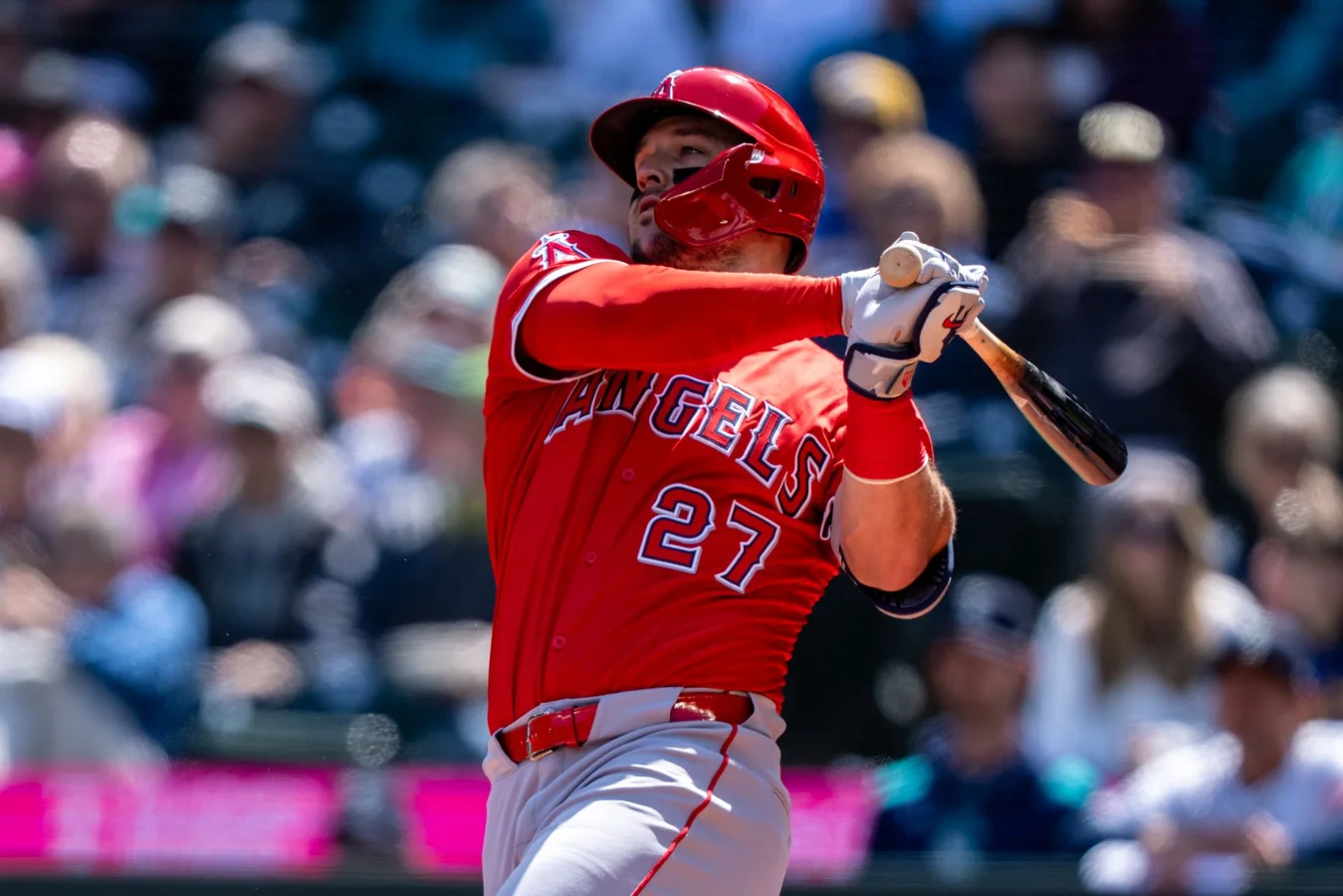

Mike Trout of the Los Angeles Angels made his much-anticipated return to the lineup during a 4–1 victory against the Cleveland Guardians, ending a 26-game absence caused by a bone bruise in his left knee. This comeback has prompted MLB insider Chris Rose to suggest that Trout might be shifting into the role of a traditional power hitter as he adapts to this stage of his career.
Chris Rose Sees Trout’s Role Shifting Toward Pure Power Hitting
During an episode of Baseball Today alongside former major leaguer Trevor Plouffe, veteran insider Chris Rose described this period as a crucial turning point for Trout’s performance. Rose proposed that the three-time MVP may be transitioning from his well-rounded hitting style into focusing more on power at the plate.
When Plouffe pointed out that Trout once seemed destined to reach 3,000 career hits, Rose responded bluntly, saying,
“I’m worried he won’t even get to 2,500 hits.”
Plouffe further noted that Trout might need to adjust his swing mechanics to remain effective as he ages and copes with physical challenges.
Lineup Changes and Current Performance Highlight Potential Transformation
Currently holding a 26-30 record, the Angels are four games behind an American League Wild Card spot, making Trout’s health and performance critical for the team’s playoff chances. Notably, Trout returned to bat fifth in the lineup—a departure from his usual third spot and the first time since his rookie season he has hit that low.
Angels manager Ron Washington emphasized that this adjustment is temporary and expects Trout to move back to the top of the order soon. Regardless, Trout’s current batting statistics raise questions about his future approach. His batting average stands at a low .180 with a .262 on-base percentage, significantly beneath his career norms, while his strikeout rate has risen to 30%, and his chase rate now reaches 25%, reflecting more swings and misses and pitches chased outside the strike zone.
Encouraging Metrics and Team Dynamics Despite Struggles
Despite some troubling numbers, there are positive signs in Trout’s expected slugging percentage, barrel rate, hard-hit balls, and sweet spot contact—all of which remain above average. Physically, Trout continues to show strong athleticism, with his sprint speed ranking in the 84th percentile, although stolen bases are likely limited due to injury precautions.
During Trout’s absence, younger players such as Zach Neto and Logan O’Hoppe have stepped up to fill gaps, yet the team’s success is still heavily reliant on its superstar. Even if Trout is performing differently than in his prime, his contribution remains central to the Angels’ hopes for a postseason run in Anaheim.
Mike Trout’s evolution into a classic power hitter could reshape his career path and impact how he contributes to the Angels’ playoff ambitions moving forward. While this adjustment period presents challenges, it might also mark the beginning of a new phase for one of baseball’s most talented players, as his role adapts to his experience and physical condition.