
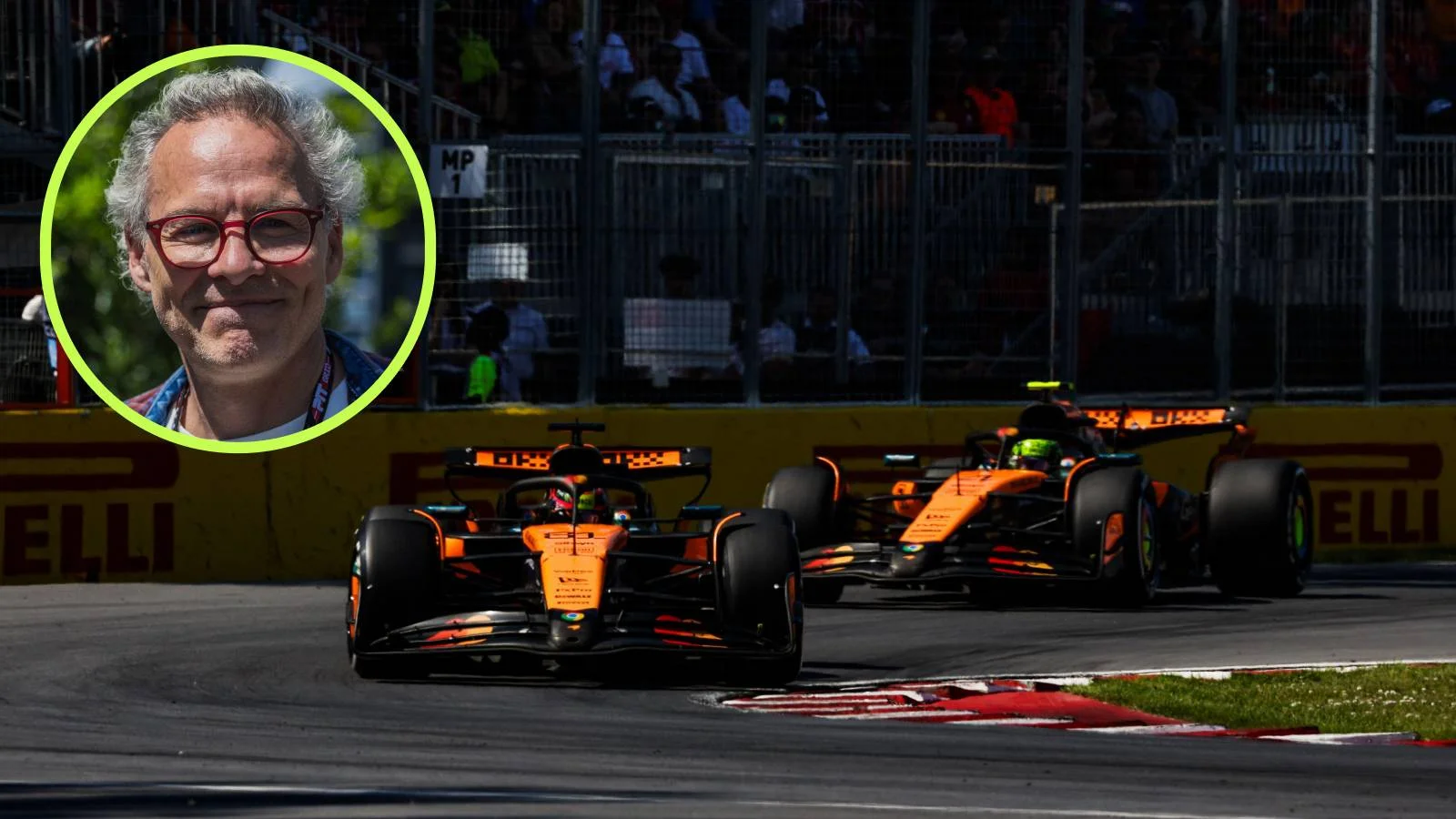

The final laps of the Canadian Grand Prix in Montreal sparked significant debate, with Lando Norris colliding with his McLaren teammate Oscar Piastri and a protest from Red Bull stirring further tension after the race. The focus turned to the Lando Norris Canadian GP collision penalty impact, as the stewards assigned a time penalty without affecting his grid position or championship points.
Alongside the incident involving Norris, a protest was lodged by Red Bull challenging the driving behavior of Mercedes’ George Russell during the safety car period, echoing earlier disputes seen in the Miami Grand Prix. This protest delayed media sessions and added layers of scrutiny to the race’s closing moments.
Red Bull accuses Mercedes of unsporting tactics during safety car restart
Red Bull team principal Christian Horner detailed two main grievances with Russell’s conduct behind the safety car. The first related to abrupt and heavy braking by Russell — an action the team claimed was excessive and strategically aimed at manipulating the race. The second issue concerned the unusually large distance maintained behind the safety car, reportedly exceeding limits by a large margin.
“We’ve put two protests to the stewards, that we’ve asked them to have a look at. Firstly relating to the erratic driving behind the safety car, where George very heavily braked, obviously looking at his mirror for Max, and then the second one is very clearly the distance that was left behind the safety car. That was well in excess, I think at least three times in excess of the permitted distance.”
—Christian Horner, Red Bull team principal
Although Red Bull’s formal protest did not explicitly accuse Russian driver George Russell of intentional misconduct, Horner labeled the situation as “gamesmanship.” He warned that such tactics are common and warned the race director to watch for them ahead of the event.
“I think that it’s inevitable that there was going to be some potential gamesmanship. It’s something that we raised after the driver’s briefing with the race director, just so that they were mindful of it as well, because it’s clear that kind of stuff goes on.”
—Christian Horner, Red Bull team principal
During a 45-minute hearing, Red Bull’s Stephen Knowles, Gianpiero Lambiase, and Verstappen presented telemetry showing Russell’s hard braking and onboard footage demonstrating mirror checks. Red Bull argued these moves were calculated to disrupt Verstappen’s momentum and provoke an illegal overtaking attempt. Additionally, they submitted radio audio in which Russell reportedly complained about being overtaken, suggesting this was an attempt to draw race control’s attention and penalize Verstappen.
“Red Bull suggested that the driver of Car 63 complained about the overtake on his team radio knowing that it would be overheard by race control and in the hope that Car 1 would be investigated.”
Mercedes defends Russell, presenting counter-evidence and alternative explanations
Mercedes was represented by Ron Meadows, Andrew Shovlin, and George Russell himself during the stewards’ meeting. Russell explained that periodic braking during safety car periods is standard practice for maintaining tyre and brake temperature, and that his heavy braking was a consequence of closing in too much on the safety car. His onboard footage depicting a gesture asking the safety car to speed up supported this claim.
Russell denied any intent to deceive, saying his mirror check was solely for safety, to avoid an accident with Verstappen behind him. He also refuted claims of trying to provoke a penalty via his radio communications, stating he was simply relaying factual information.
Mercedes backed up their defense with telemetry data highlighting that Verstappen had also braked as hard as Russell at several points on the same lap, challenging Red Bull’s narrative of erratic driving as unilateral.
FIA dismisses Red Bull’s protest, validating Mercedes’ account
FIA official Tim Malyon conveyed race control’s position, affirming that periodic braking behind the safety car is a routine expectation. He outlined that race control provides some discretion regarding the minimum allowed distance behind the safety car to accommodate this behavior.
The steward panel in Montreal, composed of Gerd Ennser, Matthew Selley, Enrique Bernoldi, Natalie Corsmit, and Marcel Demers, took five hours to reach and publish their decision after replacing Derek Warwick for this session.
The stewards fully accepted Mercedes’ explanation and evidence, rejecting Red Bull’s claims at every point. Specifically, they stated:
“Having regard to the evidence of Mr Malyon, we accept the driver of Car 63’s explanation of the incident and we are satisfied that the driver of Car 63 did not drive erratically by braking where he did or to the extent he did.”
—FIA steward panel decision
Regarding the suggestion of unsportsmanlike conduct via radio communication, the stewards found no grounds to support Red Bull’s assertion:
“We are not satisfied that by simply reporting to his team that Car 1 had overtaken that he engaged in unsportsmanlike conduct.”
—FIA steward panel decision
Moreover, the stewards independently noted that the braking itself was within acceptable limits and did not display unsporting behavior. The protest element concerning the gap behind the safety car was not addressed in detail, likely reflecting its lesser importance in the overall complaint.
Details on Norris collision penalty and its limited effect
Beyond the Red Bull protest, the stewards also reviewed multiple safety car infringements, which ultimately warranted warnings but no penalties. The other major post-race matter was Lando Norris’ collision with teammate Oscar Piastri during the race.
The hearing involved Norris, Piastri, and a McLaren representative and was straightforward given Norris’ immediate acceptance of responsibility for the incident. The stewards classified him as entirely at fault for causing the collision.
“The driver of Car 4 said that he thought there might be space but realised too late that there was not and he collided with Car 81.”
—FIA stewards’ report on Norris collision
Despite this, because Piastri was able to continue without visible damage, the stewards ruled that the collision had
“no immediate and obvious sporting consequence.”
This led to a relatively minor five-second time penalty rather than a harsher sanction.
Due to Norris completing over 90% of the race distance, his penalty was applied as an addition to his final race time rather than a grid penalty at the upcoming Austrian Grand Prix. Effectively, the five seconds were tacked onto his recorded finish time of 1 hour, 24 minutes, and 2.470 seconds, meaning that he was classified as finishing slightly later than he physically retired on track.
This time penalty did not cause Norris to lose championship points or attract any penalty points on his superlicence, leaving his standing in the driver rankings intact despite the collision.
Significance of the rulings and implications for the championship
The decisions from the Canadian GP stewards have important consequences for the teams and drivers involved. Red Bull’s unsuccessful protest reinforces Mercedes and Russell’s clean record concerning the safety car phase in Montreal, while dismissing Red Bull’s accusations of strategic misconduct.
Lando Norris’ penalty highlights the strict approach to intra-team collisions but also shows the stewards’ willingness to consider race context, avoiding penalty conversions when incidents yield limited impact. Norris retains crucial championship points despite the collision, which maintains tension in the title fight as the season progresses.
Looking ahead, the Austrian Grand Prix will see Norris start unaffected on the grid, allowing McLaren to focus on performance without additional handicaps. Meanwhile, the FIA’s handling of post-race protests and penalties continues to draw scrutiny for transparency and timing, underscoring ongoing challenges in maintaining fairness in Formula 1’s fast-moving environment.