
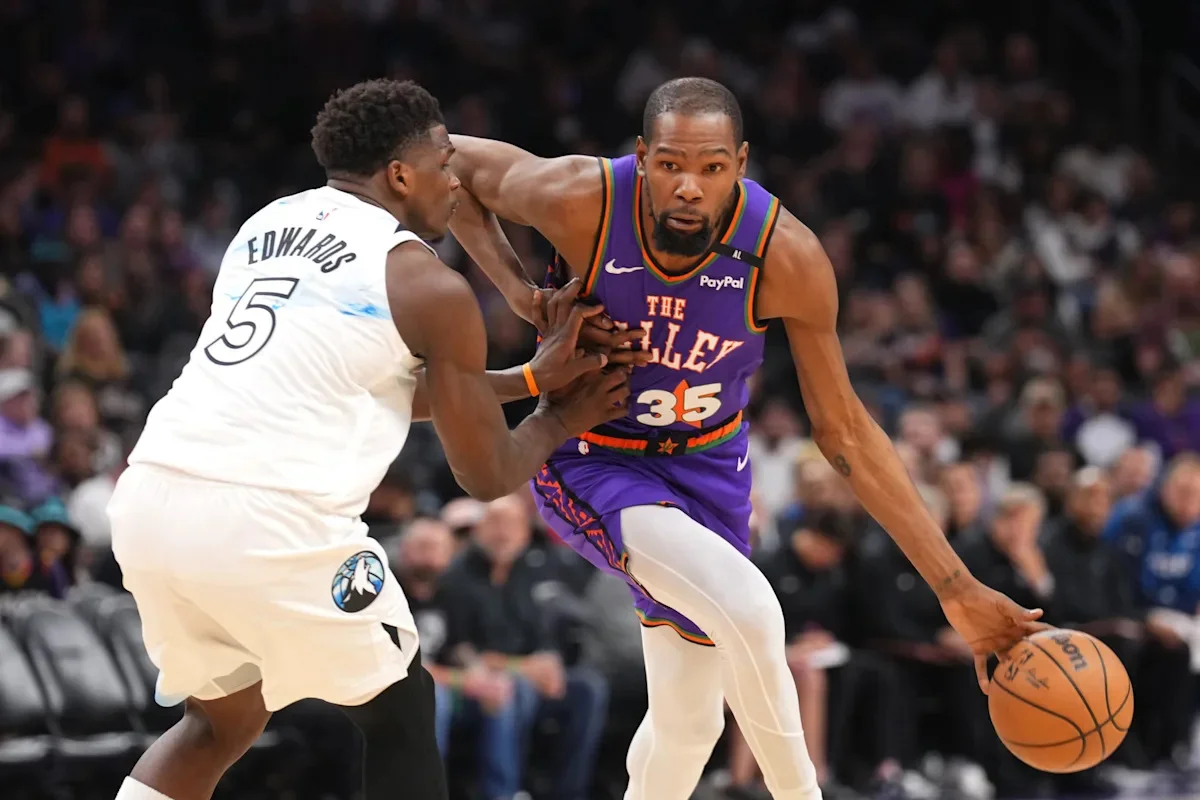

Kevin Durant, despite being in the latter stages of his basketball career at age 37, remains determined to chase championship glory. However, recent trade talks reveal his unwillingness to pair up with Anthony Edwards and the Minnesota Timberwolves, choosing instead to prioritize teams like the San Antonio Spurs, Houston Rockets, and Miami Heat. This decision has stunned fans and raised questions about the feasibility and appeal of the Edwards and Kevin Durant trade talks.
Durant’s high-profile legacy adds complexity to any trade negotiations, especially with teams uncertain about what to expect from him in the coming seasons. The Orlando Magic’s recent trade for Desmond Bane, which cost them four first-round picks, has set a benchmark that many believe undervalues Durant’s stature, yet reflects the market reality for aging superstars like him.
Trade Market Challenges and Teams’ Cautious Approach to Durant’s Future
NBA insiders note that teams interested in acquiring Durant are hesitant to part with large assets, mainly because his future performance carries uncertainty. Brian Windhorst explained,
“No, you’re not going to get that great of a package because the team paying for it isn’t sure what Durant’s going to do necessarily. And the teams that Durant wants to go to, Houston and San Antonio, for example, they’re leery of giving a huge amount for a 37-year-old.”
Given this backdrop, the Phoenix Suns, Durant’s current team, might opt not to trade him if they cannot secure a deal that meets their expectations. As Windhorst noted,
“I would not rule out the Suns not being able to get a trade they like and having to make a decision…like, do we not trade him at all?”
The complications arise from differing needs and contract considerations among potential trade partners. Windhorst further emphasized,

“Their whole teams are in their early to mid twenties. So you don’t have alignment in making everybody on the same page. You know what Durant wants, what the Suns need, and what the teams want to pay with the contract. I would not rule out the Suns not being able to get a trade they like and having to make a decision. Like, do we not trade them at all?”
The Timberwolves’ Persistence Despite Durant’s Rejection
Even though Kevin Durant reportedly excluded the Minnesota Timberwolves from his preferred destinations, the franchise remains determined to secure his services. Minnesota’s front office continues to actively pursue Durant, envisioning a dynamic offensive combination alongside Anthony Edwards and Julius Randle. Despite the player’s change of heart, Wolves fans hold onto hope that the partnership might still materialize.
NBA reporter Shams Charania confirmed Minnesota’s ongoing interest, describing the Wolves as “loud and relentless” in their chase for Durant. However, the reluctance from Durant to join underscores a deeper issue about Minnesota’s appeal to superstar players.
Financial and Contract Implications for Minnesota
Durant demands a lucrative two-year contract worth $122 million, which would extend through his age-39 season. For the Timberwolves, navigating this contract amidst salary cap constraints presents a major challenge. With the league’s second luxury tax apron set at $207.8 million, Minnesota has little flexibility, retaining less than $58 million to re-sign important players after accounting for existing commitments. Should Julius Randle opt into his contract, that figure shrinks dramatically to just $27 million.
Despite these obstacles, Minnesota’s management is willing to take the risk, betting on the transformative potential Durant could bring to their roster. The franchise appears ready to embrace the financial and strategic gamble, underscoring their desperation to move beyond their current status.
Insights into Durant’s Hesitation: Evaluating Minnesota’s Appeal
Industry experts and insiders have speculated that Kevin Durant’s reluctance to join the Timberwolves signals perceptions of the franchise’s competitive outlook and organizational stature. On the Flagrant Howls podcast, discussion centered on whether Durant’s hesitation reflects broader skepticism about Minnesota’s ability to contend at the highest level.
“The Wolves badly, badly want Kevin Durant. I’ve not been led to believe here on Tuesday morning that anything has changed in that regard. So here’s the question,”
an insider stated,
“In February, there was a sense that KD was open-minded to playing here. So why all this national chatter now about Kevin Durant having zero desire to be here in Minnesota? Not everyone looks at the Timberwolves organization as the cream of the crop, so it’s very reasonable to think that he may just not want to play in Minnesota.”
Future Prospects of the Trade and Its Broader Impact
The Anthony Edwards and Kevin Durant trade talks have become one of the NBA’s most intensively watched stories, as the implications extend far beyond the players involved. If a deal involving Durant materializes, it could reshape several teams’ trajectories and shift the competitive landscape. However, with Durant’s uncertainty, the organic risk factors, and complex salary conditions, any move remains tentative.
For the Timberwolves, securing Durant would represent a bold leap toward contending, but the financial gamble and Durant’s apparent disinterest make the outcome unpredictable. Meanwhile, the Suns face a delicate choice of whether to hold on to Durant or trade him for an acceptable package.
In this high-stakes drama, Durant’s preferences and the strategic calculations of franchises will dictate the course. For fans and analysts alike, the saga highlights how fleeting opportunity and harsh realities collide within NBA trade negotiations.