
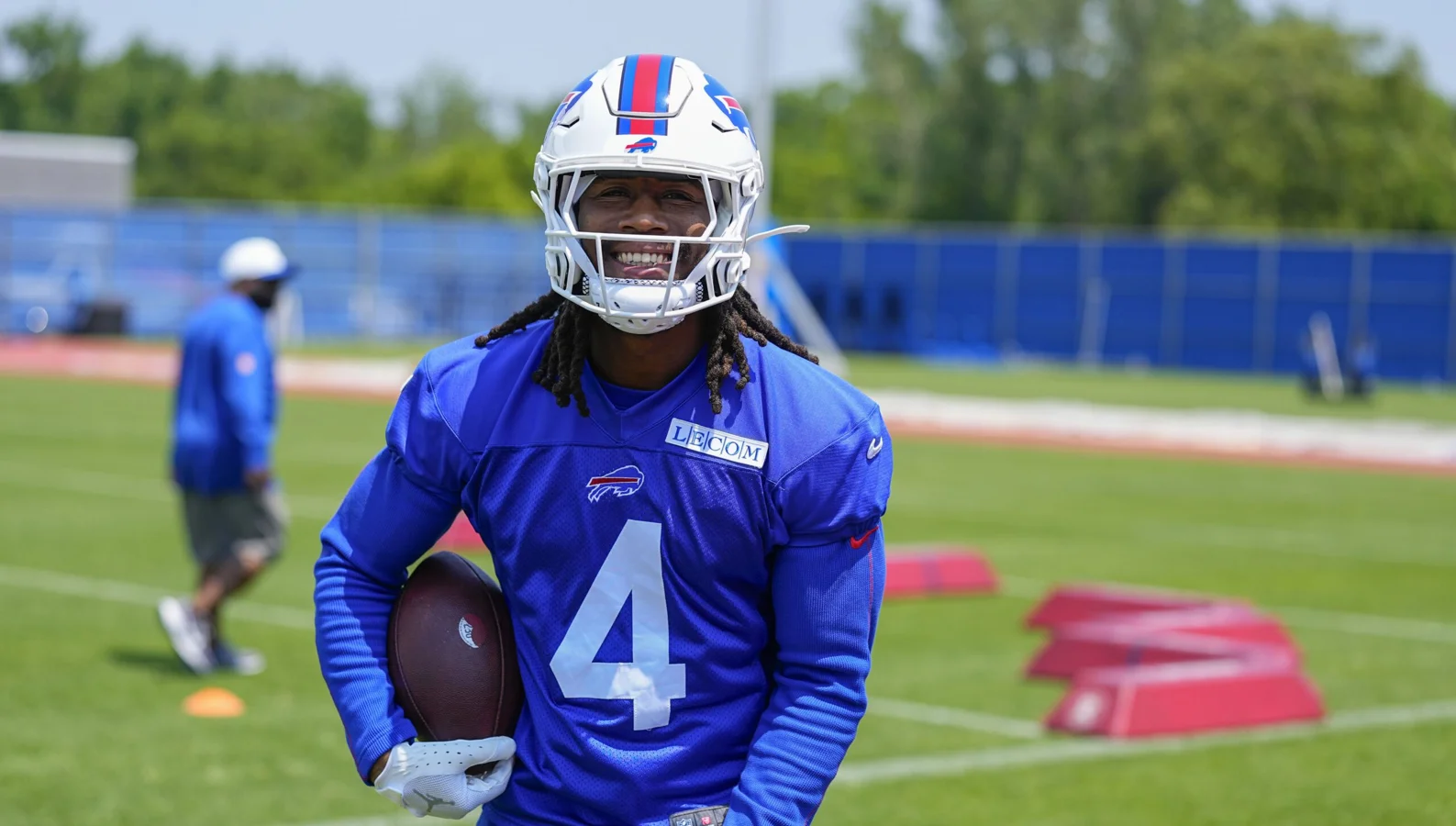

The Buffalo Bills are currently evaluating whether to meet running back James Cook’s reported request for a contract extension exceeding $15 million annually. Such a figure would place Cook among the NFL’s elite running backs in terms of pay, alongside players like Saquon Barkley, Derrick Henry, and Christian McCaffrey. Analyzing the details of Cook’s 2024 season and his role within the Bills’ offense reveals why committing to such a high salary may not be a prudent decision at this time.
Assessing James Cook’s Role and Limitations on the Field
James Cook’s appeal as a top-tier running back is tempered by his limited effectiveness in three-down roles. In 2024, he participated in only 48% of the Bills’ offensive snaps, which falls short of the involvement seen with established elite backs like Barkley and Henry, who both see well over 60% snap share. Cook’s struggles, especially in pass protection, have confined him predominantly to early downs, while backup Ty Johnson often handles critical passing situations such as third downs and two-minute drills.
According to Pro Football Focus, Cook’s pass-blocking grade was 52.3 in 2024, placing him in the lower third among starting NFL running backs. This is significant in a scheme led by quarterback Josh Allen, who faces blitzes on close to 28% of his dropbacks, underscoring the importance of reliable pass protection in key moments.
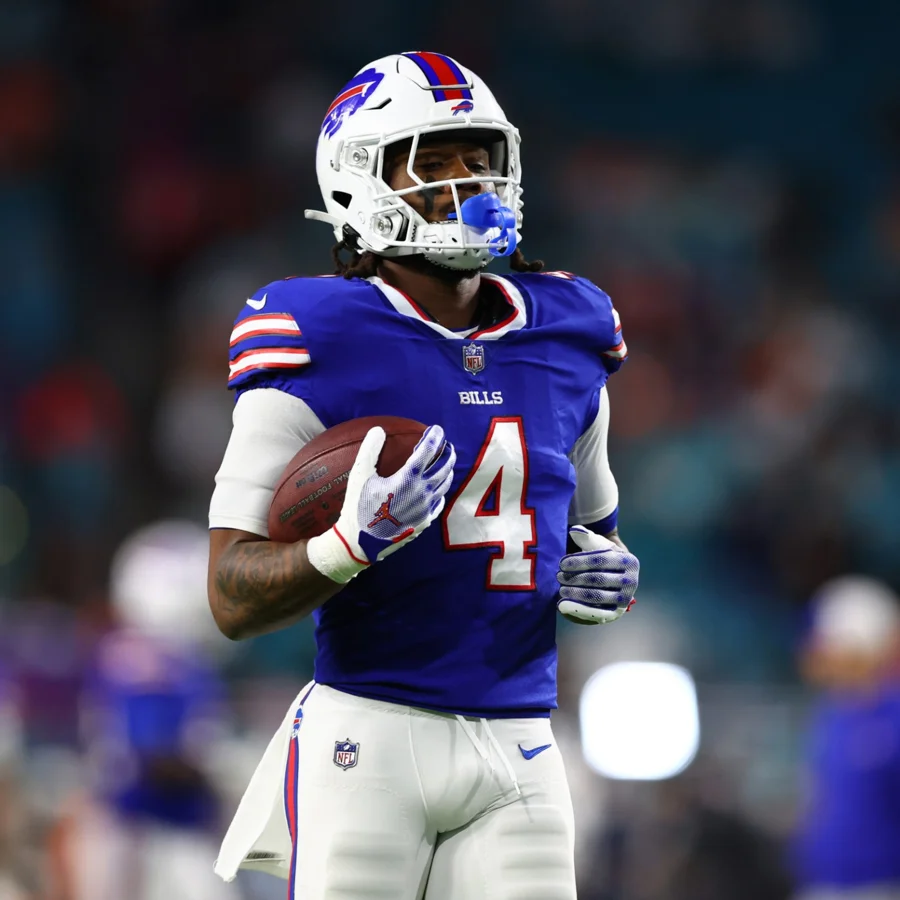
Cook’s receiving stats also reveal inconsistencies. While his 32 receptions for 258 yards and two touchdowns in 2024 are respectable for his role, his six drops in 2023—including three possible touchdown receptions—and a 7.4% drop rate in 2024 highlight reliability concerns. His reception rate under offensive coordinators Ken Dorsey and Joe Brady, at about 2.4 to 3.1 catches per game, indicates a limited involvement in the passing game, suggesting he does not yet fulfill the criteria of a versatile, three-down back justifying an elite salary.
Buffalo’s Rushing Success as a Collective Effort
Cook’s impressive statistics—4.9 yards per carry and 16 rushing touchdowns in 2024—should be contextualized within the broader framework of Buffalo’s run game. The team’s offensive line, featuring five starters each playing over 1,100 snaps, played a crucial role in run blocking success. Key personnel changes, like Connor McGovern’s move to center after Mitch Morse’s exit and David Edwards taking over the left guard spot, strengthened the unit. Pro Football Focus assigned the line a solid 78.6 grade for run blocking, reflecting cohesion and physicality.
Players like O’Cyrus Torrence, Spencer Brown, and Dion Dawkins contributed significant power and movement skills within coach Aaron Kromer’s schemes, establishing openings for running backs. Cook’s 120-yard performance in the Wild Card game against Denver is largely attributed to these blocking schemes and team effort.
Moreover, Josh Allen’s presence as a dual-threat quarterback has influenced Cook’s opportunities. Allen’s 15 rushing touchdowns in 2023 and record-setting rushing in 2024 forced defenses to account for him as a running threat, decreasing defensive stacking against Cook. Data shows Cook faced stacked boxes on only 12% of his carries compared to Derrick Henry’s 18%. Cook’s touchdown totals are also opportunity-driven, highlighted by only two rushing touchdowns in 2023 when Allen and Latavius Murray shared goal-line duties. The increase to 16 touchdowns in 2024 corresponded with more red-zone carries rather than a clear dominance in running efficiency.
While Cook’s production is impressive, it remains difficult to decisively state that those touchdowns would not have otherwise been scored by teammates if opportunities had shifted. This underscores the interplay of team dynamics in his statistical output.
Evaluating Cook’s Status Among Top NFL Running Backs
When compared to the NFL’s elite running backs, James Cook’s production and role do not fully align with their levels. Saquon Barkley, under a two-year, $41.2 million extension with the Philadelphia Eagles averaging $20.6 million annually, led the NFL in rushing yards with 2,005 and scored 13 touchdowns in 2024, averaging 5.8 yards per carry. His 1,137 yards after contact and eleven 100-yard games illustrate his ability to consistently carry an offense.
Derrick Henry, earning $15 million annually on a two-year deal with the Baltimore Ravens, totaled 1,921 yards and 16 touchdowns, while forcing a league-high 80 missed tackles. Both Barkley and Henry take more snaps—68% and 62%, respectively—and operate as clear three-down backs, surpassing Cook’s limited snap share and roles.
Christian McCaffrey, the standard for passing workhorse backs, earned $19 million AAV by compiling 1,459 yards, 14 touchdowns, and 67 receptions in 2023. Josh Jacobs, on a $14 million AAV deal with Green Bay, handled 316 carries in 2024, rushing for 1,299 yards and 14 touchdowns—while Cook had 207 carries. Cook’s yards per carry (4.9) lag behind Barkley’s and Henry’s 5.8 average, and his 48% snap rate substantiates a lower tier of involvement.
Spotrac’s valuation of Cook at $10.2 million AAV further indicates his placement below these elite runners. Crucially, unlike the aforementioned backfields, Cook benefits from playing behind Josh Allen, one of the league’s most dynamic quarterbacks, which eases pressure on his production.
Emerging Talent and Depth Behind Cook
If Cook opts to hold out or the Bills decline to meet his high asking price, running back Ray Davis emerges as a strong contender to fill the starting role. Drafted in the fourth round, Davis rushed for 320 yards on 75 carries with three touchdowns in a limited 2024 role. His Week 6 performance, stepping in for Cook, featured 97 rushing yards on 20 carries and 55 receiving yards on three catches, tallying 152 scrimmage yards.
Davis received a 72.1 overall PFF grade, comparable to Cook’s 74.3, despite fewer offensive snaps. His elusiveness is reflected in a missed tackle rate of 0.15 per carry, nearly matching Cook’s 0.17. Additionally, Davis produced solid college numbers at Kentucky, showing three-down ability with 33 receptions, 323 yards, and seven touchdowns in 2023. His smaller 5’8”, 220-pound frame suits short-yardage situations, boasting a 78% success rate on carries within the five-yard line, surpassing Cook’s 60%.
In pass protection, Davis posted a 65.2 PFF grade on limited attempts, suggesting potential growth into a dependable blocking back. His direct running style resulted in only 8% of runs losing yardage, compared to Cook’s 10%. With a cap hit of about $1 million through 2027, Davis offers a cost-controlled option with promising development.
Ty Johnson further strengthens the Bills’ backfield depth, especially as the preferred ball security option in late-game passing situations. In 2024, Johnson averaged 4.4 yards per carry while catching 51 passes for 393 yards and six touchdowns. His exceptional 82.4 PFF pass-blocking grade surpasses Cook’s, explaining his role on third downs and two-minute drills. Re-signed for 2025, Johnson complements Davis’ emerging presence, ensuring the Bills have reliable options without overspending on Cook.
Josh Allen’s Influence and Offensive Priorities
Buffalo’s offense centers on Josh Allen, whose 2024 MVP campaign demonstrated his pivotal role. Allen amassed 4,269 total yards, 41 touchdowns, and only eight turnovers. The team’s ability to consistently score 30 or more points in 12 games mostly derives from Allen’s dynamic play, not from any single running back’s contributions.
The run game’s success primarily depends on Allen’s threat as a runner, supported by the offensive line’s schemes and the running backs’ abilities. Assessing Cook’s value becomes challenging without factoring Allen’s presence; the quarterback’s dual-threat style alleviates pressure on the backfield and inflates rushing statistics.
Given Cook’s 48% snap share and lack of involvement in critical situations, allocating $15 million for his services conflicts with Buffalo’s broader strategy of rewarding players who impact game-defining moments consistently. At present, Cook has not demonstrated such influence.
Current Market Values for Running Backs and Cook’s Position
The NFL market for running backs confirms that Cook’s $15 million salary demand is an overreach. Barkley’s $20.6 million and Henry’s $15 million AAVs reflect their established elite status, while McCaffrey and Jacobs command premiums for consistent, three-down workhorse roles.
Cook’s demand would rank him as the third-highest-paid back despite statistical and usage shortcomings relative to his peers. Amid the Bills’ current salary cap constraints, investing heavily in Cook when Ray Davis and Ty Johnson provide scalable, cost-efficient production is economically unsound.
Why Holding Firm on Cook’s Request Matters
James Cook undoubtedly possesses talent, but his limited role and inconsistent impact during crucial game moments make a $15 million contract hard to justify. Compared with the league’s top backs, he falls short of delivering elite three-down value.
Ray Davis’s emerging skill set—including a 4.3 yards per carry average, receiving contributions, and promising pass-blocking grades—offers a viable alternative if Cook departs or holds out. Along with Johnson’s dependable third-down presence, the Bills have competent and affordable depth. Meanwhile, Josh Allen’s dominance under center ensures offensive productivity, freeing the team to maintain flexibility and invest in players who can influence the most critical moments.
If Cook continues his development and addresses weaknesses in pass protection and receiving reliability, he might merit a more lucrative contract future. For now, though, the burden of proof remains on him to demonstrate elite backfield impact comparable to figures like Barkley, Henry, or McCaffrey.
By standing firm against excessive contract demands, Buffalo positions itself to sustain its window for a Super Bowl run. Cook has another year on his rookie deal to prove he can become a franchise-changing back like Thurman Thomas. At this stage, however, he is not that player and should not be compensated as such.