
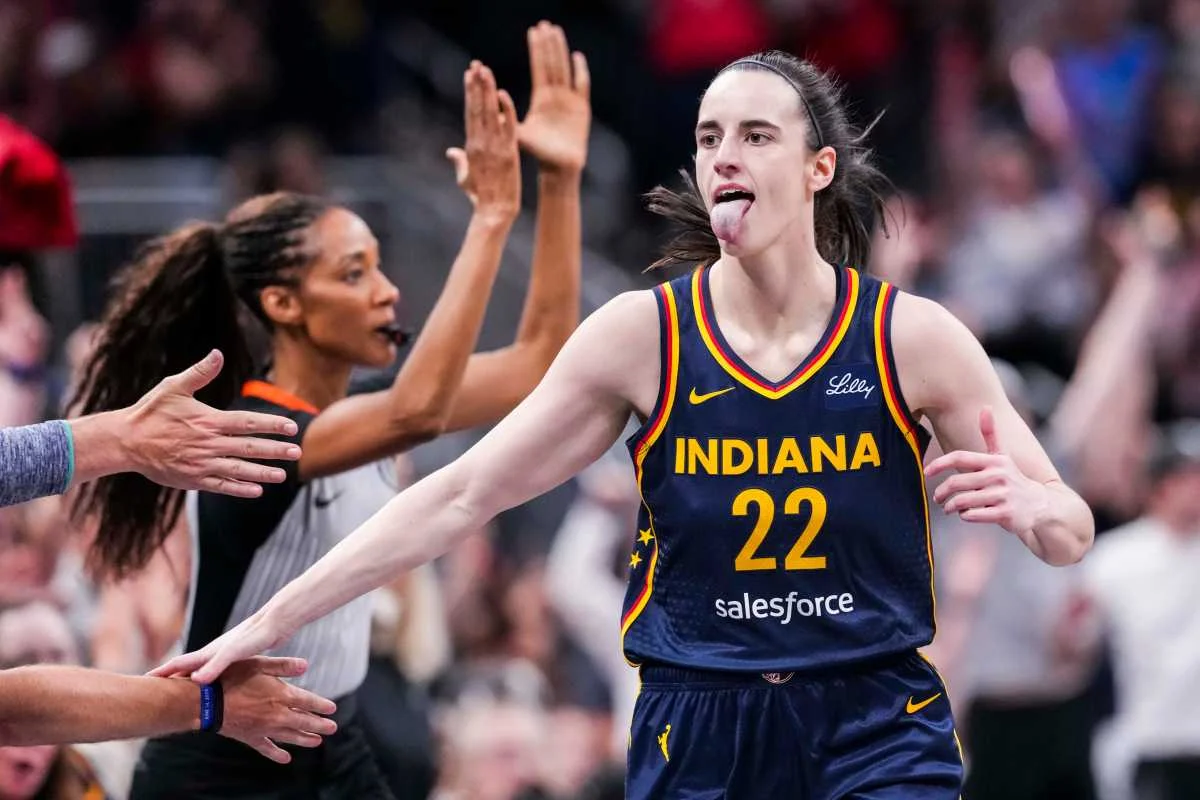

Caitlin Clark’s impact on the WNBA has sparked heated discussions, especially after Stephen A. Smith’s recent comments on ESPN accusing her of provoking the physical fouls she endures in games. Fans and analysts argue that Smith’s portrayal misrepresents Clark’s influence and downplays her role in elevating the league’s popularity and competitiveness.
Clark, celebrated for her fast-paced playing style and exceptional shooting abilities reminiscent of Steph Curry, has been a major reason why many have begun following the WNBA closely. However, ESPN coverage, particularly Smith’s analysis, has come under fire for minimizing her contributions and casting unjust blame on Clark for the aggressive treatment she faces from opponents.
ESPN’s Controversial Narrative on Caitlin Clark and On-Court Incidents
During the recent Commissioner’s Cup game against the Connecticut Sun, Caitlin Clark was subjected to intense physical fouling, including a poke to the eye by former college rival Jacy Sheldon and a forceful shove from Marina Mabrey that sent her crashing to the floor. Such physicality is not uncommon in the WNBA, but instead of condemning these tactics, Stephen A. Smith suggested that Clark’s own behavior, particularly her trash talking and attitude, invites retaliatory fouls from opposing players.
On a June 18 episode of First Take, Smith explicitly linked the rough treatment Clark receives to her apparent habit of provoking opponents. He recalled an incident involving Angel Reese during Clark’s college days, implying that Clark’s gestures stirred resentment among her rivals. Smith remarked:

“There’s also resentment towards her because she instigates resentment sometimes. ‘Oh Caitlin can clap at you now. Caitlin can antagonize you now.’ Remember in college, Doggy (Mad Dog Russo), the whole Angel Reese thing started because Caitlin was giving it to everybody else. She was the one waving at their face. And that’s why when Angel Reese and LSU got a hold of her, Angel Reese was like ‘Yeah, it’s your turn.’” —Stephen A. Smith, ESPN Analyst
Smith’s framing places responsibility for the fouls on Clark, suggesting that her outspoken demeanor justifies the aggressive responses she experiences on court. This interpretation has been at odds with many fans and commentators who view Clark as a victim of excessive physical play rather than its instigator.
Strong Backlash from Caitlin Clark’s Supporters Against Stephen A. Smith
Caitlin Clark’s supporters were quick to denounce Smith’s comments as inaccurate and unfair. They highlighted that Clark’s infamous “John Cena” gesture in college was directed toward her own coaching staff—not her opponents—refuting the notion that she purposely taunted adversaries. Moreover, statistics show that Clark is more frequently on the receiving end of flagrant fouls than committing them, with a sixth of all flagrant fouls in the WNBA last season targeting her.
As a prominent national broadcaster, Smith is expected to provide fact-based analysis. Critics argue that his continued misrepresentation undermines the truth about Clark’s playing style and character. His treatment of Clark in the media is seen by many as perpetuating a biased narrative that diminishes her achievements and unfairly vilifies her behavior.
Viewers and fans expressed frustration on social media, claiming that Smith’s commentary is part of a broader pattern of distorting reality, particularly in downplaying Clark’s influence on the league. One user said it plainly:
“It astounds me how, still years later, people with platforms as large as ESPN continue to misrepresent the incident against Louisville despite the player supposedly targeted by Caitlin Clark completely dispelling the notion Clark was taunting her.” —Ben Schuff, Social Media User
Others praised Clark’s undeniable talent and rising status within the WNBA, insisting that her contributions are being ignored or belittled by mainstream sports media. A fan remarked:
“Imagine not just acknowledging the fact that she’s already the best player in WNBA HISTORY and has barely stepped foot in the league lol. It’s easier when you just accept it.” —AL, WNBA Enthusiast
Additional voices acknowledged Clark as the league’s new face, urging both players and media to accept her prominence despite personal preferences:
“Not a fan of Clark to be honest but man the talk about her. The people in the league, players and medias alike need to accept it, she is now the face of WNBA. You can say whatever but she is now the face of WNBA. you can shove some records whatever but she is the face of WNBA.” —bluppy, Social Media Commentator
Context and Clarification on Past Incidents Involving Clark and Angel Reese
The polarizing debate over Clark’s conduct traces back to an infamous episode during the national championship game when Angel Reese taunted Clark by following her around from the free throw line to center court. Fans and legal commentators have pushed back against any claim that Clark initiated similar taunting behavior. Legal professional Shuaiyb Newton refuted these claims as blatant distortion:
“This is a complete distortion of the facts. Caitlin Clark never did to any player what Angel Reese did to her at the end of the National Championship – following a player around taunting them from the free throw line to center court as the game ends.” —Shuaiyb Newton, Esq.
These clarifications emphasize that past accusations against Clark often lack context or rely on misrepresented facts, further fueling frustration among her fanbase regarding how media outlets handle her narrative.
Why Caitlin Clark’s WNBA Impact and Stephen A. Smith Controversy Matter
The ongoing dispute highlights larger issues surrounding coverage of women’s sports and the challenges star athletes face in gaining fair respect and recognition. Clark’s exceptional skill and charisma have driven renewed interest in the WNBA, creating a platform for the league to grow and shine. Nevertheless, the persistence of critical and sometimes inaccurate portrayals by influential figures such as Stephen A. Smith threatens to undermine this progress.
Accusations that Smith’s commentary carries racial or cultural bias have surfaced, amplifying demands for more accurate and responsible sports journalism. Fans and impartial observers alike urge ESPN and other broadcasters to focus on truthful reporting instead of sensationalizing controversy for ratings.
As the WNBA season unfolds, Caitlin Clark’s performance and public image will remain under intense scrutiny. How media entities respond to criticisms about their portrayal of her could significantly impact both Clark’s career trajectory and the league’s broader reputation. The fight for truthful coverage continues, with many hoping for a shift toward fairness and acknowledgment of Clark’s rightful place as a transformative figure in women’s basketball.