
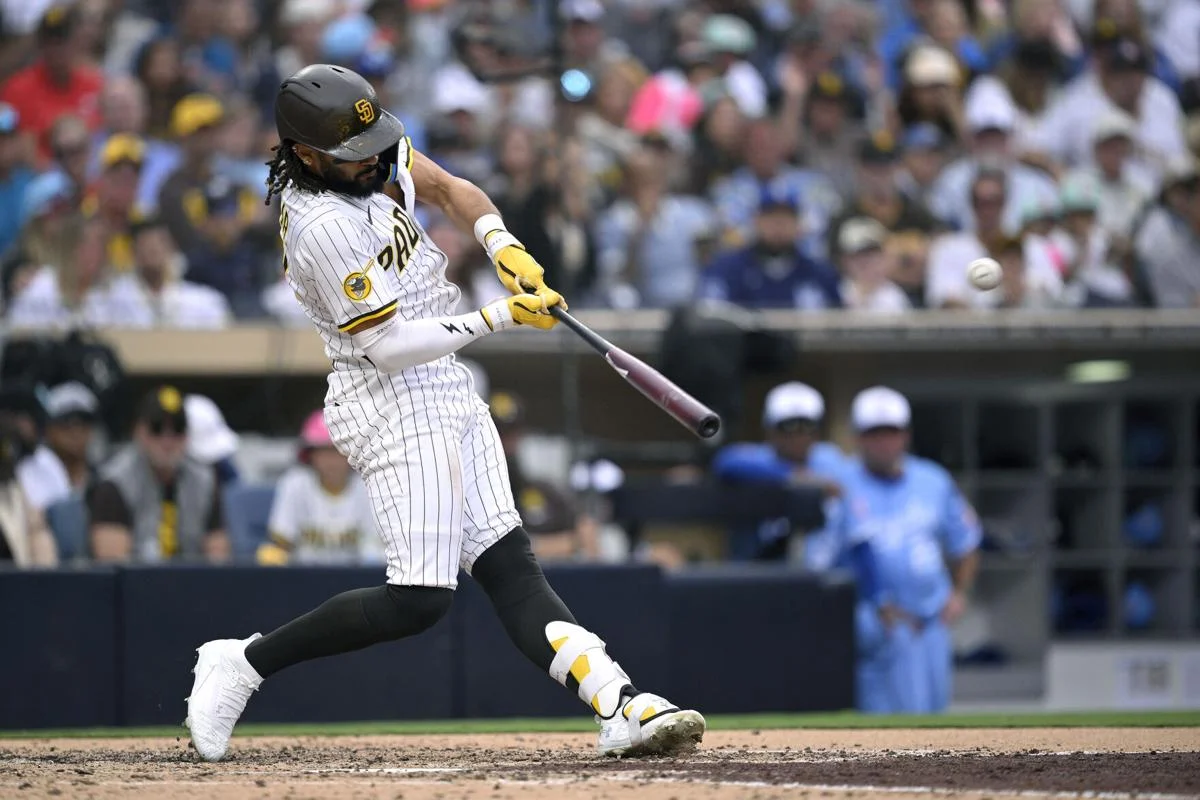

Fernando Tatis Jr. ended his longest stretch without a home run on Saturday in San Diego, delivering a pivotal three-run homer to boost the Padres to a late lead against the Kansas City Royals. The shot came in the seventh inning and turned a narrow 2-1 advantage into a more comfortable 5-1 cushion, helping San Diego secure a crucial victory. This marked Tatis’ first home run since May 27, snapping a 21-game homerless streak—the longest drought of his career—and proving critical for both the slugger and the Padres.
Facing Royals’ right-hander Taylor Clarke, Tatis connected on a 96-mph sinker, driving the ball with an exit velocity of 107.9 mph for an estimated distance of 380 feet. The blast featured a signature flourish: after admiring his shot, Tatis stylishly slammed the bat before rounding the bases, highlighting the significance of breaking his longest cold streak at the plate.
Challenges and Setbacks During Tatis’ Homer Slump
Tatis’ struggle to hit home runs this season was compounded by being hit by pitches three times in a 10-day span during games against the Los Angeles Dodgers, intensifying the rivalry between the two NL West teams. In a contentious moment on June 19, Dodgers reliever Jack Little, making his MLB debut, struck Tatis on the right wrist. This incident led to benches and bullpens clearing, requiring intervention from managers Mike Shildt and Dave Roberts.
Consequences followed those events, with Shildt and Roberts each receiving fines and one-game suspensions. Padres reliever Robert Suarez was suspended for three games for hitting Dodgers’ Shohei Ohtani in the same series, marking the second time both superstars were plunked in a single frame. After being hit on the wrist, Tatis needed X-rays and further scans, fortunately revealing no fractures—unlike Diamondbacks outfielder Corbin Carroll, who was recently sidelined after a hit-by-pitch injury.
“For me it wasn’t [intentional], in the moment,”
Tatis said regarding being hit.
“But how many times have they hit me already?”
—Fernando Tatis Jr., Padres slugger
He added that he spent a long morning at the hospital but considered himself fortunate:
“It got the bones on my wrist. That’s a delicate area,”
continuing,
I was just happy I didn’t break any bones and happy I’m able to stay on the field.”
—Fernando Tatis Jr., Padres slugger
Comparing Tatis’ Homerless Streak with Other Major League Players
Before this season, Tatis had never experienced a homer drought longer than 18 games in his six-year career. Still, a 21-game stretch without a home run is not unprecedented across the league. For example, Chicago Cubs infielder Nico Hoerner has yet to homer in 74 games so far this year.
Several former All-Stars with established 30-homer seasons have endured even longer homerless streaks, including Michael Conforto (41 games), Freddie Freeman (36 and counting), Joc Pederson (33), Salvador Perez (31), Gleyber Torres (28), and Paul Goldschmidt (27). Tatis’ teammate Xander Bogaerts also shared long streaks of 30 and 28 games without homering, with the longer stretch ending in the same game where Tatis left due to injury.
Tatis’ Homer Production and Season Performance Overview
Despite the drought, Tatis leads the Padres with 15 home runs this season. His power display has been uneven, hitting eight home runs in his first 21 games, then experiencing a 14-game drought, followed by a surge of four homers in eight games. The lengthy gap was followed by a single homer over a 29-game period, before he added two more homers in the last three contests.
Overall, Tatis’ offensive production remains close to his 2023 level but shows improvements in strikeout and walk rates, a lower batting average on balls in play (BABIP) and isolated power (ISO), as well as superior defensive metrics that have allowed him to surpass last season’s Wins Above Replacement (WAR) value.
Analysis of Tatis’ Quality of Contact and Batted Ball Metrics
While Tatis has consistently hit the ball hard, his results have not always matched the quality of contact. In subjective terms, although he ranks in the 96th percentile for average exit velocity (93.8 mph) and the 92nd percentile for hard-hit rate (52.6%), his barrel rate of 12.4% is down from last year’s 14.5%, now sitting in the 74th percentile.
Additionally, Tatis has experienced a career-high groundball rate of 50.4%, up more than four percentage points from the previous year. This increase in groundballs contributes to fewer home runs and extra-base hits despite solid contact speed.
His monthly performance data reveals that Tatis was hot in March and April but still lagged behind his expected slugging percentage (xSLG) by 78 points. He maintained a 54.7% groundball rate during that period, with a low average launch angle of just three degrees. After a cold May, June has seen better contact quality, but the gap between actual and expected slugging has widened. These patterns are partially explained by playing home games at Petco Park, a venue known to suppress offense, where the league slugging percentage is .369, significantly below the expected .408 xSLG.
Over 21 games between his last two home runs, Tatis hit .237/.383/.289 but posted a .275 expected batting average (xBA) and a .420 expected slugging percentage, demonstrating solid underlying metrics masked by results.
Impact of Adjustments in Tatis’ Batting Stance and Swing Mechanics
Tatis is known for regularly adjusting his stance and swing, frequently tinkering to find more consistent success. An MLB Network post from April highlighted shifts that include an increasingly open batting stance—moving from 14 degrees open late last year to as much as 45 degrees open in 2024—and changes like wrapping the bat differently and eliminating a leg kick. Interestingly, the leg kick appeared likely to return if Tatis struggled, and indeed, it seems to have re-emerged following the initial homerless stretch.
A Supercut of Tatis’ homers from May 10–27 shows evidence of the leg kick during most of those blasts. However, his recent 435-foot homer off Washington Nationals’ Zach Brzykcy, a mound sensation, came without a visible leg kick.
Tracking his stance over recent seasons reveals fluctuations. For instance, in July 2023, his stance was open by 16 degrees, narrowing to 11 degrees by late in the season. This year, the stance has ranged widely, opening by 52 degrees early in March and April, then narrowing through May and June, while the distance between his feet increased gradually from 20.9 to 24.9 inches.
Alongside stance changes, Tatis’ average bat speed has declined slightly from 74.7 mph last year to 73.6 mph, and his attack angle has flattened from 10 degrees to 7 degrees. However, both metrics have experienced monthly increases recently, while tilt angle has decreased and attack direction shifted.
Deeper Insight into Swing Angles and Sabermetric Evaluations
Baseball Prospectus analyst Matthew Trueblood’s recent research grouped swing attack angles and directions into 36 categories, revealing Tatis’ common combination of a 5-10 degree attack angle and slight opposite-field direction corresponds with one of the lowest weighted on-base averages (wOBA) at approximately .250. Examining Tatis’ performance within this narrow range, his underground numbers are notably down compared to the previous two seasons.
Within these attack angles, Tatis has hit grounders on 45.3% of balls in play—on par with 2023 but considerably higher than the 33.8% from 2022—while his output has dropped to a wOBA of .092 compared to .210 previously, despite a higher exit velocity (93 mph versus 88.7 mph).
Tatis’ Continued Search for Optimal Hitting Form
The data and recent trends suggest Fernando Tatis Jr. is still refining his swing and stance to better align outcomes with the quality of his contact. Though the adjustments and approach shifts have produced mixed results, his overall performance stands out among major league hitters. Currently ranked 17th in wRC+ and fifth in WAR, Tatis continues to be a formidable player striving for improvement and consistency.
His resilience and drive to optimize his offensive game amid challenges, including the recent homer drought and hitting setbacks, underscore his elite status as a young star in Major League Baseball. As the season progresses, observing how his mechanical tweaks and plate discipline evolve will be key for the Padres’ success and Tatis’ long-term trajectory.