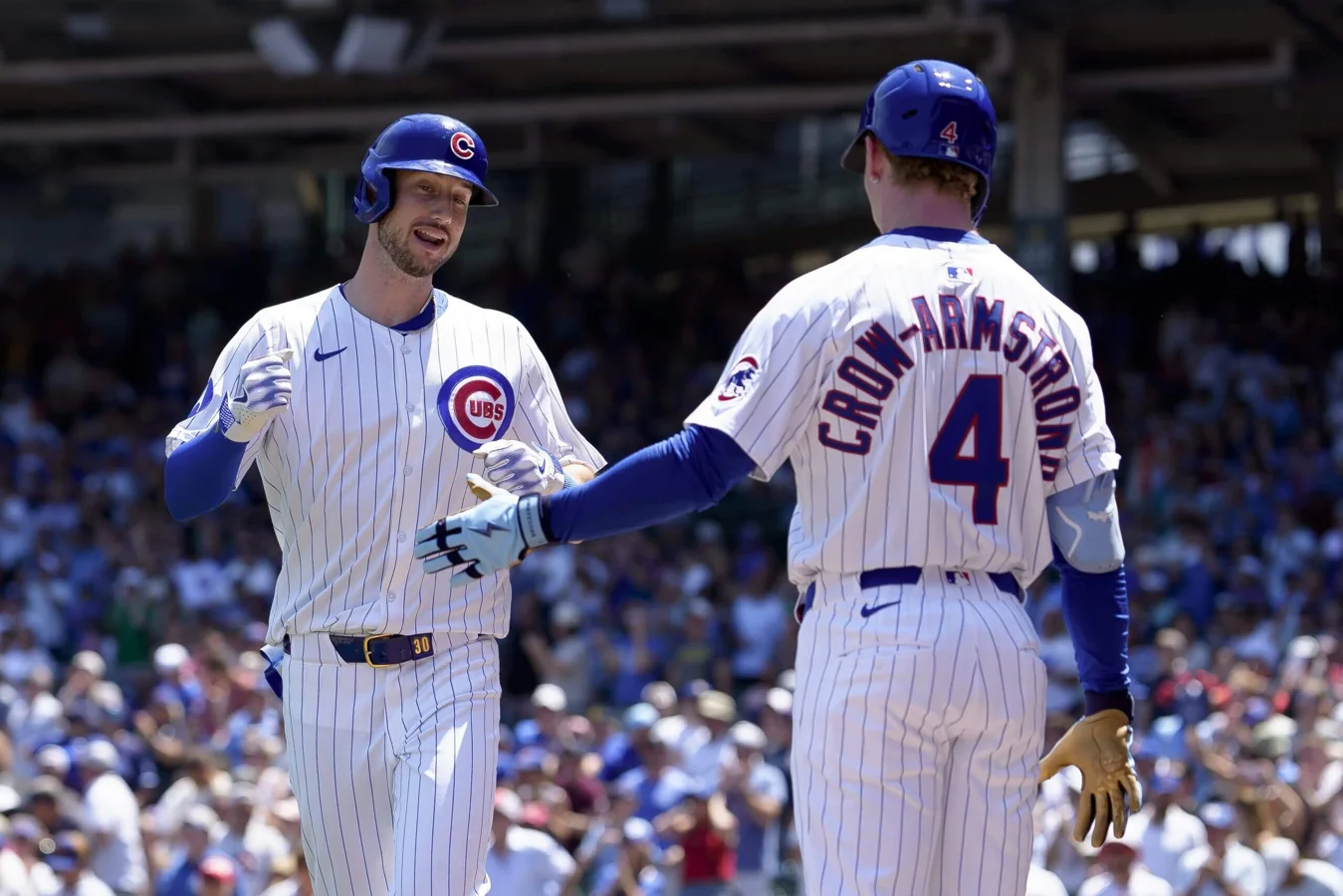
Kyle Tucker's Cubs contract uncertainty looms, raising questions about the team's future and financial commitments.
The Chicago Cubs find themselves at a crossroads with outfielder Kyle Tucker, as uncertainty surrounding his contract extension grows amid escalating costs and the team‘s payroll restrictions. Despite acquiring Tucker from the Houston Astros with one year of certainty on his contract, the Cubs’ desire to compete immediately clashes with the financial challenges of locking him in long-term.
Chicago boasts a strong roster that positions them competitively within the National League, but doubts linger on whether they can surpass rivals like the Los Angeles Dodgers. An MLB insider recently emphasized the necessity for the Cubs to fully commit, stating that
“the Cubs can’t go halfway at the deadline.”
Ken Rosenthal, writing for The Athletic, offered Cubs fans some reassurance by suggesting that even if Tucker were to leave, the team’s roster would remain solid thanks to emerging talent such as center fielder Pete Crow-Armstrong. However, Rosenthal also cautioned that the long-term outlook is troubling, given that five key players are scheduled to hit free agency after the 2026 season.
“Their situation is not now or never, not with the emergence of center fielder Pete Crow-Armstrong giving the 2026 roster a formidable look even if Tucker departs,”
Rosenthal noted.
“But ownership’s reluctance to sign players long-term, coupled with the possibility of a work stoppage in 2027, adds to the perception of a shrinking window. Or, to use a more dire analogy, walls closing in.”
Fans eagerly await news of a Tucker extension, which would solidify the Cubs’ outfield and alleviate many uncertainties surrounding the team’s future. Unfortunately, current indicators suggest such a deal is improbable. Rosenthal highlights Tucker’s transformative impact on the lineup since joining Chicago, mentioning that
Image of: Kyle Tucker
“The addition of Tucker has been that transformational, producing ripple effects throughout the lineup,”
yet his projected price might surpass $500 million, a substantial sum for the franchise.
The key issue revolves around whether Cubs owner Tom Ricketts is willing to commit to the high payroll needed to retain Tucker while building a competitive team. Rosenthal points out that
“Even if Ricketts was willing to pay Tucker that much – another open question – would he be willing to increase the Cubs’ payroll enough to build a strong team around him? The prospect of Tucker and Crow-Armstrong in the same lineup for the next five years should be enticing … The Cubs actually are positioned perfectly to sign Tucker. Their only player under contract beyond 2026 is shortstop Dansby Swanson, who is signed through ’29. Of course, the reason their commitments are so low is because Ricketts seems resistant to the notion of paying a player in his decline years. Which, with Tucker, he almost certainly would need to do.”
Two major obstacles stand in the way of a long-term agreement: the steep financial demand and the risk of overpaying Tucker during his downturn years. Tom Ricketts’ history of strict payroll management adds further doubt that the Cubs will make a substantial offer. While his stance on investing heavily in Tucker remains uncertain, past decisions suggest hesitation is likely to prevail.
Ultimately, the continued contract uncertainty surrounding Kyle Tucker not only impacts the Cubs’ immediate strategies but also shapes the franchise’s outlook for the coming years. If an extension cannot be reached, the team may face a challenging road ahead amid upcoming free agency waves and potential labor disruptions. On the other hand, securing Tucker long-term alongside emerging stars like Pete Crow-Armstrong could position Chicago as a formidable contender in the National League for the foreseeable future.