
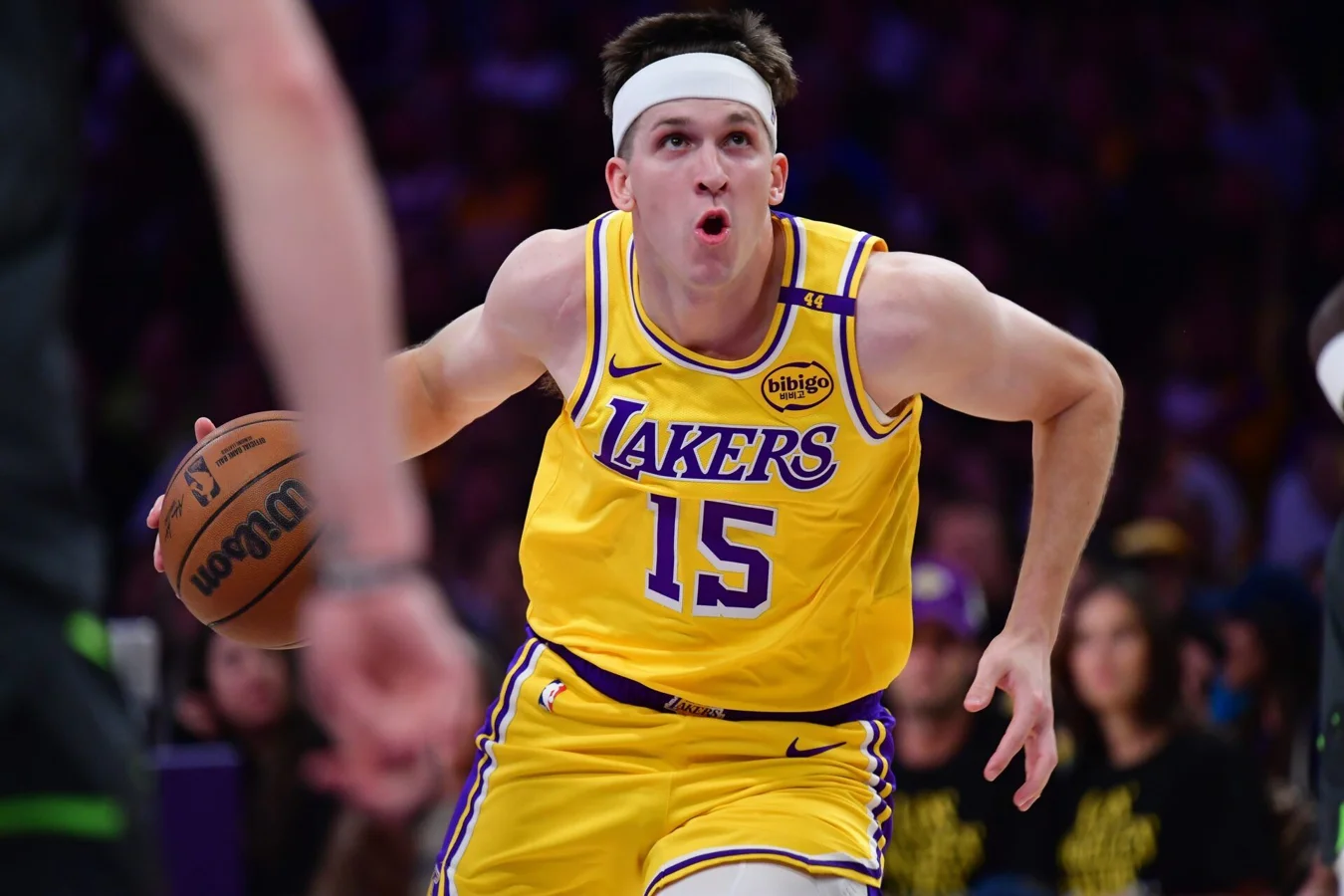

Austin Reaves made it clear earlier this month that he wants to spend his entire NBA career with the Los Angeles Lakers, stating,
“I want to be in LA. I want to play my whole career in LA. I love it there.”
Despite this public commitment, Reaves recently declined a substantial four-year, $89.2 million contract extension offered by the Lakers. This decision signals his confidence in securing an even larger contract in the upcoming free agency period, but it places his future with the team under scrutiny as the Lakers now navigate their roster strategy without him being locked in.
The initial stage of free agency was subdued for the Lakers. Key players they pursued, like Clint Capela and Brook Lopez, signed elsewhere, while Dorian Finney-Smith, a valuable rotational player, moved to the Houston Rockets. The only addition the Lakers made early on was signing Jake LaRavia, a 23-year-old wing from the Sacramento Kings, on a two-year deal worth $12 million. While this might appear as a minor depth move, insider Dave McMenamin described it as a significant strategic action aimed directly at Reaves and his representatives.
Jake LaRavia’s Role Reflects Lakers’ Intentions Toward Reaves
During a recent ESPN LA broadcast, Dave McMenamin illuminated the calculated nature of LaRavia’s signing. He noted,
“He’s also repped by the same agents that rep Austin Reaves,”
adding,
“And that’s kind of an olive branch as well. Saying that, ‘Austin Reaves, we want to continue to be in business with you.’”
This move serves as a subtle yet clear message that the Lakers are maintaining communication and goodwill with Reaves’s camp while still preparing for various roster scenarios.
Dan Woike of The Athletic also revealed that the Lakers’ very first contact during free agency was with LaRavia and his agents, underscoring that the franchise values its relationship with Reaves’s representatives. LaRavia, for his part, expressed enthusiasm about joining a championship contender, stating before free agency began,
“Scratch the money part, I want what everyone else wants, which is being on a team that’s really competing for a championship.”
He described his game as versatile and fitting for the Lakers’ needs:
“Being on a team that is competing for a championship and that needs a guy like me, a wing that plays both sides of the ball… I’m a defender who can shoot the three and can make plays. I do a little bit of everything.”
LaRavia’s recent performance, particularly a strong March where he shot over 40% from three and nearly 50% overall, highlighted his potential value as a young, cost-effective player who offers both size and hustle.
Lakers’ Strategic Balance Between Present Needs and Future Flexibility
Signing LaRavia shows the Lakers are skillfully balancing immediate roster demands with longer-term planning. Compared to the departed Finney-Smith, LaRavia is a younger player with upside who fits the team’s financial outlook better. This approach aligns with the Lakers’ wider strategy as they await Reaves’s decision following his gamble in declining the lucrative extension.
While the team quietly signals ongoing interest in Reaves by engaging with his representatives, they simultaneously prepare alternative options, reflecting the uncertainty surrounding his next move. This dual approach creates leverage for the Lakers and sends a message to the league that they have contingency plans regardless of how Reaves’s free agency unfolds.
Potential Addition of Deandre Ayton: A High-Stakes Decision for the Lakers
As the focus remains on Reaves’s future, the Lakers encountered an unexpected opportunity with Deandre Ayton becoming available. The Portland Trail Blazers decided to buy out Ayton’s contract due to ongoing issues, including tardiness and missed rehabilitation sessions, as cited by a team source. Now a free agent, the 26-year-old former No. 1 overall pick instantly attracted interest from the Lakers, who have been desperate to address their need for a dominant center.
Ayton apparently fits the Lakers’ requirements on paper: an athletic, seven-foot presence capable of rebounding, rim protection, and finishing alley-oops, especially those from stars like Luka Dončić. However, his tenure in Portland was troubled, marked by reports of locker room clashes and questionable effort levels. This has split the Lakers’ fanbase, with some embracing the signing and others expressing concern, exemplified by the comment,
“Luka will hate this low motor, non-defending diva.”
Interestingly, Lakers head coach JJ Redick has a public history of praising Ayton’s potential. As an ESPN analyst, Redick once remarked,
“Ayton’s fantastic. He’s fantastic at punishing mismatches. In the two-man pick-and-roll with him and [Chris Paul], they’re the No. 1 offensive duo.”
Now, Redick has the chance to coax this talent into consistent performance within the Lakers system.
Lakers’ Front Office Faces a Crucial Choice Amid Championship Aspirations
This situation represents a pivotal moment for Lakers general manager Rob Pelinka and the organization’s decision-makers. Their prior willingness to make tough, pragmatic moves—such as waiving young player Quincy Olivari to refine their roster—signals they might be prepared to take a significant risk on Ayton despite his troubled background. The balance between risk and reward is stark: landing Ayton could provide the defensive and athletic boost necessary to return LA to championship contention, or it could become a costly mistake that disrupts team chemistry.
With the Lakers in clear “win-now” mode, their pursuit of Ayton exemplifies the difficult decisions required to remain competitive. As Reaves’s contract saga unfolds and LaRavia settles in, the addition of Ayton could represent either the final piece of their puzzle or a potentially perilous gamble for the franchise moving forward.