
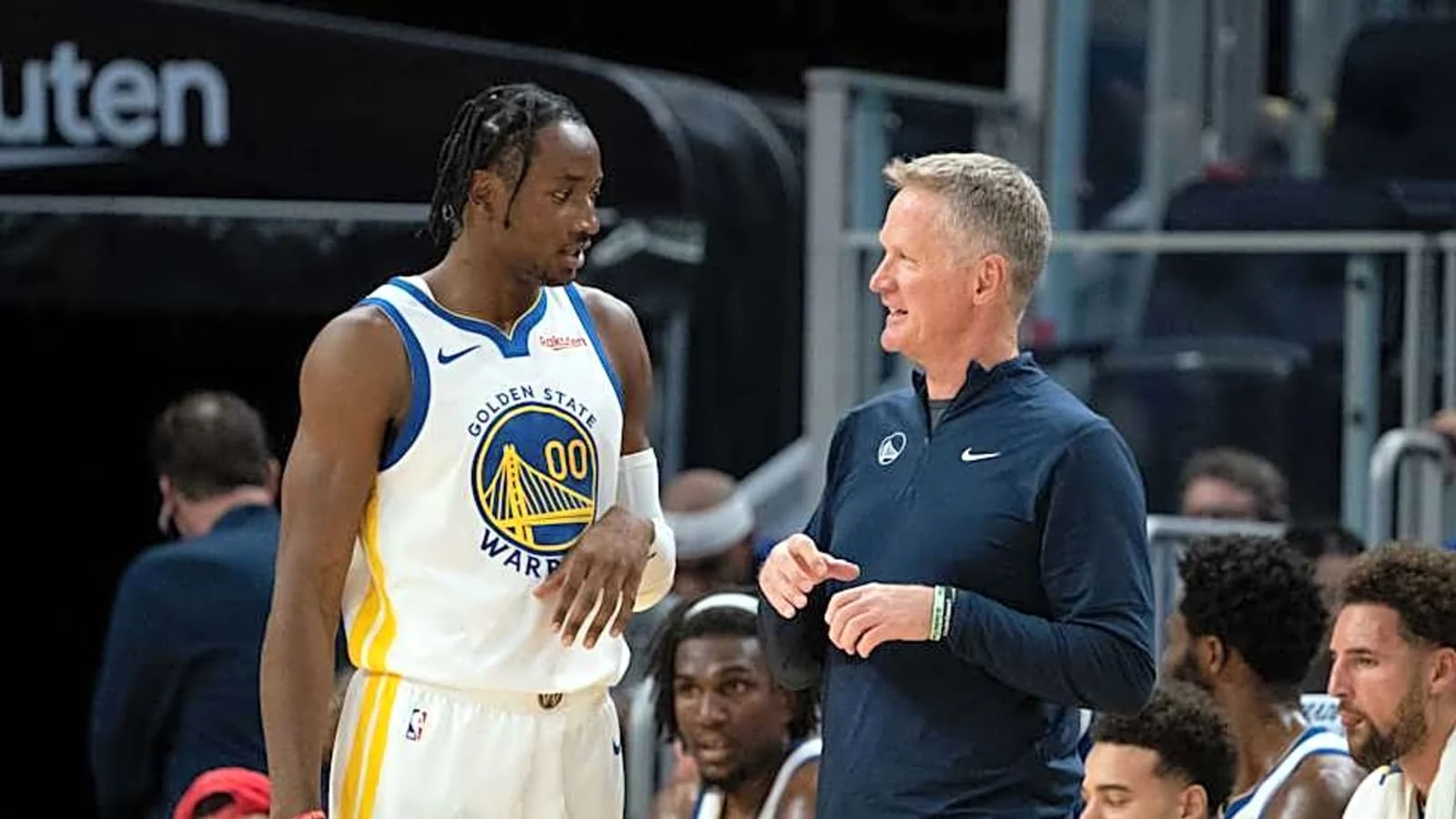

The Golden State Warriors and forward Jonathan Kuminga have reached a standstill in contract negotiations, with the added complication of collective bargaining agreement (CBA) restrictions affecting possible moves. As the 2025 offseason progresses, the uncertain status of Jonathan Kuminga contract negotiations has intensified, raising questions about his future with the Warriors and potential trade alternatives.
Stalemate Over Long-Term Deal Between Kuminga and Warriors
Discussions between Kuminga’s representatives and the Warriors over a long-term contract have failed to produce significant progress. According to Anthony Slater of The Athletic, both sides remain far apart in their expectations, and external CBA rules are making traditional contract solutions challenging. As a restricted free agent, Kuminga has the option to explore the market, but the complexities in trading or restructuring his deal have stalled constructive movement.
They haven’t really been close. There’s been no traction, and he’s going to explore the restrictive free agent market, with the Warriors understanding that they can look at various sign-and-trade scenarios. But there’s a lot of CBA mechanisms that make that really difficult. It’s called this base year compensation rule, that basically means the Warriors can only take back half of what they’re sending out. So, there’s a lot of complications here. But Jonathan Kuminga has high ambitions for himself,
Slater said on NBA TV’s Free Agent Fever on June 30.
He wants to spread his wings, potentially be an All-Star. And the difficult challenge with him with the Warriors is that’s, in some ways, kind of blocked.
Kuminga’s performance last season supported his ambitions, with averages of 15.3 points, 4.6 rebounds, and 2.2 assists per game. He notably elevated his game during the 2025 playoffs when Stephen Curry was sidelined by injury, proving himself as a dependable contributor during critical moments. Despite this, the Warriors’ salary cap situation and the CBA’s regulations are limiting the team’s options in meeting Kuminga’s expectations.
Sign-and-Trade Challenges with Potential Chicago Bulls Partnership
The Warriors have considered a sign-and-trade arrangement with the Chicago Bulls as a potential solution to the deadlock. However, this option has been complicated by Kuminga’s salary demands and Golden State’s position near or over the luxury tax line, which affects financial flexibility. From the Bulls’ perspective, figuring out what assets to exchange for Kuminga is further complicated by the base year compensation (BYC) rule.
K.C. Johnson of the Chicago Sports Network addressed the difficulties facing this potential deal, noting both the absence of recent progress in trade discussions and the financial limitations preventing straightforward transactions.
I’m here to tell you that I have not heard any traction on a sign-and-trade deal to the Bulls. That’s not to say it won’t happen. I’m just saying that I have not heard it,
Johnson said on The Fastbreak on July 1.
Let’s just say $25 million for a starting salary – he counts for $25 million going out to the team that he’s being traded to, and the Warriors can only take half that salary back in a trade. That would be $12.5 million, if my math’s correct. So, there goes the [Nikola] Vucevic contract. Does not fit in a base-year compensation trade with Jonathan Kuminga.
Coby White could fit, but I would be surprised if the Bulls trade Coby White for Jonathan Kuminga. So again, we’ll see where this goes, but that’s where things stand.
The BYC rule is a rarely applicable provision retained in the NBA’s collective bargaining agreement that primarily impacts sign-and-trade transactions. Larry Coon, a noted NBA salary cap expert, explained that this rule originally existed to prevent teams from signing free agents to inflated salaries simply to facilitate trades, though its scope has since narrowed.
Base Year Compensation (BYC) is mostly an artifact of previous collective bargaining agreements. Its intent was to prevent teams from signing free agents to new contracts with salaries specifically intended to help facilitate trades,
Coon wrote.
The 2011 CBA mostly eliminated BYC — in fact, the term ‘Base Year Compensation’ was removed from the agreement entirely. The rules formerly known as BYC now apply under just one circumstance — during sign-and-trade transactions.
The Uncertain Path Forward for Jonathan Kuminga
As the 2025 offseason unfolds, speculation continues to swirl around Kuminga’s possible destinations. While the Chicago Bulls have been mentioned frequently as a trade partner, no substantive progress has emerged, and a reunion with Golden State remains a realistic possibility given Kuminga’s restricted free agent status. This status provides the Warriors with the right of first refusal on any offers made to Kuminga by other teams, and enables them to outbid competitors if they choose.
Nevertheless, the prevailing conditions create a difficult negotiation environment for all parties involved. Slater pointed out that the restrictive free agent market and team control make it challenging for Kuminga to secure the contract he desires immediately, despite being a young player with significant potential. He added that this situation may extend longer than many other free agent processes in this offseason.
It’s not easy to just necessarily right now get away from the Warriors, get the contract he wants, because the restrictive free agency market and the control that a team like the Warriors has over an asset that is still a young 22-year-old on the rise,
Slater said.
They have a lot of say in this. So, it’s just – it could figure itself out in the next few days, but this is also a situation, I believe, in this free agent period, that might drag out more than some of the other situations.
The resolution of Kuminga’s contract negotiations will carry ramifications for both the Warriors’ roster planning and the broader NBA trade landscape. How this impasse is ultimately settled—whether through a restructured deal with Golden State, a sign-and-trade involving an external team like Chicago, or another outcome—will be closely watched by analysts and fans alike as the offseason continues.