
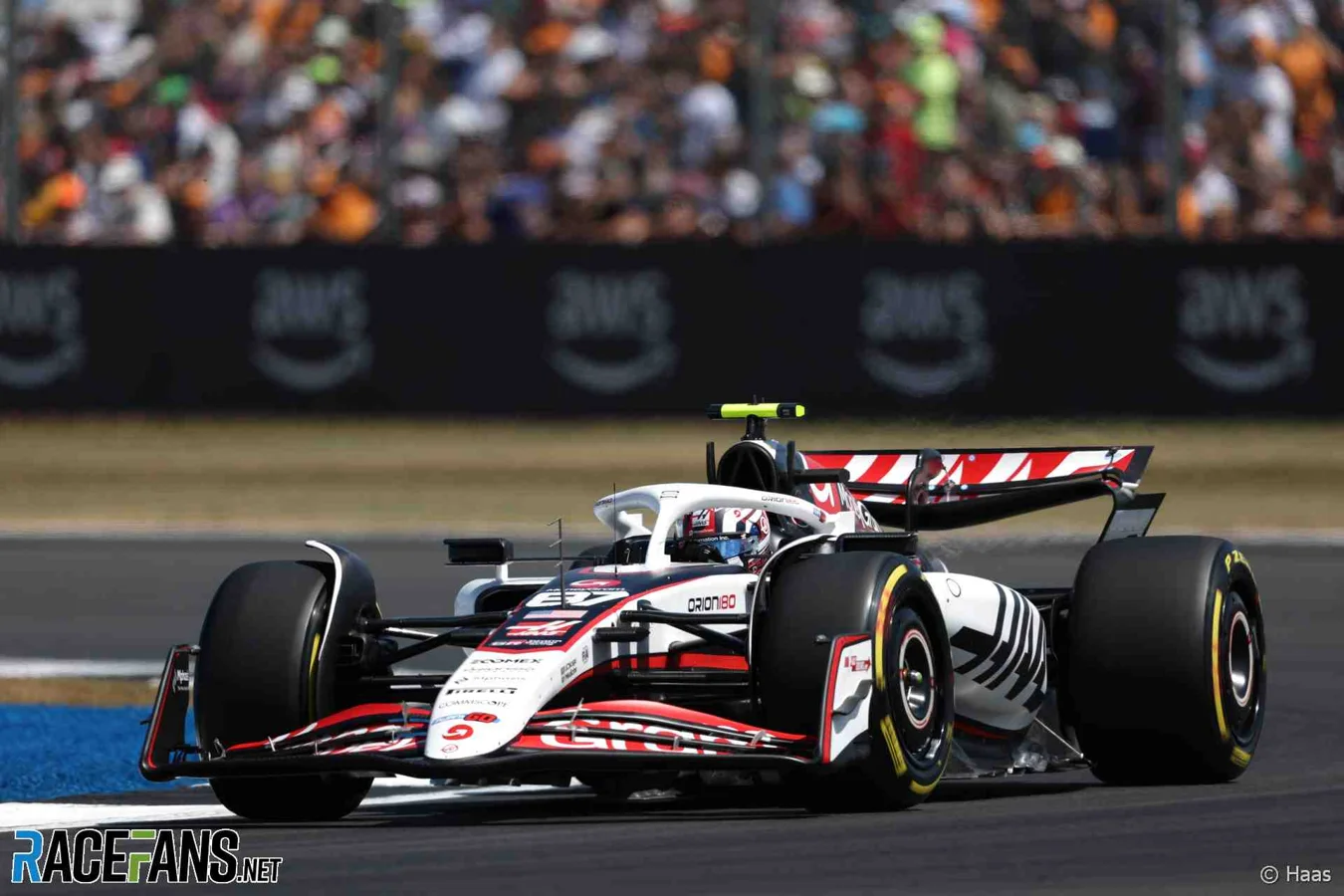

Ollie Bearman has been given a 10-place grid penalty for disregarding red flags during the third free practice session at the British Grand Prix, an incident which ended with a crash into the pitlane barriers. The penalty comes as a direct consequence of Bearman’s failure to reduce speed under red flag conditions while losing control of his Haas car entering the pit area.
Details of Bearman’s incident during FP3
During FP3, Bearman collided with the wall at the pit entry after accelerating to 260km/h despite a red flag being displayed, which had been triggered by Gabriel Bortoleto’s crash exiting the Maggotts and Becketts corners. The red flag required drivers to slow down and return cautiously to the pits, but Bearman’s high speed caused him to lose grip, striking the barriers and breaking off most of his car’s nose cone. This forced other drivers to take evasive action to avoid the damaged vehicle.
FIA’s investigation and findings on the breach
The FIA stewards reviewed extensive evidence, including video footage, timing data, telemetry, and team radio communications. According to the stewards’ report, despite the red flag shown at 12:33:57, Bearman initially slowed but then accelerated sharply as he approached Turn 15 and entered the pit lane slip-road at an unsafe speed of 260km/h. This was notably faster than his previous in-lap under normal racing conditions, violating Art. 37.6(a) of the Formula One Sporting Regulations and Art. 2.5.4.1(b) of the International Sporting Code, which mandate that all cars must reduce speed immediately and proceed slowly back to the pits when a red flag is displayed.
The stewards heard from the driver of Car 87 (Oliver Bearman), the team representative and reviewed positioning/marshalling system data, video, timing, telemetry, team radio and in-car video evidence,
read the official report.
The race was red flagged at 12.33:57. Car 87 had slowed down for the red flag and, as he was approaching Turn 15, accelerated significantly to race pace and entered the pit entry road at 260km/h. He lost control of the car in the pit entry road and crashed into the barriers.
To make matters worse, he lost control of the car and crashed into the barriers while at speed. The driver informed us that he misjudged the fact that his brakes were not warm because the lap was done slowly, due to the red flag. While this may have been a factor contributing to the crash, we did not consider it to be a mitigating factor.
Consequences of Bearman’s actions on his racing career
For this violation, Bearman has been penalized by a 10-place grid drop for the British Grand Prix qualifier and received an additional four penalty points on his super license, raising his total to eight points. This is not his first penalty for ignoring red flags; Bearman was previously sanctioned with four penalty points following a similar breach during FP2 at the Monaco Grand Prix, where he overtook Carlos Sainz at Rascasse under red flag conditions.
Additional details on FP3 session disruption
The FP3 session was also interrupted by a red flag caused by debris from Bearman’s Haas VF-25 chassis, specifically a broken portion of the outer floor fence that detached and was left on the track. This incident added to the session’s complications and highlights further issues with the Haas car’s reliability during practice.
The broader implications for Bearman and Haas
This penalty places Bearman in a difficult position ahead of the British Grand Prix, as starting further back on the grid will make it harder for him to score significant points. With the added pressure from accumulating penalty points, Bearman must demonstrate greater discipline and caution to avoid harsher consequences in upcoming races. For Haas, managing the car’s performance and reliability remains critical as drivers seek to avoid incidents that can damage both results and equipment.
Our Reader’s Queries
Q. Is number 13 banned in F1?
A. Yes, using 13 is permitted. Pastor Maldonado chose number 13 when the permanent number system started in 2014. Although some cultures see 13 as unlucky, F1 drivers decide their numbers.
Q. Which F1 driver has ADHD?
A. Sir Lewis Hamilton, born in 1985, is a British Formula One driver for the Mercedes team and formerly raced for McLaren. He openly talks about living with ADHD and shares his various interests and hobbies.
Q. Why is 17 not allowed in F1?
A. The number 17 is not used in honor of Jules Bianchi, who had that number during his Formula 1 career. If a driver doesn’t pick a permanent number, they are given one based on their team’s history.
Q. What F1 driver has ADHD?
A. Lewis Hamilton, born in 1985, is a British Formula One driver who races for Mercedes and has also driven for McLaren. He openly talks about living with ADHD and shares his wide-ranging interests and passions.