
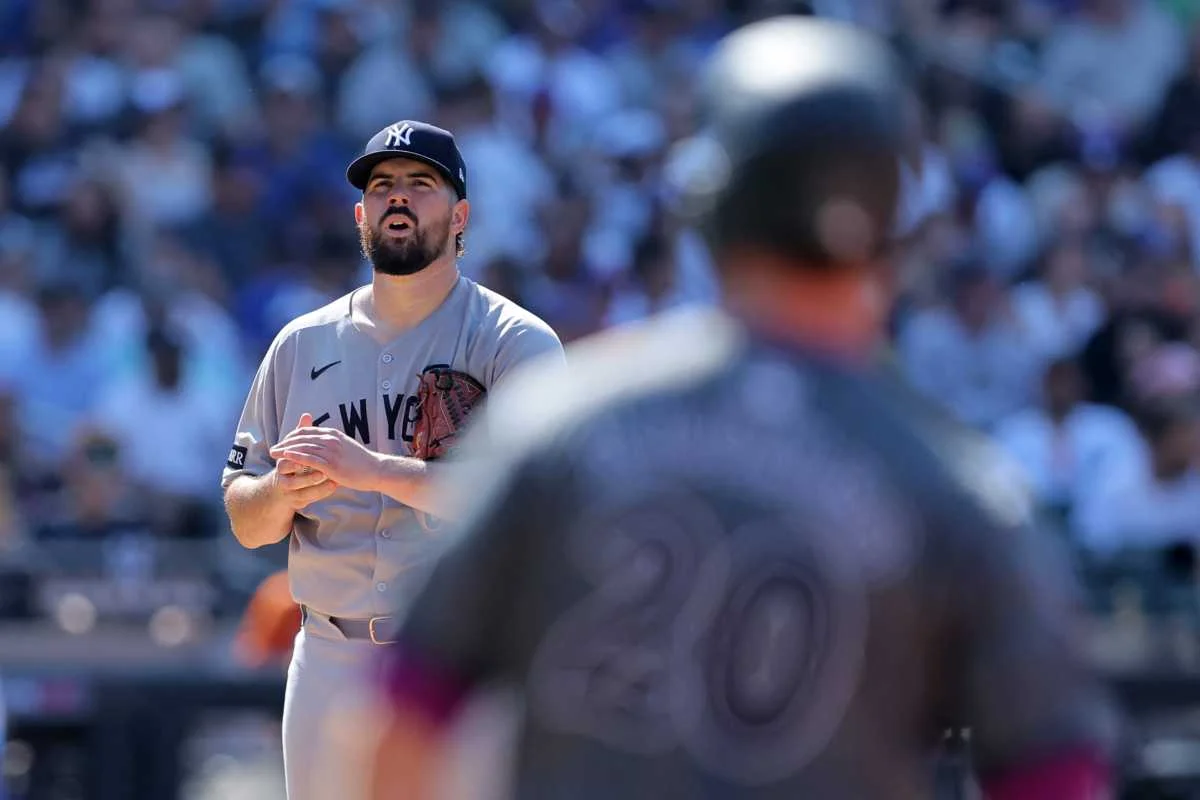

The New York Yankees are facing growing turmoil as starting pitcher Carlos Rodón’s struggles worsen, compounded by questionable decisions involving catcher selection. Throughout the 2024 MLB season, particularly highlighted during a difficult game against the New York Mets, the team’s insistence on pairing Rodón with catcher Austin Wells has drawn criticism amid mounting evidence that this combination negatively affects Rodón’s performance.
With key pitchers Gerrit Cole and Clarke Schmidt sidelined due to injury, the pressure on Rodón to lead the rotation has intensified. However, rather than stabilizing the pitching staff, Rodón’s results have deteriorated, raising concerns that flawed analytics and decision-making behind the scenes are aggravating the Yankees’ problems.
Player-Catcher Dynamics Affecting Rodón’s Performance
Injuries to critical pitchers left Rodón as a pivotal figure in the Yankees’ rotation, yet his recent outings have failed to inspire confidence. The root of these struggles appears to extend beyond his control, involving the ongoing use of Austin Wells as his primary catcher. Statistical analysis reveals a stark difference in Rodón’s effectiveness based on who is behind the plate. When Wells catches, Rodón’s ERA inflates to over 4.5, compared to an ERA under 3.00 when José Treviño or JC Escarra act as catcher.
This discrepancy is more than an isolated anomaly; it has persisted over multiple appearances, contributing significantly to the Yankees’ downfall. Analysts and insiders highlight this issue as a glaring oversight given the detailed performance data available.
Hector Beauchamp, an informed insider, expressed his frustration about the situation:
“When Austin Wells is there, the ERA balloons. When Escarra’s behind the plate, Rodón’s ERA dips below three.”
—Hector Beauchamp, Baseball Analyst
Despite such observations, management has continued to rely heavily on Austin Wells, suggesting a disconnect between analytical findings and roster strategy. This has raised questions about the Yankees’ use of their analytics resources and whether they are adequately responding to clear, repeatable trends.
Questionable Analytics Approach Undermines Team Coordination
The problems facing Rodón and the pitching staff appear symptomatic of a wider issue within the Yankees’ front office: an overreliance on analytics that may cloud practical decision-making. Beauchamp criticized this tendency to prioritize perceived intelligence over straightforward data, noting:
“You’re just wanting to prove everybody that you’re smarter when the analytics and the stats show you something different.”
—Hector Beauchamp, Baseball Analyst
This disconnect seems to have handicapped the rotation’s ability to adapt in real time. Instead of adjusting catcher assignments or considering other variables based on observed performance, the team remains locked into a strategy that exacerbates Rodón’s decline. The consequences are clear as the Yankees’ pitching staff suffers inconsistent results and mounting losses.
Rodón himself accepted responsibility for a recent poor performance following a heavy defeat to the Mets: “I just wasn’t good enough,” he admitted. Yet, that acknowledgment does not fully capture the reality of the situation, which includes subpar defense, lack of synchronization with catchers, and management’s resistance to change. These factors together contribute to a deepening losing streak that has fans and analysts growing increasingly impatient.
Defensive Breakdown and Lineup Challenges Highlight Team’s Woes
The Yankees’ difficulties extend beyond pitching, evident in their recent meeting with the rival New York Mets. In the second encounter of the Subway Series, Yankees’ starting pitcher Rodón was overwhelmed early on. Brandon Nimmo ignited the game with a grand slam off Rodón in the opening inning, setting a hostile tone at Citi Field. Pete Alonso then further dismantled the Yankees by hitting two home runs, including a decisive three-run shot in the seventh inning, contributing to a rout that shattered any hope of a Yankees rally.
The two Mets players combined for nine RBIs in that game and made history as only the second pair from their team to surpass four RBIs each against the Yankees in a single match. This dominant performance underscored the Yankees’ defensive vulnerabilities and inability to respond under pressure.
Recent Roster Changes Reflect Growing Pressure to Adapt
Recognizing the need for change, the Yankees recently executed a trade involving catcher Alex Jackson, who was sent to the Baltimore Orioles in exchange for international signing bonus pool money and future considerations. While this move is not considered a major transaction, it indicates an awareness within the front office of the need to act amid mounting turbulence.
Whether intended to open roster space or inject fresh motivation, the trade falls short of addressing the root causes of the team’s problems. The Yankees now confront the stark reality that minor adjustments cannot hide the significant gaps exposed by their rivals, particularly the Mets.
Wider Consequences Signal a Critical Season for the Yankees
The challenges facing the Yankees extend beyond individual player slumps and isolated injuries. From flawed interpretations of analytics to unstable catcher-pitcher relationships and incomplete in-game strategies, the team is witnessing a widening fracture in cohesion and performance.
If the front office does not recalibrate its approach based on both statistical evidence and practical insights, the current season risks spiraling further downward. With pressure building and fans wearing thin, the Yankees approach one of the most crucial trade deadlines in recent memory, a moment that could determine the trajectory of their entire campaign.