
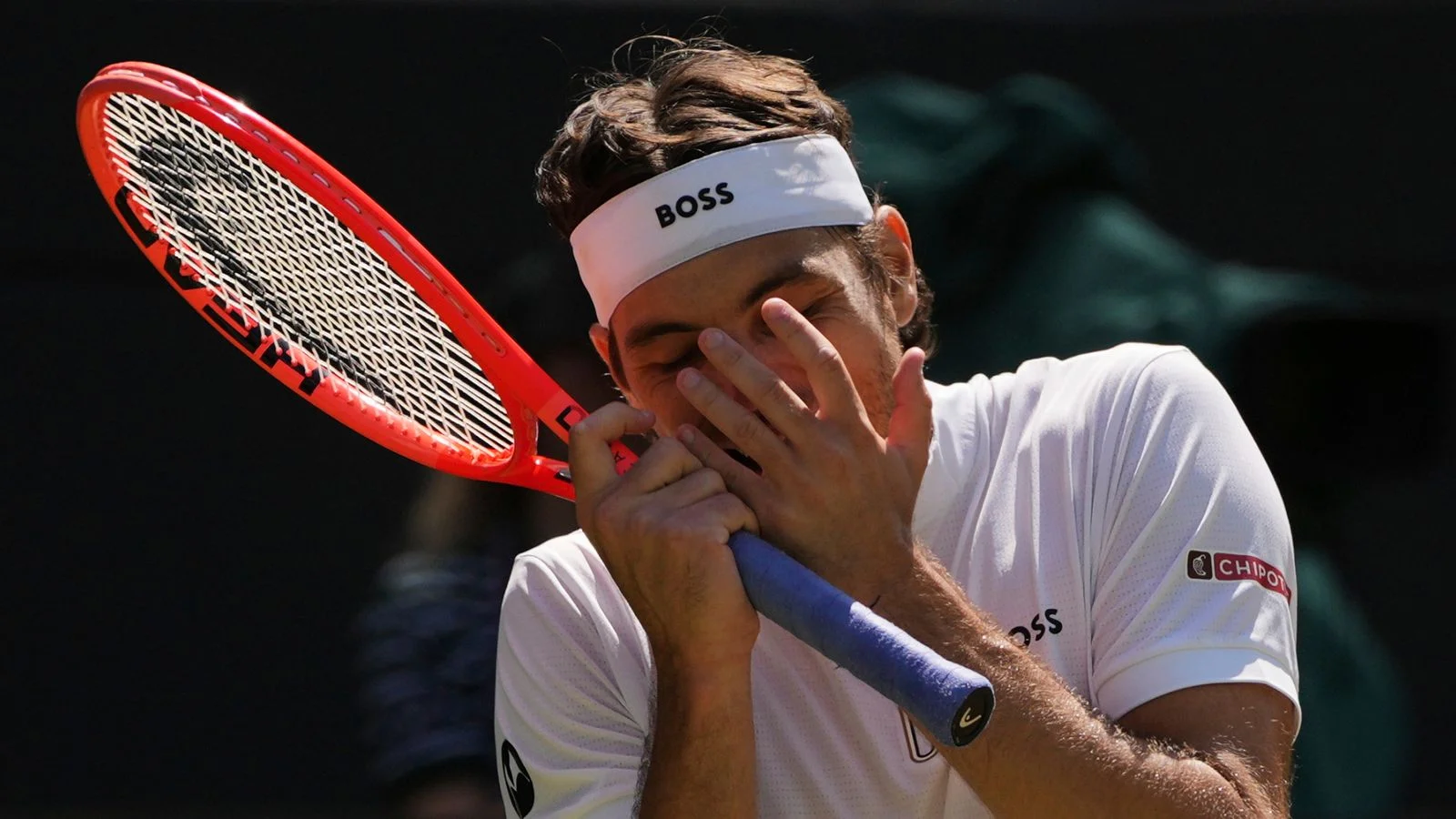

Taylor Fritz‘s quarter-final win at Wimbledon was overshadowed by a technical glitch in the electronic line-calling system on Tuesday. During the fourth set on Court One, an incorrect ‘fault’ call was issued after Fritz’s forehand landed well inside the baseline, triggering a stoppage in play by umpire Louise Azemar-Engzell.
The error occurred because the system misinterpreted the situation, tracking Fritz’s serve despite the rally being in progress. Tournament officials later clarified that the malfunction was caused by a ball boy crossing the court while Fritz began his second serve, which prevented the electronic system from resetting properly.
Details Behind the Line-Calling System Problem
The All England Club explained the issue in a statement:
“The player’s service motion began while the BBG (ball boy or girl) was still crossing the net and therefore the system didn’t recognise the start of the point,”
causing the technology to fail. Because of the malfunction, umpire Azemar-Engzell instructed the point to be replayed, and neither Fritz nor Karen Khachanov reacted strongly to the incident.
At the time of the disruption, Fritz led two sets to one and eventually secured a 6-3, 6-4, 1-6, 7-6 (4) victory after two hours and 36 minutes on Court One. Despite the win, the latest electronic glitch added to growing concerns about the new line-calling technology implemented this year.
Previous Controversies and System Adjustments at Wimbledon
This incident follows a similar problem just days earlier, when the new system failed during Sonay Kartal’s fourth-round match against Anastasia Pavlyuchenkova. On that occasion, an ‘out’ call was not made correctly on a shot that landed far behind the baseline, which had a direct impact on the score. Umpire Nico Helwerth then ordered a replay of the point, ultimately allowing Kartal to win the game although Pavlyuchenkova went on to win the match.

Following an investigation, Wimbledon organizers acknowledged that the electronic system was mistakenly disabled on part of the court during Kartal’s match. As a corrective measure, the All England Lawn Tennis Club amended the system so that Hawk-Eye operators no longer have the power to manually deactivate ball-tracking technology.
Players and Officials Express Ongoing Frustrations
Britain’s top players, including Jack Draper and Emma Raducanu, have publicly questioned the reliability of the new electronic line-calling system, which remains a subject of unease since its introduction at Wimbledon. The controversy is intensified by this year’s removal of line judges, placing even more pressure on the technology to function flawlessly.
Despite tournament officials’ confidence expressed earlier in the week that errors would be avoided after the Kartal incident, Tuesday’s malfunction highlights continuing vulnerabilities in the system. The fragrance of frustration and tension around the technology raises questions about its suitability for such a high-profile and traditional event.
Implications for Future Matches and Tournament Integrity
The repeated electronic line-call malfunctions threaten to undermine the reputation of Wimbledon and the integrity of its matches, stirring apprehension among players, officials, and fans alike. As technology shoulders a greater role in officiating, ensuring its accuracy is crucial to maintaining fairness in competition.
With the Championships serving as one of the sport’s most prestigious stages, the All England Club faces pressure to implement further improvements or reconsider the system’s deployment. How the organizers manage these issues could influence the public’s trust and the experience of competitors in forthcoming Wimbledon rounds and future tournaments.
Ongoing scrutiny will likely accompany the use of this technology for the remainder of the event. Observers and stakeholders will watch closely for any additional malfunctions, hoping for a smoother integration of electronic line-calling as the Championships progress.
Our Reader’s Queries
Q. What is Taylor Fritz’s height and weight?
A. In a video with ATP, Fritz mentioned he’s considered dyeing his hair blonde for a long time. He recently fulfilled a yearly promise to himself. He explained, “I think about it every year at the Australian Open.”
Q. How old was Taylor Fritz when he had a child?
A. In January 2017, the Break Point subject became a father when his then-wife, Raquel Pedraza, gave birth to their child, Jordan. At that point, Taylor was a 19-year-old promising tennis player. Now, he has reached the semi-finals of the 2024 US Open.
Q. How fast is Taylor Fritz’s serve?
A. A new Wimbledon record was set with a 153 mph serve. The runner-up of the U.S. Open hit this fast serve against unranked French player Giovanni Mpetshi Perricard during the first game of their match on Monday.