
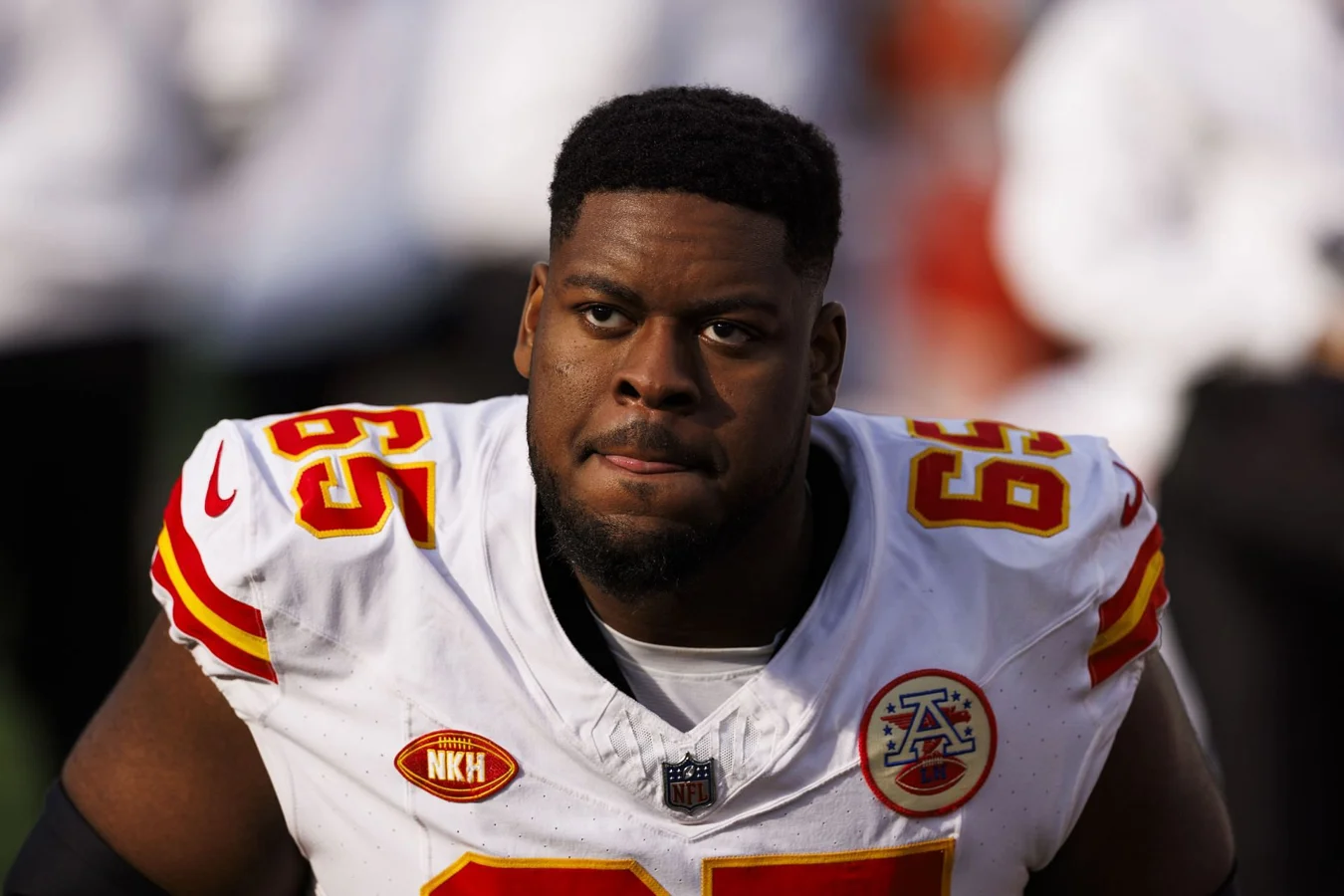

Trey Smith, a key figure on the Kansas City Chiefs’ offensive line and one of the NFL’s top guards, signed his franchise tag with the team in March. As July 15th approaches, both Smith and the Chiefs face a crucial deadline to decide whether to finalize a long-term contract or let the $23.4 million tag stand for the 2025 season.
The franchise tag guarantees Smith $23.4 million for one year, making him the highest-paid offensive guard by nearly $3 million this season, according to Pro Football Talk. Mike Florio recently discussed the challenges this creates for the Chiefs and why the impending deadline could determine the future of Smith’s tenure with the team.
Florio explained:
“Given the magnitude of the tag and the realities of the guard position, it could be a challenge to get a deal done before Tuesday of next week. For Smith, the choice is to proceed at $23.4 million in 2025 with either $28.08 million or a trip to the open market in 2026, or to accept the team’s best offer on a multi-year deal.”
Unlike position-specific franchise tags, offensive linemen’s tags do not differentiate between tackles, guards, or centers. Since tackles usually command higher salaries, the franchise tag value for linemen tends to be skewed upward. This is why it is uncommon for centers or guards to be tagged, raising questions about the Chiefs’ decision to use their tag on Smith. Essentially, Smith is earning a tackle’s pay despite playing guard.
Florio noted that Smith will be eligible for the franchise tag again next year if no multi-year deal is reached. This puts the decision largely in Smith’s hands: either finalize an extension beforehand or opt to maintain the franchise tag through July 15th, which could force Chiefs into a difficult position in 2026 if Smith reaches unrestricted free agency.

Potential Structure of Trey Smith’s Contract Extension with the Chiefs
Mike Florio elaborated on common contract patterns for players in Smith’s situation. Typically, athletes negotiating from a franchise tag leverage ask for the first two years of a new deal to be fully guaranteed and include player options for additional seasons. Additionally, each successive year often includes a 20% salary increase over the previous year.
Applying this framework, Smith’s desired contract might involve roughly $51.48 million in fully guaranteed money over the initial two seasons, with potential player options to extend further with the Chiefs. Although this represents a costly commitment for a guard, Smith’s current franchise tag status gives him significant bargaining power in these discussions.
The outcome of these negotiations will have major implications for the Chiefs’ salary cap and offensive line stability heading into the upcoming seasons. If Smith declines a long-term agreement, the Chiefs could face uncertainty in protecting one of their core offensive players or risk losing him to free agency after the 2026 season.
As the July 15 deadline nears, both Trey Smith and the Chiefs must weigh the financial and strategic consequences of either finalizing a multi-year deal or continuing under the franchise tag arrangement that pays Smith an unusually high salary for his position.
Our Reader’s Queries
Q. Does Trey Smith have Parkinson’s?
A. In 2021, Trey and Louise moved back to Charlotte because he had been diagnosed with both Parkinson’s and Alzheimer’s, and his conditions were getting worse.