
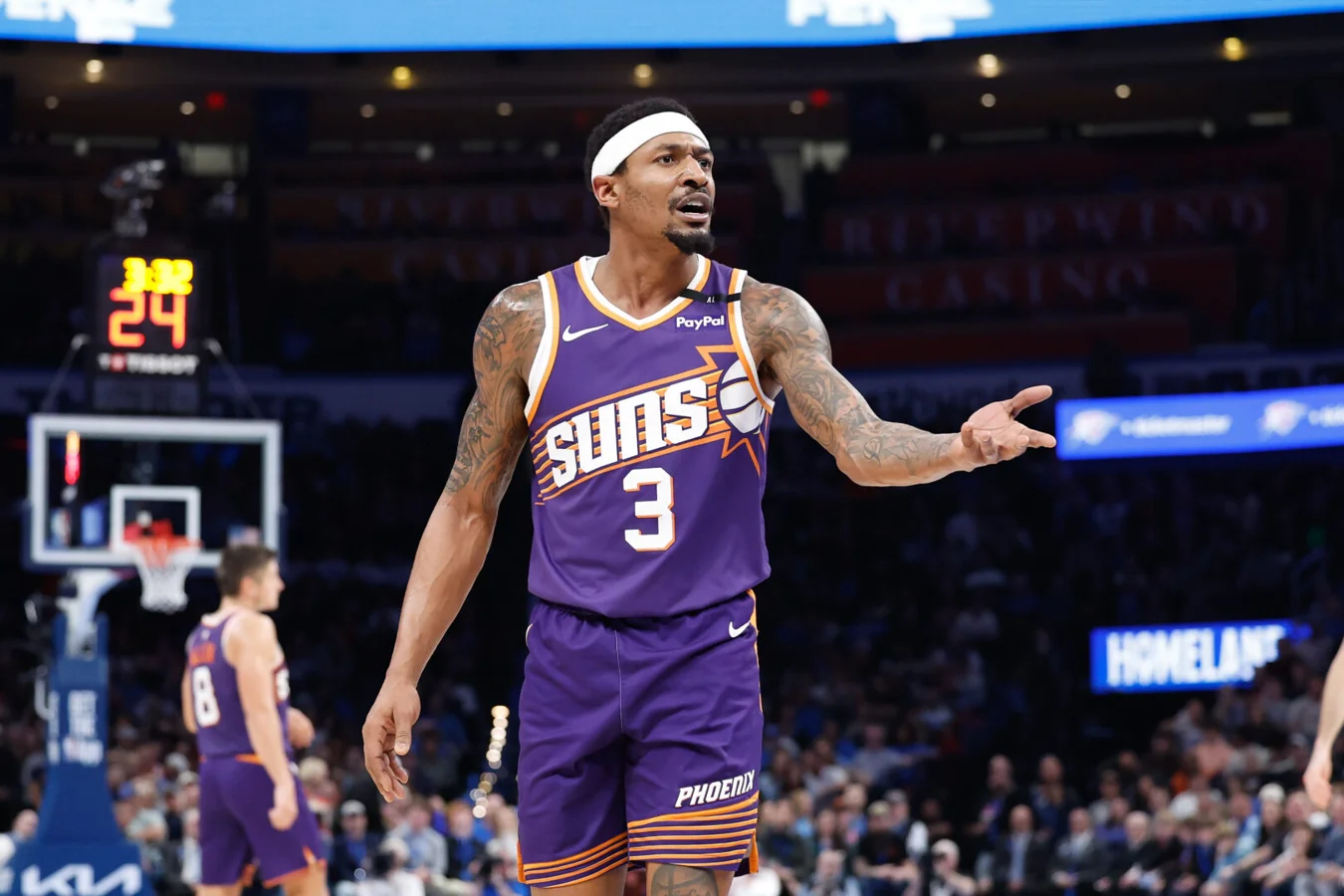

After months of uncertainty and friction, Bradley Beal has officially reached a $99 million buyout deal with the Phoenix Suns, paving the way for the veteran guard to join the Los Angeles Clippers. The agreement was finalized on Wednesday by agent Mark Bartelstein and Suns CEO Josh Bartelstein, marking the close of an extended and complicated saga involving the star player’s future in Phoenix.
The timing coincides with personal milestones for the Bartelstein family, as they prepare to celebrate Josh’s 36th birthday and a major family wedding in Chicago this weekend, showing how professional and personal spheres merged amid the ongoing negotiations.
How Bradley Beal’s role and frustrations evolved in Phoenix
Beal’s departure from the Suns unfolded in distinct phases, beginning with the arrival of new head coach Jordan Ott in early June. Ott presented Beal with a detailed plan intended to revitalize the star’s role, which had shrunk under former coach Mike Budenholzer. Despite Beal maintaining solid scoring averages last season—17 points per game with nearly 50% shooting overall and close to 40% from three-point range—his usage rate was the lowest of his career, and his $50 million salary increasingly seemed disproportionate to the output and team performance.
With two years and $113 million remaining on Beal’s contract and a no-trade clause severely limiting trade options, the Suns struggled to move forward with him. Though Ott showed interest in retaining Beal, the player and his agent had determined that a fresh start elsewhere was necessary, spurred by a desire to compete in high-stakes games.

“We couldn’t take the chance [of another lost year],”
Mark Bartelstein said.
This decision was about basketball. Bradley wants to play in big games and in big moments.
—Mark Bartelstein, agent
Kevin Durant trade reshapes Suns’ roster and Beal’s uncertain role
The Suns’ trade of Kevin Durant to the Houston Rockets on June 22 further reshaped Beal’s future. Receiving 23-year-old guard Jalen Green as part of the deal gave the Suns a promising new perimeter prospect alongside Devin Booker. Prior to that, Phoenix had considered a more complex trade package with the Minnesota Timberwolves that could have preserved space for Beal, possibly changing the team’s approach to his contract.
However, Durant’s reluctance to join Minnesota and his limited contract control made that deal unviable. The Rockets trade prioritized youth, leaving Beal’s role in the Suns’ updated lineup ambiguous. Following this, the Suns authorized Beal and his agent to explore buyout talks with other teams, signaling the official end of his time in Phoenix. More than 20 teams expressed interest, with Beal engaging in initial discussions with several possibilities via Zoom.
Clippers emerge as preferred destination amid shifting NBA landscape
The Los Angeles Clippers became the focal point in Beal’s search for a new team following a July 7 trade that sent Norman Powell to Miami in a three-way deal, bringing John Collins from Utah to Los Angeles. The Clippers had expressed prior interest, and the Powell trade expedited negotiations. Owner Steve Ballmer and head coach Ty Lue, himself a Missouri native like Beal, personally reached out to him to outline their vision.
Adding significant weight to the Clippers’ recruitment was James Harden, who actively lobbied management to sign Beal and contacted the player directly. Harden, a key Clippers figure who logged the fifth-most minutes in the league last season and earned All-Star and All-NBA honors, sought to lighten his own load by bringing on Beal’s scoring ability.
The Clippers’ strong finish to last season and their hard-fought seven-game playoff series with the Denver Nuggets created a promising backdrop for the pitch, centered on team depth and synergy.
Harden emphasized how Beal’s skill set would complement key players, including Powell, and how he understood the challenges of reviving a career after setbacks—a situation both players faced, making the opportunity a mutual path to redemption.
The recruitment process even extended to discussions involving agents, with Harden speaking to Bartelstein to secure consensus, an uncommon but strategic move to ensure all parties were aligned.
“No one wants to be released. There’s heartache with that,”
Mark Bartelstein remarked.
But Bradley wants to be in a position where no one remembers he got released, that they’ll remember how he plays next season.
—Mark Bartelstein, agent
Financial realities and roster flexibility shape Suns’ decision
To facilitate the buyout, the Suns utilized the waive-and-stretch provision, agreeing to spread the $99 million owed to Beal over five years. This strategy incurs about $20 million annually against their salary cap through the decade’s end, a heavy financial burden compounded by a lack of first-round picks until 2031.
Despite the long-term cap challenges, the move frees Phoenix from the second and first apron luxury tax restrictions, granting the team roster-building flexibility it desperately needs after excessive spending failed to translate into playoff success. Owner Mat Ishbia’s expenditure of $620 million on salary and tax over two seasons yielded no playoff victories, underscoring the necessity of a drastic change.
The Suns saved approximately $210 million in combined salary and luxury tax costs this season alone through waiving Beal, a financial reprieve that justifies enduring payments in future years. While those payments will gradually become a smaller ratio of the salary cap, the Suns are left navigating the long tail of this costly contract mistake.
The addition of Jalen Green remains a key optimism point for the Suns, as they aim to build around Booker and Green’s promising potential.
“[We] brought in one of the rising stars in the NBA in Jalen,”
Suns general manager Brian Gregory said.
His athleticism and natural ability are off the charts. Jalen has already proven his commitment to putting in the work that excellence requires, and we believe that his approach to the game will allow him to further unlock his incredible upside here in Phoenix.
—Brian Gregory, Suns general manager
Negotiations tested as Beal leaves minimal salary on the table
Finalizing the buyout was not without tension. League rules permit the Suns to buy out only up to 15% of the salary cap on designated players, meaning Beal had to give back at least $13.9 million from his remaining salary to open the door to a legal buyout. The two sides engaged in intense discussions, with Beal ultimately agreeing to surrender the minimal amount required for the deal to proceed.
Following the agreement, Beal signed a two-year, $11 million contract with the Clippers, with about $5.4 million payable this season through their available midlevel exception after signing Brook Lopez. While this income is less than his guaranteed Phoenix salary, Beal’s contract includes a player option next summer, allowing him to test free agency at age 33 if he performs well.
Beal’s performance last season failed to meet expectations given his $50 million yearly earnings, but replicating similar production at a fraction of the salary with the Clippers offers a rare success story in NBA contract management.
Clippers’ offseason moves build a deeper, competitive roster
The Clippers’ offseason infusions transform their lineup, with the departures and acquisitions bordering on strategic overhaul. After securing Harden on a fresh two-year, $81 million deal with a player option, the Clippers utilized the full midlevel exception to add Lopez and Beal alongside John Collins. This combination emerged from trading Norman Powell and reallocating cap space, significantly strengthening roster depth.
With Collins signed for $27 million in the final year of his deal and team options available on Bogdan Bogdanovic, Nico Batum, and Lopez, the Clippers maintain financial flexibility to pursue a maximum contract next summer if desired.
Beal and Harden, both equipped with opt-out clauses, are motivated to excel and enhance their market value, while Kawhi Leonard prepares his body for a deep playoff run after recovering from several injury-plagued seasons, suggesting the Clippers are primed for meaningful progression.
Implications of Beal’s transition and what lies ahead
The resolution of the Bradley Beal Phoenix Suns buyout and his planned move to the Clippers signals a significant shift for all involved. Phoenix absorbs a costly financial hit but gains roster flexibility necessary to reshape its future, building around younger talent like Jalen Green and Devin Booker. For Beal, the Clippers offer a clean slate and a chance to reignite his career alongside familiar figures like Harden and Lue.
This move concludes a tense and complex chapter marked by underperformance, contract burdens, and organizational restructuring. Looking ahead, Beal’s upcoming seasons in Los Angeles, combined with the Clippers’ revamped core, will be closely watched as they aim to convert offseason investments into playoff success.
As the Bartelstein family prepares for their wedding celebrations, the professional drama surrounding Beal’s transition quietly closes, leaving anticipation for the next chapter in a career seeking redemption and renewed impact.
Our Reader’s Queries
Q. Can Bradley Beal be waived?
A. Liddell is included in the roster. If the Suns outright release Beal at his full salary, they can’t spread his payment over time. This is because it would exceed the allowed 15% limit. For a legal stretch, Beal would need to forfeit about $13.9 million from his contract total.
Q. Only two players in the NBA have a no-trade clause. Do you know which players? That’s right! It’s LeBron James and Bradley Beal.
A. As of now, no current NBA player has a no-trade clause in their contract.