
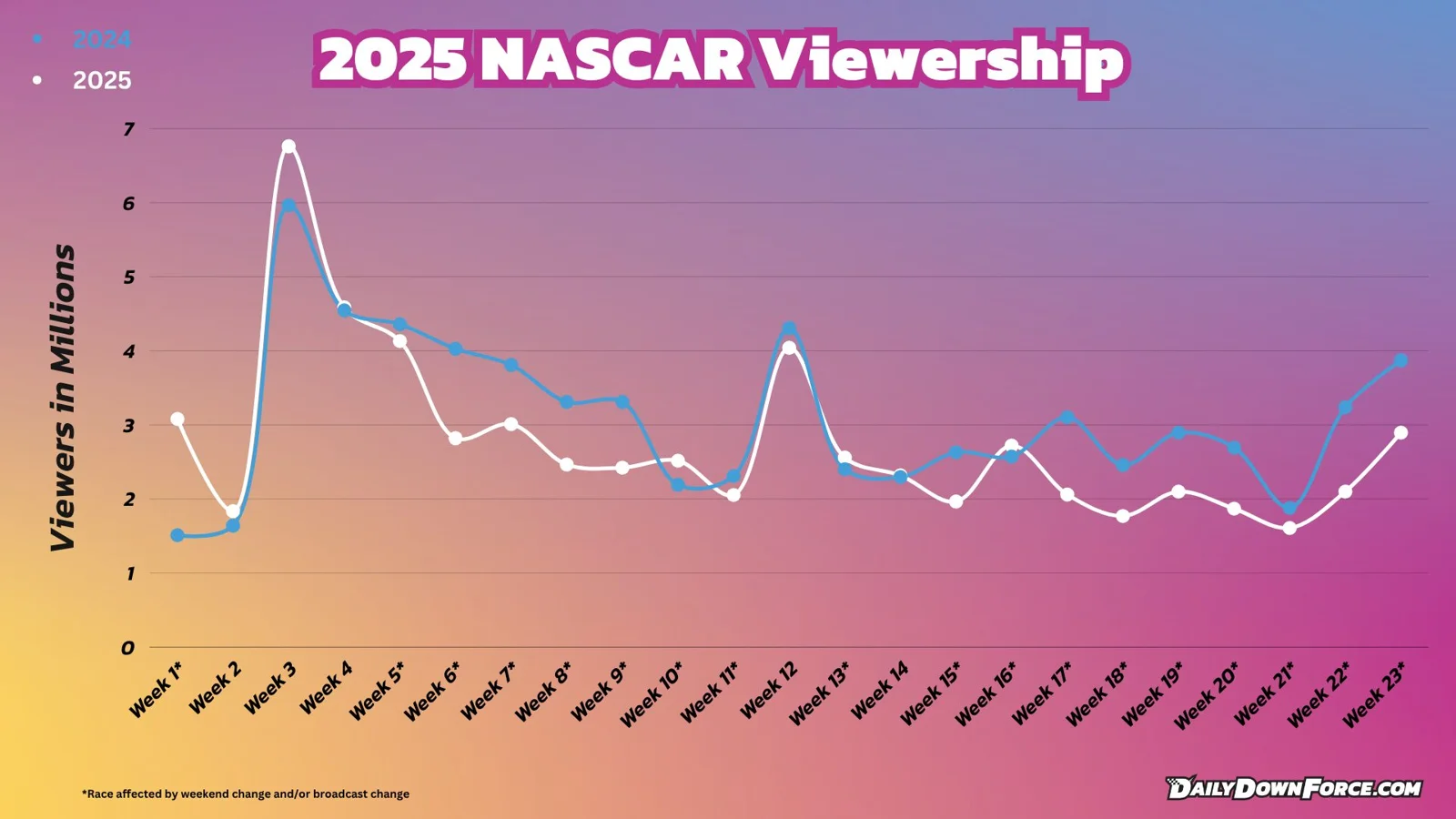

NASCAR Commissioner Steve Phelps recently highlighted how stock car racing maintains a strong lead in viewership compared to Formula 1 and IndyCar, particularly within the United States. Speaking with journalist John Ourand, Phelps underscored NASCAR’s unique position as a motorsport that appeals to a broader, more accessible audience, which has helped it remain America’s top racing series despite increased attention towards F1 and IndyCar.
Addressing whether NASCAR sees F1 and IndyCar as direct competitors, Phelps stated,
“I don’t think so. They’re in a different subset. If you go back five or six years, motorsports were struggling. F1 wasn’t doing very well. IndyCar wasn’t doing very well. We were in a slow, steady decline for about a decade. But since 2019, that’s changed. We celebrate F1’s success. We celebrate IndyCar’s success on Fox this year. It’s a positive thing if motorsports are growing. If you consider that we’re the top of the heap of motorsports domestically—and we are, by a wide margin—it’s a good thing.”
—Steve Phelps, NASCAR Commissioner
Differences in Audience and Accessibility Between NASCAR and F1
Phelps emphasized that NASCAR caters to a different group of fans compared to F1, noting that only six percent of NASCAR’s audience also watches Formula 1, whereas crossover with IndyCar is approximately twenty percent. He pointed to NASCAR’s focus on making the sport approachable and affordable as a key factor setting it apart from F1’s more exclusive model.
He elaborated,
“We are different brands. F1 is all about restricted access. Ours is all about accessibility. Our fans can stand on pit road, where the cars are. The other part of accessibility is about the cost to attend a race. Going to an F1 race is incredibly expensive. Fans can get NASCAR race tickets for $30 to $50. Typically, parking is free. Fans can walk in with a cooler filled with their favorite beverages. That doesn’t mean that one is better than the other. It just means they’re different, with different audiences and different accessibility. We lean into the Americana that we are.”
—Steve Phelps, NASCAR Commissioner
This approach positions NASCAR as a sport deeply connected to its American fan base, promoting engagement through affordable tickets, access to the racing environment, and a welcoming atmosphere, contrasting with F1’s high-cost, more exclusive events.
Current Viewership Trends Favor NASCAR as Young Fans Tune In
Despite the growing global profile of Formula 1 and the increased attention on IndyCar following its new broadcasting deal with Fox, NASCAR remains the most-watched motorsport in the United States. Not only does NASCAR enjoy high viewership numbers, but it is also experiencing a notable shift in audience demographics, attracting younger fans who watch races on streaming platforms such as Prime Video.
On June 1, 2025, the NASCAR race from Nashville broadcast on Prime Video attracted 2.06 million viewers, surpassing Formula 1’s Spanish Grand Prix at 1.17 million viewers and IndyCar’s Detroit Grand Prix at 1.06 million on the same day. Across the first two NASCAR races streamed on Prime Video this year, the average viewership was 2.39 million, compared to F1’s yearly average of 1.33 million and IndyCar’s 1.77 million, which marks IndyCar’s best year since 2016.
A significant aspect of NASCAR’s streaming success is its younger audience demographic. The median age of NASCAR viewers on Prime Video is 56.8 years old, about six years younger than the median age of 62.8 for NASCAR’s traditional television audience. This shift suggests an influx of younger adults engaging with stock car racing through digital platforms, a trend considered essential for sustaining NASCAR’s long-term viewership strength.
Implications for the Future of Motorsports Viewership Competition
NASCAR’s ability to maintain its lead in viewership while simultaneously drawing in younger fans could reinforce its dominance over F1 and IndyCar in the U.S. market over the coming years. Phelps’ remarks reflect confidence that NASCAR’s distinct identity—rooted in accessibility, affordability, and Americana—continues to resonate deeply with its existing fan base while welcoming a new generation of viewers.
With Formula 1 gaining global buzz through media projects and potential partnerships, and IndyCar steadily growing under new broadcast contracts, the landscape of motorsports viewership is evolving. However, NASCAR’s current performance illustrates that prioritizing ease of access and connection to fans remains a powerful strategy for audience retention and growth.
Our Reader’s Queries
Q. Is number 13 banned in F1?
A. Yes, drivers can choose number 13. Pastor Maldonado picked #13 in 2014 when F1 introduced permanent numbers. Despite some cultures seeing 13 as unlucky, F1 let drivers decide.
Q. Which F1 driver has ADHD?
A. Lewis Hamilton, born in 1985, is a British Formula One driver for Mercedes and formerly raced for McLaren. He openly talks about his experiences with ADHD and shares his varied interests and passions.
Q. Is 69 allowed in F1?
A. Drivers can pick a permanent number from 0 to 99, but not 1. Only the World Drivers’ Champion can use the number 1, but it’s optional for them.
Q. Which F1 drivers have ADHD?
A. Lewis Hamilton, also known as Sir Lewis Carl Davidson Hamilton, was born in 1985. He is a British Formula One driver. Currently, he races for the Mercedes team and has previously driven for McLaren. Hamilton openly shares his experiences living with ADHD and talks about his wide range of interests and hobbies.