
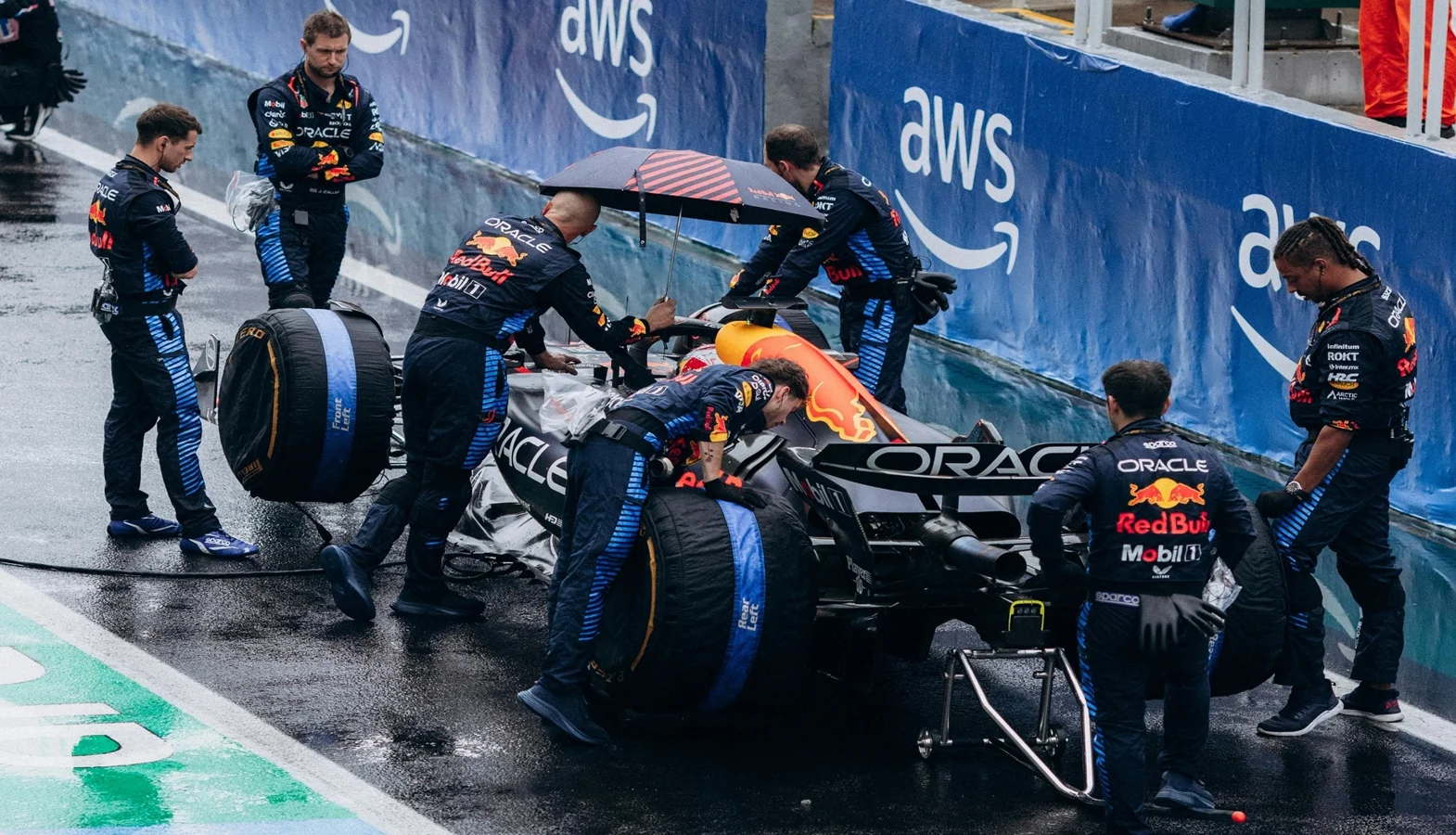

Red Bull Racing is undergoing a critical transition after the sudden exit of longtime team principal Christian Horner, with Laurent Mekies stepping in to lead the team. This change has intensified concerns about the future stability and performance of the team, marking the beginning of what many see as a Red Bull F1 leadership crisis.
Former Formula 1 driver Jolyon Palmer has voiced serious concerns about the unstable situation facing Red Bull Racing. With Horner’s departure and Mekies unexpectedly assuming control, the team must confront a steep challenge to halt its recent downturn and restore its previous dominance.
Red Bull’s Unexpected Decline Sparks Doubts Over Team’s Prospects
The team’s recent performance slump, despite the absence of rule changes, has left fans and analysts puzzled about Red Bull’s trajectory. Palmer pointed out the enormous difficulties Mekies faces in regenerating a squad that once led Formula 1. This downturn, without regulatory factors to blame, raises questions about internal issues and leadership effectiveness.
A critical concern is Red Bull’s new venture into engine manufacturing, an area previously managed by external suppliers. Mekies’ limited engagement with this vital power unit development puts additional pressure on him as Red Bull seeks to build competitive proprietary engines for the first time.
Driver Uncertainty and Technical Challenges Compound Team’s Predicament
Adding to Red Bull’s challenges is the ongoing speculation regarding Max Verstappen’s future. Rumors of Verstappen potentially moving to Mercedes have intensified the instability within the team, as retaining their star driver remains paramount for any hope of recovery.
The impending overhaul of Formula 1’s technical regulations further complicates Mekies’ task. Navigating these changes successfully will be crucial for Red Bull to catch up with rival teams and maintain its place among the sport’s elite.
Mekies Under Pressure to Restore Red Bull’s Competitive Edge
Facing a combination of leadership upheaval, uncertain driver commitments, and technical development hurdles, Laurent Mekies finds himself at the center of a high-stakes effort to steer Red Bull back toward its former strength. The coming months will test his ability to manage both team dynamics and technological innovation.
As Formula 1 operates within an unforgiving environment where leadership and strategy swiftly impact results, Red Bull’s current situation highlights the thin margin between success and decline. With Mekies now leading the charge, the team’s future performance will reveal how effectively he can respond to these pressing challenges.
“With Horner gone and Mekies stepping into a high-pressure role, the team is facing an unprecedented challenge to reverse their recent decline.” —Jolyon Palmer, Former F1 Driver
“Palmer emphasized the daunting task ahead for Mekies, as he navigates the complexities of reviving a team that was once at the forefront of the sport.” —Jolyon Palmer, Former F1 Driver
Our Reader’s Queries
Q. Is number 13 banned in F1?
A. Yes, the number 13 is permitted. Pastor Maldonado selected #13 when the permanent number system was introduced in 2014. While some cultures see this number as unlucky, F1 lets drivers decide their own numbers.
Q. Which F1 driver has ADHD?
A. Lewis Hamilton, born in 1985, is a British driver who competes in Formula One. He currently races for Mercedes and has previously driven for McLaren. Hamilton openly shares his experiences living with ADHD and talks about his varied interests and passions.
Q. Is 69 allowed in F1?
A. Drivers can pick any permanent number between 0 and 99, except for 1. Only the World Drivers’ Champion can decide to use the number 1, but it is not mandatory.
Q. Which F1 drivers have ADHD?
A. Lewis Hamilton, also known as Sir Lewis Carl Davidson Hamilton, is a well-known British driver born in 1985. He races in Formula One for the Mercedes team and previously drove for McLaren. Hamilton openly talks about his experiences with ADHD and shares his wide range of interests and passions.