
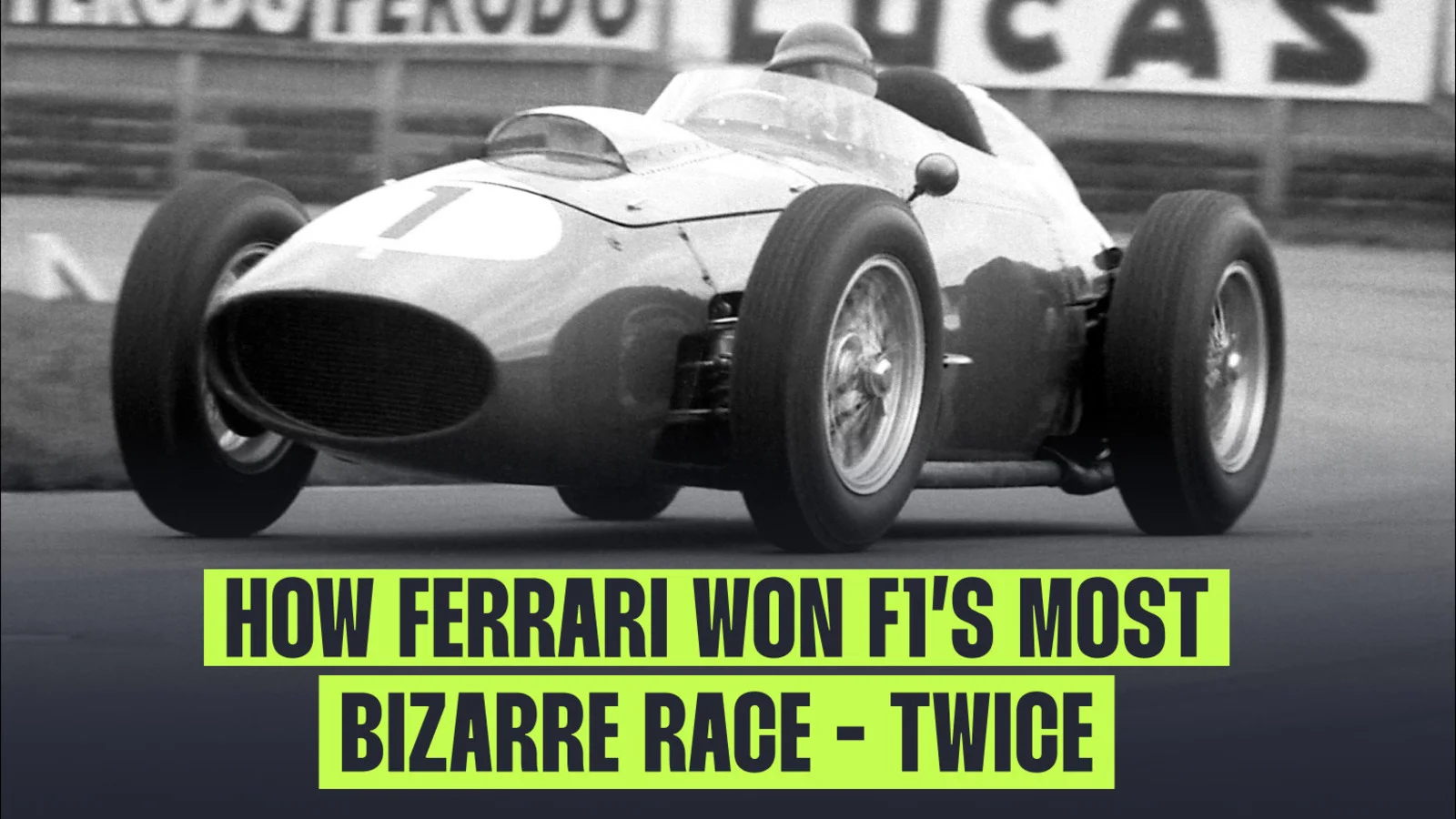

The 1959 German Grand Prix holds a unique place in Formula 1 history for its bizarre race structure, which has not been repeated since. Unlike the typical championship races that consist of a single continuous event, the 1959 German GP was contested in two separate heats, with results combined to determine the final winners. This unusual arrangement allowed Ferrari to claim a rare feat of finishing first, second, and third twice in the same race weekend, a record that remains unmatched.
At the time, Formula 1 races were generally endurance-style events, set around a distance of roughly 300 kilometers or a race duration of two hours. Past races varied in length, including the exceptionally long 504 km 1950 Italian Grand Prix and the inclusion of the Indianapolis 500 in the world championship calendar. However, by 1959, the standard format was largely settled into single-race events lasting about 300 kilometers or two hours, with the driver crossing the finish line first declared the winner.
The German Grand Prix organizers broke from this tradition at the 1959 race, creating a two-heat system where each heat lasted one hour, and the combined times of the heats determined the overall finishing order. This arrangement was unprecedented and reflected both the circuit’s characteristics and the conditions of the event.
The AVUS Circuit: Fast but Dangerous and Unpopular
The 1959 event was held at the AVUS circuit in West Berlin, a track notorious for both its incredibly high speeds and its lack of driver appeal. The circuit, first opened in 1921, was essentially a stretch of public highway transformed into a racing venue by adding a long straightaway on each side of the autobahn and capped by a sharp left-hand bend at the southern end.
One of AVUS’s most infamous features was the 43-degree banked turn known as the “Wall of Death,” installed in 1937. This brick-built banked curve made it one of the fastest racing circuits on the planet, with Luigi Fagioli reaching an average speed of 284.3 km/h there in 1937. While extraordinarily fast, the circuit was also extremely dangerous, combining high-speed straights with the perilous banking, which many drivers found terrifying.
The AVUS layout had been shortened by 1959, down from 19.569 km to about 8.3 km, possibly due to geopolitical changes after World War II, as the track crossed the border between West and East Berlin. But the cut did little to improve safety or popularity. A concrete cut-through replaced the southern loop portion, leaving AVUS as a mostly flat-out speed track. Denis Jenkinson, a respected motorsport journalist of the era, criticized the circuit strongly:
“The AVUS track bears no resemblance at all to a Grand Prix racing circuit, as exemplified by the Nurburgring,”
—Denis Jenkinson, Motorsport Journalist
“Being 90 per cent a pure speed track it was felt that holding a leg of the Drivers’ World Championship on the AVUS was to make an absurdity of the whole thing.”
—Denis Jenkinson, Motorsport Journalist
AVUS’s dangerous reputation was reinforced tragically just one day before the race when Jean Behra lost his life. His Porsche 718 RSK went airborne over the banked curve and struck a concrete gun turret, killing him instantly. This incident cast a shadow over the event and contributed to organizers’ hesitation about holding a full-length race under normal rules.
A Race Transformed: Why Two Heats Were Needed
The combination of AVUS’s lethal banking, immense speeds, and the resulting tyre wear concerns led race organizers to deviate from the standard race format. They decided to split the race into two one-hour heats instead of one extended sprint. This strategy aimed to reduce the risk of tyre failures during the race, as Dunlop tyres at the time were not expected to cope with sustained speeds approaching 240 km/h over a long distance.
The sport’s governing body also banned streamlined bodywork for the race, ruling out cars like the Mercedes W196 that had previously competed in the early 1950s. The W196 had raced at AVUS in 1954 during the Gran Preis von Berlin, which was a non-championship event dominated by Mercedes cars. Mercedes driver Karl Kling had won that race averaging over 212 km/h, narrowly beating defending world champion Juan Manuel Fangio and Hans Herrmann’s third Silver Arrow.
Despite the threat of danger, the 1959 German GP drew a competitive field that included Ferrari, Cooper, Lotus, BRM, and Maserati entries. Ferrari lined up Tony Brooks, Dan Gurney, and Phil Hill, with Cliff Allison serving as a reserve driver. Cooper’s squad featured Jack Brabham, Stirling Moss, Bruce McLaren, and others, while Lotus brought Graham Hill and Innes Ireland. BRM entered Hans Herrmann, Harry Schell, and Jo Bonnier.
Ferrari’s Early Dominance and the Intense Competition
Practice sessions hinted at the speed and risk involved, with Cliff Allison posting the fastest time from a slipstream but being relegated to the back of the grid due to his reserve status. Tony Brooks claimed pole position, joining Stirling Moss, Dan Gurney, and Jack Brabham on the front rows for a four-three-four grid formation.
At the first heat’s start, Brooks quickly jumped into the lead, closely followed by Moss and Masten Gregory. Despite the tight racing early on, the pack began to break up as drivers tackled the fast banking. Moss retired almost immediately with gearbox trouble, and Gurney moved up to claim second place after a strong recovery. Gregory made a thrilling but short-lived charge at the front before his engine failed.
By the end of heat one, the three Ferraris led the field one-two-three, with Brooks ahead, followed by Gurney and Phil Hill. Cliff Allison retired due to clutch problems, emphasizing the harshness of the AVUS circuit.
Second Heat Battles and Spectacular Moments
Between the heats, Cooper mechanics worked to repair Gregory’s and Brabham’s cars, both sidelined earlier by mechanical failures. However, both were withdrawn from the restart by race officials because they had not finished the first heat, leaving just nine cars on the grid for the second hour-long race.
Bruce McLaren briefly led the second heat but soon succumbed to gearbox issues, allowing the three Ferraris to dominate once more. Jo Bonnier provided some opposition in his BRM but eventually faded. Meanwhile, a dramatic incident involving Hans Herrmann created one of motorsport’s iconic images when his BRM suffered a front brake failure on the southern hairpin.
Herrmann crashed violently into the straw bales, which rolled his car and ejected him. Remarkably, he escaped with only minor injuries, though his car was completely destroyed. This moment epitomized the risks drivers faced on the AVUS circuit.
Ultimately, team orders at Ferrari dictated the finishing order in the second heat, mirroring the first: Brooks first, Phil Hill second, and Gurney third. Aggregating both heats confirmed this result, marking an extraordinary and unique one-two-three finish by Ferrari twice in the same race event.
Aftermath and Lasting Legacy of the 1959 German Grand Prix
Only seven cars saw the checkered flag by the end of the event, which was marred by organizational problems and safety concerns. To add to the oddities, the wrong national anthem was played during the victory celebrations, underscoring how unpopular and poorly managed the AVUS event was.
The German Grand Prix did not return to AVUS afterward and instead resumed at the Nurburgring in 1960 as a non-championship race before returning to the Formula 1 calendar in 1961. The two-heat format employed in 1959 was discontinued, though aggregate results from restarted races have occasionally appeared in F1 history, mainly when a race was halted and restarted due to incidents rather than by design.
The last time an aggregate timing format was used in Formula 1 was at the 1994 Japanese Grand Prix. The 1959 race at AVUS remains a fascinating outlier, remembered for its dangerous circuit, unusual two-heat structure, and Ferrari’s unprecedented double podium domination.
Our Reader’s Queries
Q. Is number 13 banned in F1?
A. Yes, the number 13 is permitted. Pastor Maldonado selected #13 when the fixed number system started in 2014. Although some cultures see it as unlucky, F1 let drivers choose their numbers.
Q. Which F1 driver has ADHD?
A. Lewis Hamilton, born in 1985, is a British Formula One driver. He races for Mercedes and has previously driven for McLaren. Hamilton openly talks about his experiences with ADHD and shares his various hobbies and interests.
Q. Is 69 allowed in F1?
A. Drivers can select their own fixed numbers ranging from 0 to 99, except for number 1. Only the World Drivers’ Champion has the option to use number 1 if they want, but it’s not mandatory.
Q. Which F1 drivers have ADHD?
A. Lewis Hamilton, born in 1985, is a British driver in Formula One. He races for Mercedes and has also raced for McLaren. Hamilton openly talks about his experiences with ADHD and shares his wide range of interests and passions.