
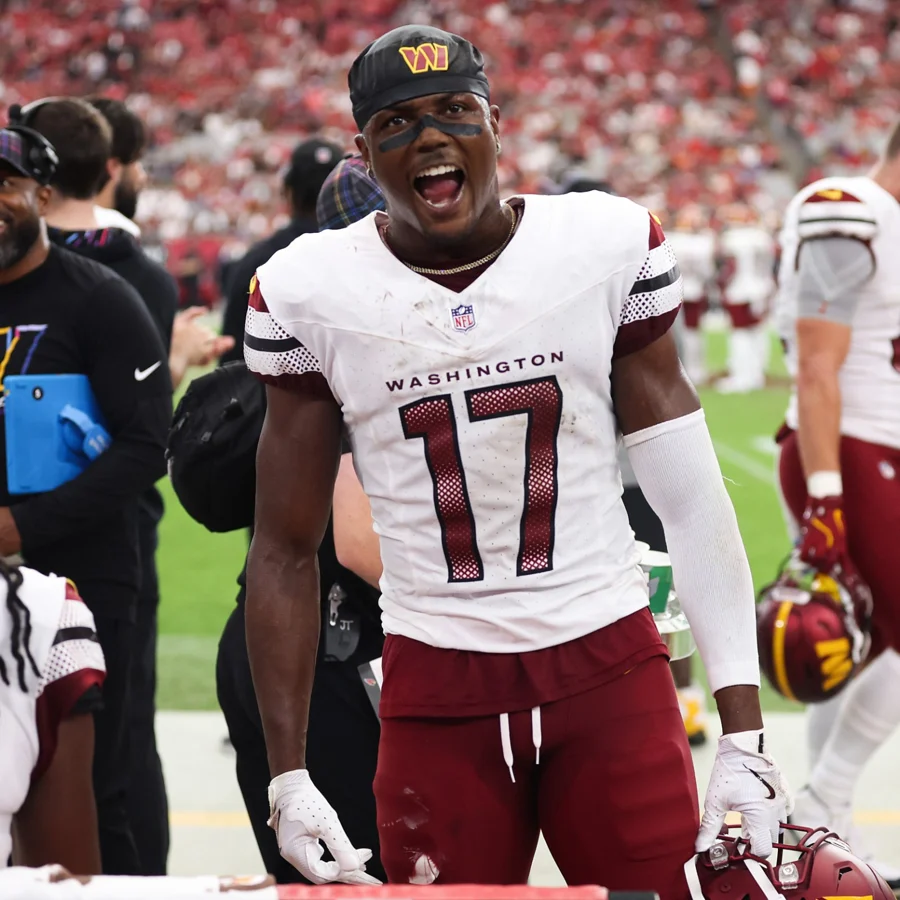

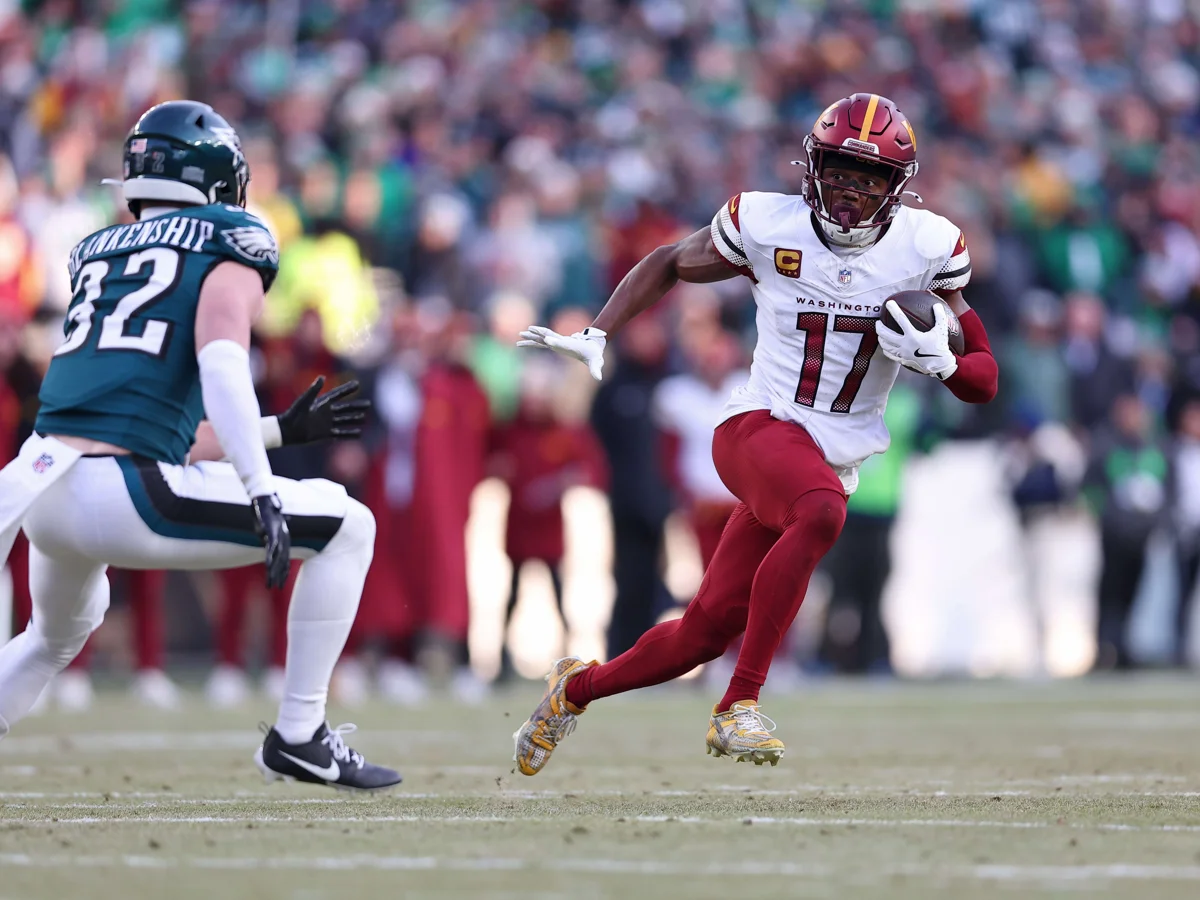
The Washington Commanders face a crucial decision regarding the future of their star wide receiver Terry McLaurin as they consider a contract extension. With McLaurin approaching his 30th birthday this September, the question arises whether committing substantial financial resources and years to a player entering the latter stage of his career is prudent. The ongoing Terry McLaurin contract extension debate centers on balancing respect for his past contributions and the financial risks involved in betting on sustained peak performance.
From a business standpoint, offering a hefty contract to McLaurin involves significant risk due to the natural decline wide receivers tend to experience as they age. Data tracking fantasy football points, often used as a proxy for on-field productivity, indicates that receivers typically peak between ages 23 and 27, with a notable downturn after age 28. Since McLaurin is approaching 30, it is statistically more probable his performance will regress rather than improve in upcoming seasons.
While McLaurin unquestionably earned his production last season, worth multimillion-dollar value, the key issue remains whether he can maintain or exceed that level going forward. The Commanders will struggle offensively without him, given he is their most productive wide receiver, yet NFL contracts are investments in players’ future output, not past success. Signing McLaurin to a contract averaging $30 to $35 million annually might constrain Washington’s salary cap flexibility and hamper roster construction in the years ahead.
The Implications of Von Miller’s Arrival to the Commanders
Adding a new dynamic to the team’s roster, the Commanders recently secured veteran pass rusher Von Miller for the 2025 season, as Miller confirmed by sharing a photo in the team’s alternative uniform. Miller, a future Hall of Famer and one of the NFL’s all-time leaders in sacks, arrives as a high-profile addition while raising questions about his capability at age 36.
The Commanders traded one top pass rusher, Dante Fowler, in free agency without replacing him with a high-profile counterpart. Instead, they opted for Miller, who’s transitioned into a situational role rather than an every-down player. His snap counts have steadily declined during his time with the Buffalo Bills, from 71% of snaps in 2021 to about 32% in 2023 and 2024, demonstrating a shift towards a specialist role that limits wear and sustains effectiveness in key moments.
Though he no longer plays every down, Miller’s athleticism and extensive pass-rushing skills remain formidable. He has developed a diverse arsenal of techniques over his career, further highlighted by his creation of an annual pass rush camp where NFL elite pass rushers share insights to refine their craft. This leadership and skill set make him a valuable component—even if used sparingly—to bolster Washington’s defensive front.
Potential Impact of Von Miller on Washington’s Defense
Miller’s contribution to the Commanders may not be measured by Pro Bowl accolades but by his ability to close out games and create crucial defensive moments. At 36, he fits the mold of a specialist in pivotal game situations, similar to how noted closers like Mariano Rivera operated in baseball. Miller’s value lies in exerting pressure late in games, particularly in the fourth quarter, where the Commanders have struggled to generate sacks and decisively end opponents’ drives.
Washington’s 2024 performance showed weaknesses in pass rushing during critical moments, with only five sacks recorded in fourth quarters, ranking near the league’s bottom. Miller’s 25.5% pass rush win rate in fourth quarters last season with Buffalo, one of the highest in the NFL, signals his potential to elevate the Commanders’ late-game defense. His ability to produce sacking bursts and disrupt plays could be a key factor in determining close game outcomes in 2025.
The signing also embodies the Commanders’ shift toward attracting veteran players seeking championships rather than just contracts. Miller joins linebacker Bobby Wagner and tight end Zach Ertz as seasoned players committing to Washington for a shot at postseason success, signaling a strategic resurgence built on experience and leadership.
The Commanders Secure Second-Round Defensive Back Trey Amos
In another roster development, the Commanders reached agreement with cornerback Trey Amos on a four-year contract. Amos was Washington’s 61st overall selection in the most recent NFL Draft and is among a select group of second-round picks who have finalized deals amid wider negotiations slowing down due to guaranteed money terms.
Amos brings collegiate experience from Louisiana, Alabama, and Ole Miss, where he showed versatility and playmaking ability with 50 tackles, multiple tackles for loss, interceptions, and forced fumbles during a 13-start season. This addition aims to strengthen the secondary while addressing depth and future potential in the defensive backfield.
Von Miller Represents a Strategic Asset and Luxury for the Commanders
Though not expected to play full-time, Miller operates as a luxury roster piece for a team poised for contention. His specialized role in passing downs allows the Commanders to deploy his pass rushing expertise selectively, aiming to disrupt opponents at decisive moments. Last season with the Bills, Miller participated in roughly a third of defensive snaps and recorded six sacks, exemplifying the impact he can deliver in limited action.
Washington’s recent NFC championship appearance and current roster talent have transformed the franchise into an attractive destination for veterans seeking a final run at glory, as players like Miller, Wagner, and Ertz choose the team for its championship aspirations rather than financial incentives alone.
The presence of quarterback Jayden Daniels, who has emerged as a promising young leader, combined with head coach Dan Quinn’s respected player-first approach, fosters an environment conducive to attracting premier talent determined to compete at the highest level. This cultural shift supports the Commanders’ ambitions to build a sustainable contender anchored by both youth and experience.
Challenges Facing NFC East Rival Teams Ahead of the Season
The Commanders will face stiff competition within the NFC East and beyond as other teams prepare for the upcoming season. The Denver Broncos, for example, are watching their quarterback Bo Nix’s development closely after an impressive rookie campaign. Much like Daniels for the Commanders, Nix sparked Denver’s offense and is expected to either build on that success or face a sophomore slump.
Denver’s defense was a cornerstone of their 2024 campaign, ranking among the league’s best against the run and excelling in forcing turnovers. With key departures like Cody Barton but additions including Greenlaw and Talanoa Hufanga, the Broncos hope to maintain or improve on their defensive performance despite the challenges presented by an increasingly competitive conference.
On offense, Denver’s running game remains a question mark following the departure of lead back Williams. The tandem of RJ Harvey, known for his prolific college scoring, and veteran J.K. Dobbins, who had a solid 2024 season, is expected to propel the ground attack. Their success will be instrumental in bolstering Denver’s overall offensive balance and complementing Nix’s passing game.
Reflections on the Terry McLaurin Contract Debate Within the Commanders Organization
The ongoing debate surrounding McLaurin’s contract extension remains a focal point for the Commanders. His candid frustrations, voiced publicly, have drawn attention to stalled negotiations and underlined the tension between player expectations and organizational strategy. McLaurin’s contributions have earned him strong locker room respect, yet the team’s front office must weigh emotional ties against the risks of limiting roster flexibility.
Industry insiders agree the Commanders face a difficult balancing act. Overpaying McLaurin on a long-term deal may jeopardize future roster moves crucial to sustaining competitive success. Given McLaurin’s age and the statistical likelihood of decline, the team’s decision will set a precedent on how to value veteran wide receivers entering their 30s.
Meanwhile, commentary from analysts highlights the complexity of managing such negotiations amid a changing NFL financial landscape. The presence of emerging stars like Daniels alters team dynamics, while veteran specialists like Von Miller symbolize a strategic blend of experience and role-specific impact.
Instant reaction to Von Miller headed to the Commanders + @corryjoel’s thoughts on Terry McLaurin’s contract extension now that the frustrated WR offered his candid assessment of the stalled talks. https://t.co/PoUDgL1FML https://t.co/ytmrFsftuG
— Ben Standig, NFL Analyst
Episode 1,114 – Analysis of the Commanders signing Von Miller. He’s better than people realize.Guest: @BarrySvrluga. Terrific perspective on the stalled Terry McLaurin contract-extension talks. Great intel on the Nationals’ GM search & on Mike DeBartolo.
— Al Galdi, Sports Commentator
Issues and Moves in the Wider NFL Landscape Influencing the Commanders
The Commanders’ negotiations and signings happen amid several notable league-wide stories, including leadership changes in the NFL Players Association and evolving contract benchmarks. Lloyd Howell Jr., the NFLPA executive director, recently resigned following criticism, a move that could affect players’ collective bargaining leverage going forward.
In parallel, several rookie contracts have come under scrutiny as second-round picks negotiate for fully guaranteed deals, a trend seen with players like Seahawks’ safety Nick Emmanwori. These shifts in contract norms have implications for teams like Washington navigating key extensions.
Off-field developments also impact the Commanders, especially ongoing discussions about their stadium future. The DC Council is under pressure to approve a revitalization plan for RFK Stadium, which remains the front runner for the team’s long-term home, even as Maryland and Virginia emerge as potential alternatives. The project’s timely approval is critical to avoiding delays threatening a 2030 stadium opening, with sources emphasizing the need for prompt action.
Chairman @RepJamesComer is calling on the DC Council to approve the revitalization plan for the RFK Stadium in Washington.No more stalling, it’s time to Make DC Beautiful Again!
— Oversight Committee, Official Statement
RFK Stadium update from @SegravesNBC4: If I’m a betting man, this is going to happen. The team is going to open a domed stadium in 2030 and were all going to be there…The deal is ultimately going to get done. It’s just about the optics.
— JP Finlay, NBC Sports Reporter
Comparing Contract Trends: Cowboys Salary Moves and Their Impact
Elsewhere in the NFC East, the Cowboys have taken a hard stance on player accountability by reducing Trevon Diggs’ salary by $500,000 due to incomplete offseason workouts, despite his knee surgery recovery. This decision underscores an increasing emphasis on performance-based financial measures across the league. Diggs’ injury history, including a torn ACL and cartilage surgery, has complicated his development and availability, prompting the Cowboys to make clear contractual adjustments.
On the defensive front, rising stars like Micah Parsons face increasing financial expectations after the Pittsburgh Steelers signed T.J. Watt to a record deal worth $41 million per year, with $108 million guaranteed. This benchmark complicates upcoming negotiations for players like Parsons, highlighting the broader inflation of defensive players’ contracts across the NFL.
Streaming and Media’s Growing Influence on NFL Exposure
The NFL’s reach continues expanding with streaming platforms like Netflix investing heavily in sports content, including NFL games. Netflix has scheduled a major 2025 Christmas NFL doubleheader featuring high-profile matchups such as the Cowboys versus Commanders and the Lions facing the Vikings. This push aims to surpass the exceptional 2024 holiday viewership of over 24 million viewers, setting new records for league streaming.
Netflix’s continued commitment to big, live sporting events complements the NFL’s strategy to capture broader audiences and generate revenue beyond traditional broadcasting. Netflix co-CEO Ted Sarandos emphasized their approach to securing “ownable” and economically viable sports events that resonate strongly with viewers, a development likely to influence how NFL games are packaged and marketed in future seasons.
Our live strategy and our sports strategy are unchanged,
said Sarandos.
We remain focused on ownable, big, breakthrough events, because our audiences really love them. Anything we chase in the events space or in the sports space has got to make economic sense as well. We bring a lot to the table, and the deals that we make have to reflect that.
Looking Ahead: Strategic Balances and Future Prospects for the Commanders
The Commanders are at a pivotal juncture as they prepare for the 2025 season, balancing reliance on veteran talent like McLaurin and Miller with the rise of younger players such as Jayden Daniels and Trey Amos. The tension between honoring proven performers and safeguarding future roster health influences key decisions about contracts and acquisitions.
Washington’s incremental moves suggest a broader strategy focused on competing now while managing financial risk. Von Miller’s signing epitomizes this approach, accepting a specialized, limited role to add pass rush power without compromising cap flexibility. Meanwhile, negotiating McLaurin’s future contract remains a delicate challenge with potentially long-term implications for the team’s offensive capabilities and salary structure.
As the Commanders navigate these complex choices, their success will hinge on maintaining roster depth, attracting complementary veterans, and fostering the development of emerging stars. These factors collectively position the team to contend in the NFC East while managing the inevitable challenges of player aging and contract economics.
Our Reader’s Queries
Q. Why does Terry McLaurin wear 17?
A. Terry McLaurin, a receiver, chose the number 17. He initially wanted 83, his number at Ohio State, but Brian Quick already had it. His other choices were 80 or 17.
Q. Why is Terry McLaurin so good?
A. McLaurin’s main talent is following the ball, predicting its path, and catching it. “I always keep my eyes on the ball,” McLaurin said. He also shared, “I trust my strength to keep my hands clear of defenders and my speed to stay in position.”