
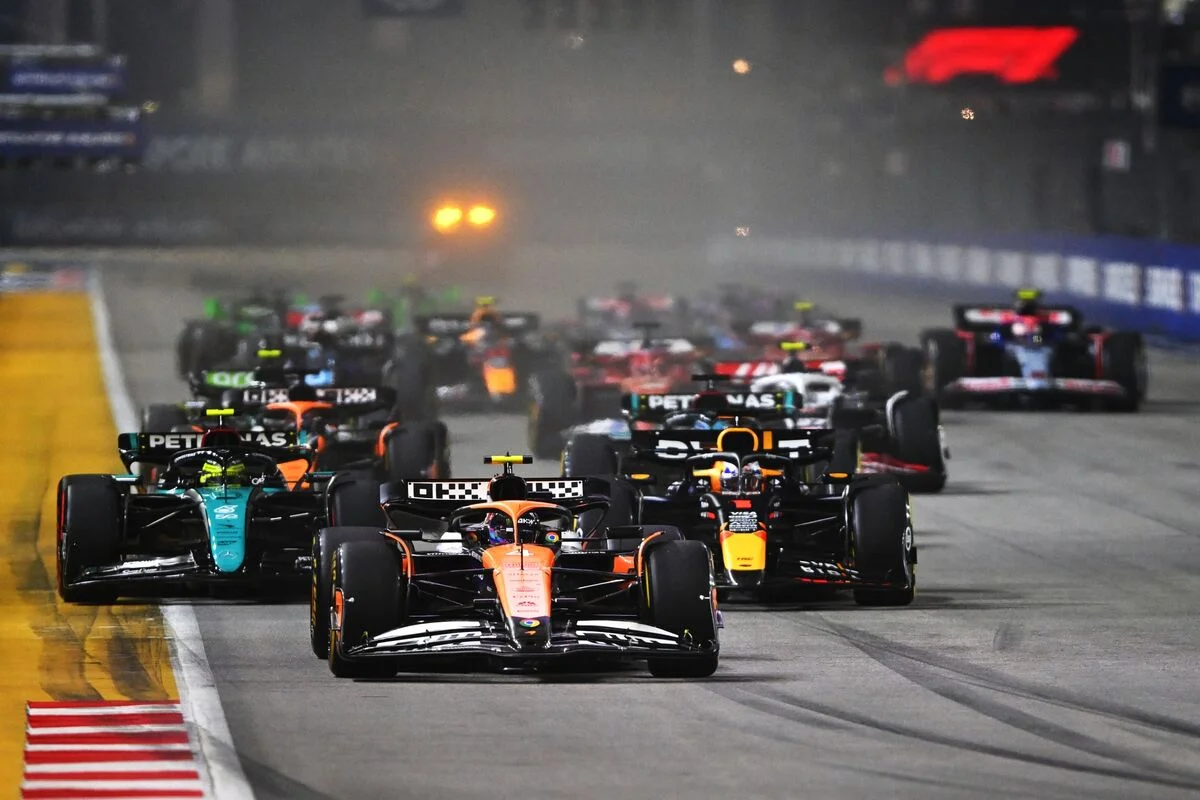

Netflix’s docuseries Drive to Survive has played a crucial role in expanding Formula 1’s fan base in the United States, but recent viewership data suggest a potential shift in the platform’s approach may be forthcoming. New insights from Netflix highlight that although Drive to Survive remains highly popular, its audience growth is decelerating amid growing interest in live sports streaming.
An internal Netflix report spanning January to June 2025 offers revealing statistics about the continued but slowing momentum of the series and hints at broader strategic changes for the streaming service’s sports content offerings.
Viewing Patterns Reveal Slowdown in Drive to Survive Engagement
According to data published by Sports Business Journal, season 7 of Drive to Survive sustained its position as Netflix’s most-watched sports documentary, accumulating 10.4 million views during the first half of 2025. This figure notably surpasses other popular Netflix sports documentaries, including Court of Gold with 6.6 million views and Full Swing season 3 with 4.1 million views.
Despite these impressive totals, the 10.4 million views represent a 10.3 percent drop compared to the same timeframe in 2024. When examining the amount of consumed viewing hours, a 16 percent decline is observed in 2025 compared to the previous year’s season 6.
This gradual decline may reflect a shifting audience interest, as Netflix has not historically provided detailed viewership reports, making precise year-over-year comparisons for Drive to Survive challenging.
Understanding the Rise and Recent Plateau of Formula 1 in the U.S.
The surge in Formula 1’s American following can largely be traced back to coinciding factors occurring around 2020. The COVID-19 pandemic caused lockdowns, confining many citizens to their homes and leading to increased consumption of streaming content. Drive to Survive had released a new season shortly before this period, introducing many U.S. viewers to Formula 1 for the first time with its dramatic and glamorous presentation of the sport.
Moreover, Formula 1 was one of the first live sports to resume competitions during the pandemic, filling the void left by other sports suspended by health restrictions. Fans craving the shared social experience of watching live events found Formula 1 accessible and exciting, amplified by social media conversations.
This increasing enthusiasm was further energized when record crowds gathered at the Circuit of The Americas for the 2021 United States Grand Prix. The sport’s rising profile led to the addition of new events in Miami and Las Vegas and resulted in multiple American sponsorships, along with an increase in localized content tailored to the U.S. audience.
However, this rapid expansion of interest appears to be leveling off, prompting Netflix to explore alternative methods of engaging sports fans on its platform.
Netflix’s Foray into Live Sports and Its Impact on F1 Broadcasting
In early 2025, Netflix made a significant move by acquiring rights to air WWE’s weekly Raw broadcasts on Monday nights, which has attracted strong viewership. The debut episode on January 6 reached 6.9 million views, and the following week saw 4.4 million views, quickly surpassing Drive to Survive’s weekly average during the same period in 2025.
Collectively, WWE Raw has generated 88.6 million views so far in 2025, averaging 3.4 million views per broadcast, proving the appeal of live sports on streaming platforms. This success raises questions about how Netflix might approach Formula 1’s streaming rights going forward.
With ESPN’s contract as Formula 1’s American broadcast partner concluding at the end of 2025, the rights are ripe for acquisition. While ESPN could renew, indications suggest it is increasingly likely these rights will transition to a streaming giant such as Netflix or Apple. Both platforms have indicated strong interest: Netflix aims to leverage the Drive to Survive momentum, while Apple seeks to capitalize on the popularity generated by F1: The Movie.
Live sports broadcasts on streaming services remain relatively new, but Netflix notably pushed boundaries by airing two NFL games live on Christmas Day 2024, drawing an impressive 65 million viewers in the U.S. alone. Other platforms have followed Netflix’s lead, recognizing the appeal of live content alongside on-demand programming.
Given their investments and strategies, Netflix and Apple are well positioned to become central hubs for Formula 1 content in the United States, continuing to grow the sport’s audience even amid current viewership plateaus.
What This Means for the Future of Formula 1 Viewing
The evolving landscape of sports broadcasting suggests that Drive to Survive’s role as the primary driver of Formula 1’s popularity in the U.S. may be complemented or even surpassed by livestream rights on major streaming platforms. Netflix’s initial experimentation with WWE Raw and its NFL broadcast success point to a new era where live events could attract larger, more engaged audiences than sports documentaries alone.
As the ESPN broadcast arrangement ends, the acquisition of Formula 1 rights by streaming services like Netflix or Apple could change how American viewers access and experience the sport, potentially integrating live races, documentaries, and exclusive behind-the-scenes content under a single digital roof.
This shift could also influence how Formula 1 markets itself in the United States, aiming to sustain the gains achieved during the pandemic-fueled surge and to attract diverse viewers through innovative streaming experiences.
Our Reader’s Queries
Q. Is number 13 banned in F1?
A. Sure, the number 13 is permitted. Actually, when Formula 1 introduced permanent numbers in 2014, Pastor Maldonado chose to use #13. While some cultures view 13 as unlucky, F1 lets drivers decide their numbers.
Q. Which F1 driver has ADHD?
A. Lewis Hamilton, a British racing driver born in 1985, competes in Formula One. He currently drives for Mercedes and has previously driven for McLaren. Hamilton openly talks about his experiences with ADHD and shares his wide range of interests and hobbies.
Q. Is 69 allowed in F1?
A. At present, drivers can choose any number from 0, 2 through 99 for their careers. However, only a World Champion can use the number 1. If a driver hasn’t raced for two seasons, their number can be reassigned, except for the number 1.
Q. Which F1 drivers have ADHD?
A. Lewis Hamilton. Born in 1985, Sir Lewis Carl Davidson Hamilton MBE HonFREng is a British Formula One driver for Mercedes. He previously raced for McLaren. Hamilton openly talks about his experience with ADHD and shares details about his wide range of interests and passions.