
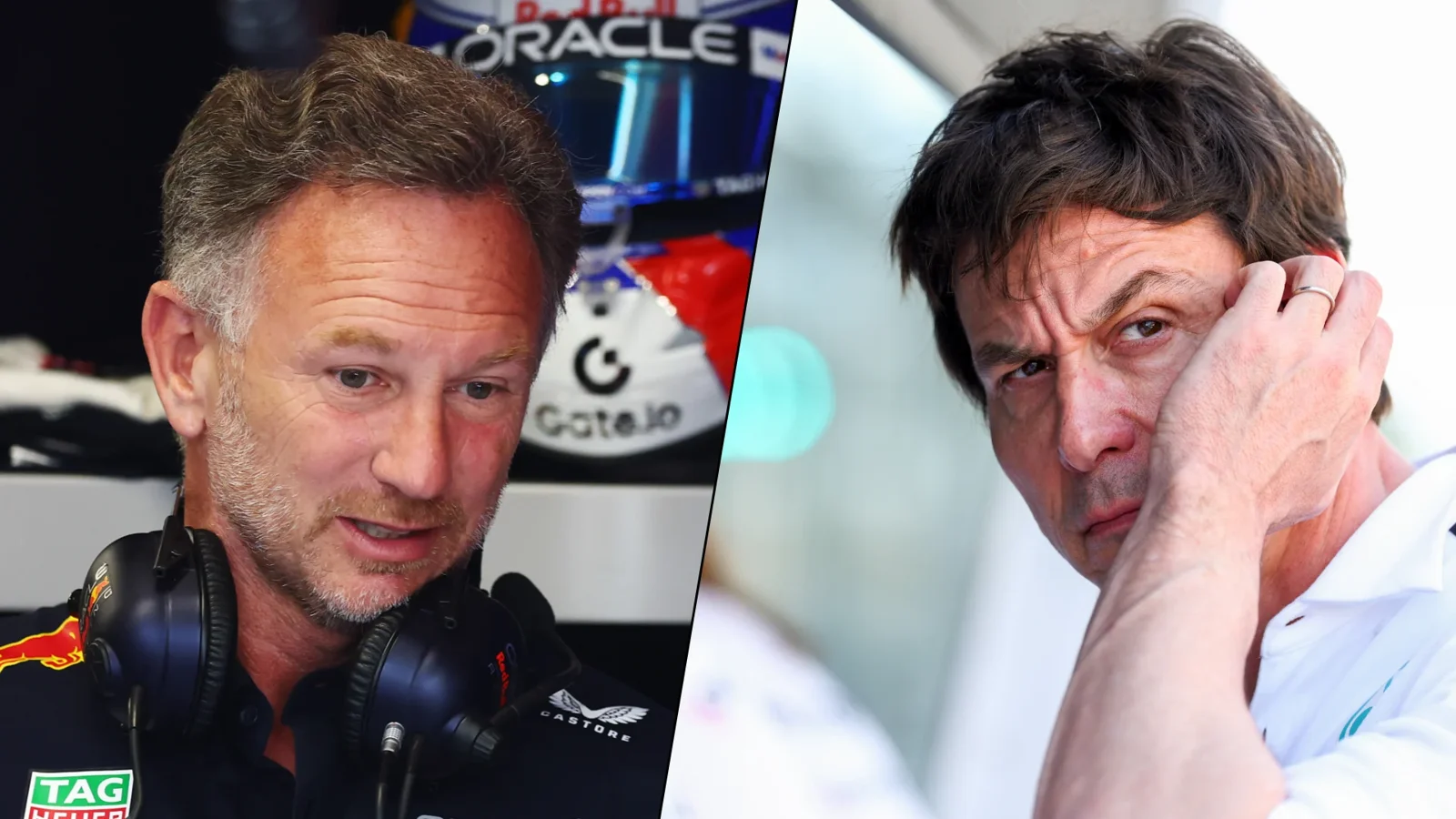

Christian Horner, former Red Bull Racing team principal, reportedly struggled with feelings of being overshadowed by Mercedes counterpart Toto Wolff, according to F1 insider Peter Hardenacke. After more than twenty years leading Red Bull from its base in Milton Keynes, Horner’s departure followed speculation about internal power struggles and his apparent frustration over Wolff’s growing prominence and public recognition.
Growing Fame and Its Impact on Christian Horner
The rise of Formula 1’s popularity through Netflix’s Drive to Survive greatly increased the recognition of team principals, including Christian Horner. Hardenacke suggests that this exposure contributed to Horner losing perspective outside the racetrack, as he began to see himself as a prominent figure beyond the F1 community. The 51-year-old’s increased visibility might have led to an inflated sense of status, especially in comparison to Toto Wolff’s rising fame.
“I think that Drive to Survive also played a part in it, in the sense that he eventually lost touch with reality.”
—Peter Hardenacke, F1 insider (Backstage Boxengasse podcast)
Hardenacke recounted a notable incident highlighting Horner’s frustration. Horner reportedly reacted sharply after learning that ServusTV, Red Bull’s own home broadcaster, produced an episode focusing on Toto Wolff’s career path instead of featuring him. This stirred anger, as Horner was astonished by the lack of similar treatment for his own story within the network.
“There was once an episode of ServusTV — the home broadcaster of Red Bull — about Toto Wolff, the team boss of Mercedes. Christian Horner apparently saw that, and he supposedly astoundingly called demanding why they had never featured him.”
—Peter Hardenacke, F1 insider (Backstage Boxengasse podcast)
The Differences Between Horner and Wolff’s Roles in Formula 1
Christian Horner held the title of Red Bull Racing team principal for over two decades, steering the team through a dominant era with multiple championship wins. However, his influence within Red Bull was distinct from Toto Wolff’s, who holds a dual role as team principal and shareholder alongside Mercedes and INEOS. While Horner was seen as the face of Red Bull Racing, he never gained the same level of ownership or corporate influence as Wolff, which may have contributed to his rising sense of dissatisfaction and desire for greater control.
Success and Its Effects on Horner’s Perception
Having led Red Bull to eight drivers’ championships and six constructors’ titles, Horner’s accomplishments are undeniable. Yet, former Formula 1 driver Ralf Schumacher pointed out that the overwhelming success experienced during Max Verstappen’s winning streak could have affected Horner’s mindset. Schumacher explained that constant praise might have inflated Horner’s ego, causing him to become somewhat detached from reality.
“You can hold it against him — I’d argue you could even somewhat justify it, because at some point, it just becomes too much for one person. Don’t forget: everyone is singing your praises. And Red Bull with Max Verstappen, that was of course incredibly successful. The success can easily go to your head.”
—Ralf Schumacher, former F1 driver (Backstage Boxengasse podcast)
This dynamic illustrates the intense pressures and challenges team principals face in managing both their teams’ performance and their personal image. For Horner, success seemed to coincide with a growing difficulty in balancing fame with humility, a struggle less apparent in Wolff’s case due to his broader ownership role and corporate backing.
Rising Tensions and the Power Struggle at Red Bull
In recent years, rumors circulated that Horner sought to increase his sway within Red Bull Racing significantly. Some speculated that the team was sometimes referred to as ‘Horner Racing’ due to his dominating presence. Despite this, his position was fundamentally different from Wolff’s, as Wolff’s shareholder status granted him more substantial authority both on and off the track. This disparity in influence may have fueled Horner’s frustration, particularly in light of his perceived lower public profile despite his long tenure and achievements.
Ultimately, these internal tensions and Horner’s apparent fixation on the public recognition enjoyed by Wolff contributed to his exit from Red Bull, marking the end of an era for the team. His departure underscores the complex interplay between leadership, fame, and the evolving landscape of Formula 1 personalities fueled by media exposure.
The Broader Significance for Formula 1 Leadership
Christian Horner’s experience highlights the challenges faced by top Formula 1 executives in managing their careers amid increased media attention and competition for celebrity status. While success on the track remains paramount, maintaining balance and perspective is crucial to enduring leadership. Horner’s story serves as a reminder that visibility and influence extend beyond race results, shaped heavily by public perception and internal dynamics within teams.
As the sport progresses and personalities continue to gain prominence through platforms like Drive to Survive, leadership roles may shift, reflecting not only sporting success but also media presence and corporate structures. For Red Bull and other teams, this evolving environment will demand adaptability from their leaders to navigate fame and maintain performance.
Our Reader’s Queries
Q. Is number 13 banned in F1?
A. Yes, the number 13 is permitted. Pastor Maldonado chose #13 when the permanent number system started in 2014. Although some cultures see it as unlucky, F1 let drivers pick their numbers.
Q. Which F1 driver has ADHD?
A. Lewis Hamilton, born in 1985, is a British Formula One driver for the Mercedes team and previously drove for McLaren. He openly talks about having ADHD and shares his wide-ranging interests and hobbies.
Q. Is 69 allowed in F1?
A. Rules for Picking an F1 Driver Number:
A driver can select a permanent number between 2 and 99, except for 17, to use during their F1 career.
Q. Which F1 drivers have ADHD?
A. Lewis Hamilton, also known as Sir Lewis Carl Davidson Hamilton, is a British Formula One driver born in 1985. He currently races for the Mercedes team and has previously driven for McLaren. Hamilton openly talks about having ADHD while exploring various interests and passions.