
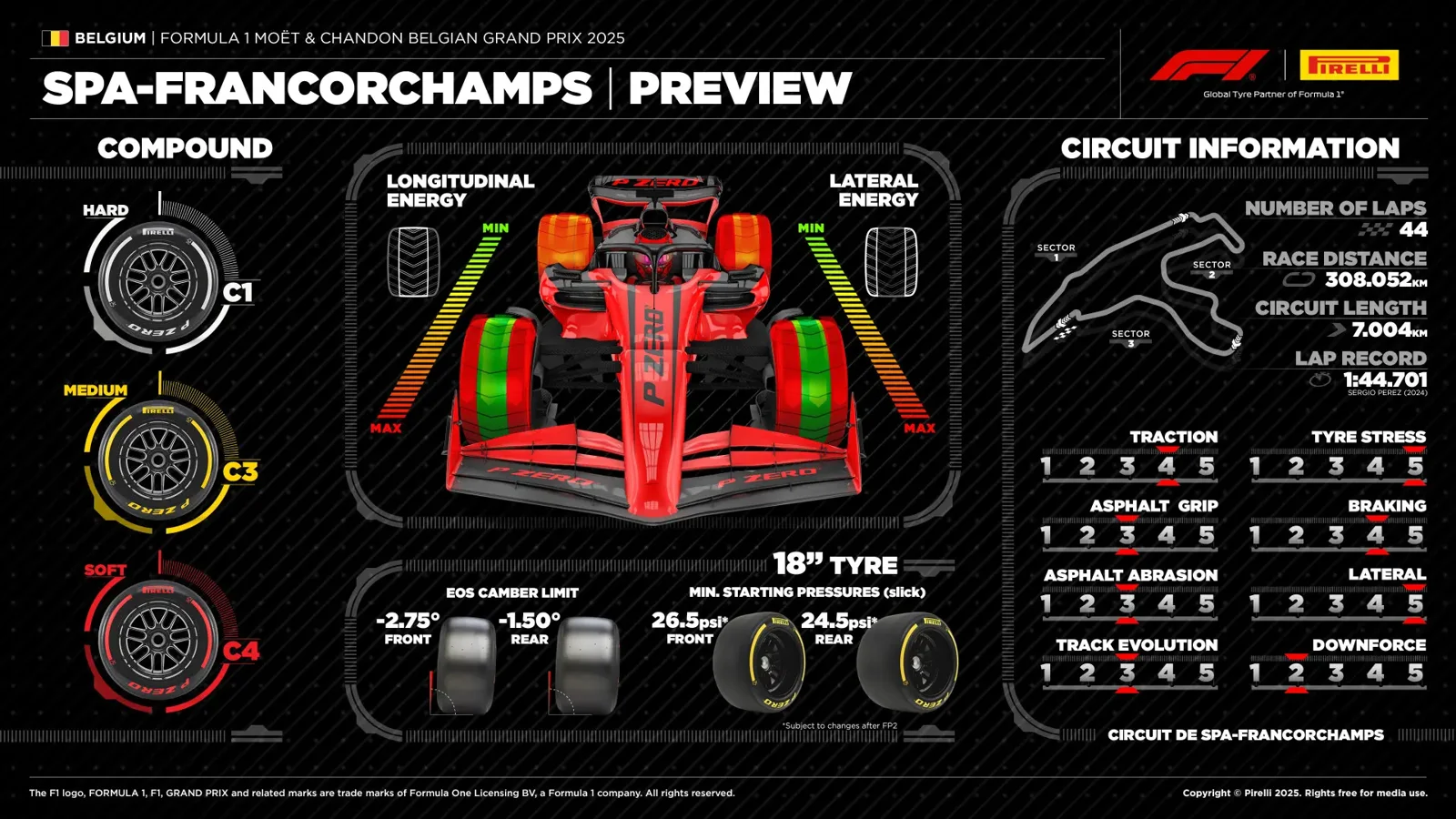

Formula 1 resumes this weekend after a two-week break with the Belgian Grand Prix, featuring a Belgian Grand Prix unique tire strategy that has not been seen since the 2022 Australian Grand Prix. Pirelli, the exclusive tire supplier for the sport, has announced the allocation of tire compounds for the event, introducing a non-consecutive tire selection that stands out from recent races.
Pirelli’s Tire Compound Selection Breaks the Recent Pattern
This season, Pirelli offers six slick tire compounds labeled C1 through C6, arranged from hardest to softest. Each race features three designated compounds categorized as hard, medium, and soft tires. For instance, at the recent British Grand Prix, the options were C2 (hard), C3 (medium), and C4 (soft), while in Austria, the selection shifted to C3 (hard), C4 (medium), and C5 (soft).
For the Belgian Grand Prix, Pirelli has assigned the C1 as the hard tire, skipped the C2, selected C3 as the medium, and C4 as the soft. This non-consecutive arrangement has not been used since the 2022 Australian Grand Prix, when Pirelli chose C2, C4, and C5 for hard, medium, and soft respectively.
Implications for Race Strategies and Pit Stops
This unique combination is expected to encourage a two-stop strategy, differing from some prior approaches. Last year at Spa, Pirelli designated C2 as hard, C3 as medium, and C4 as soft. George Russell managed a daring one-stop strategy by pitting early and running the remaining laps on C2 hard tires. Although he crossed the line first, Russell was later disqualified because his car failed the post-race minimum weight requirement.
This disqualification was likely influenced by the prolonged use of the hard tires, which caused unusual tire wear and increased rubber loss. Additionally, the Spa circuit does not have a cooldown lap after the race; drivers immediately return to the pit lane at Turn 1, restricting their ability to collect extra rubber on the tires, which could have helped achieve the required weight.
What This Means for the Upcoming Race at Spa
With this new set of compounds, teams must adapt their strategies carefully to balance tire performance and race demands. The presence of the hardest C1 tire along with a jump to C3 and C4 compounds creates different durability and grip dynamics that could reshape how teams approach pit stops and tire management.
The Belgian Grand Prix unique tire strategy introduces an element of unpredictability, testing the teams’ ability to optimize their race plans amid these distinct choices.
How this decision will impact the race outcome and whether a new approach to stints and pit stops will emerge remains to be seen as the weekend unfolds at Spa.
Our Reader’s Queries
Q. Is number 13 banned in F1?
A. Yes, 13 is allowed. Pastor Maldonado actually picked number 13 when the permanent numbering system started in 2014. Even though some cultures think 13 is unlucky, F1 let drivers choose their numbers.
Q. Which F1 driver has ADHD?
A. Lewis Hamilton, born in 1985, is a British Formula One driver for Mercedes. Previously, he raced for McLaren. He openly talks about his experience with ADHD and shares his various hobbies and interests.
Q. Is 69 allowed in F1?
A. F1 drivers are allowed to select a permanent number for their racing career, ranging from 2 to 99, except for the number 17.
Q. Which F1 drivers have ADHD?
A. Lewis Hamilton is a British race car driver born in 1985. He competes in Formula One for Mercedes and has raced for McLaren. Hamilton openly talks about living with ADHD and shares his varied interests and hobbies.