

As teams constantly search for any advantage, F1 2025 technical innovations are shaping how cars perform on the track this season. From Australia to the Canadian Grand Prix, designers have introduced clever changes to key areas, pushing the limits of the regulations to optimize airflow and cooling.
Williams’ Innovative Rear Mini-Wing
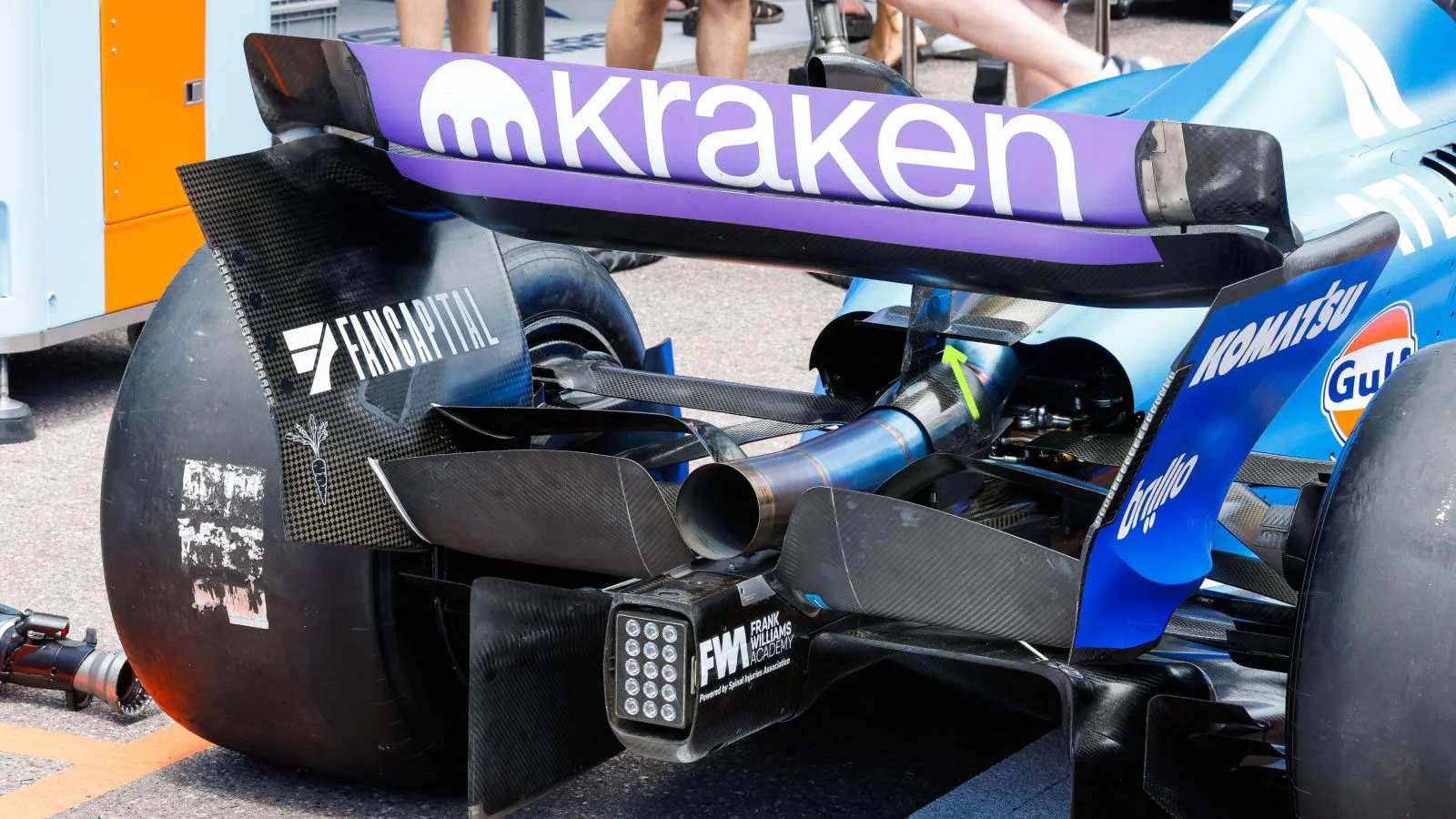
Williams began the season by adding a compact winglet attached beside the rear wing support pillar, located above the exhaust outlet. This mini-wing resembles the ‘Monkey seat’ from the V8 era but serves a modern purpose by streamlining the surrounding airflow structures. Although only used occasionally, Williams combines this feature with high downforce rear and beam wing setups to enhance aerodynamic efficiency.
Aston Martin’s Halo Airflow Improvement
Aston Martin has implemented a subtle yet effective modification near the rear leg of their halo. A narrow vertical slot redirects airflow that would normally escape around the halo’s fairing, allowing it to flow inward instead. This adjustment reduces aerodynamic losses in this region, contributing to a cleaner airflow profile and improved performance.
Sauber’s Advanced Sidepod Design
At the Australian Grand Prix, Sauber unveiled a novel sidepod layout that rethinks geometric boundaries. The design adds a secondary protrusion beneath the sidepod inlet, sized similarly to the mid-wing positioned above. This extension improves cooling by altering the inlet’s shape and refines the airflow around the sidepod’s shoulder, creating a more efficient aerodynamic package.
Red Bull’s Sidepod and Mid-Wing Enhancements
Red Bull joined the trend of sidepod innovation at the Emilia Romagna Grand Prix, introducing a new vane within the undercut area. This feature works alongside a redesigned mid-wing at the front of the sidepod, a solution resembling designs pioneered by McLaren. The mid-wing’s outer tip also intersects with the mirror stalk, allowing for a more integrated aerodynamic structure. Together, these updates guide air more effectively underneath and around the sidepod, improving flow downstream.
McLaren’s ‘Mermaid Tails’ Front Wing Upgrade
McLaren launched a fresh front wing concept at the Canadian Grand Prix focusing on the junction where the outboard flaps meet the endplate. This area has been a hotbed of development due to the complex airflow interactions involved. Building on ideas from Mercedes’ earlier semi-detached flap tip designs, McLaren replaced curved flap tips with straighter ones and added a series of small winglets nicknamed ‘mermaid tails.’ This approach refines the outwash generated, helping to direct airflow more precisely and enhance overall front-end aerodynamic performance.
These technical developments demonstrate how teams continue to explore every allowable space on their cars, creatively tackling aerodynamic challenges. By refining airflow control around critical components like the rear wing, halo, sidepods, and front wing, they gain valuable tenths of a second on track, which can translate to improved race results.
As the season advances, teams are expected to further develop these concepts or introduce new ones inspired by rival innovations, maintaining a relentless pursuit of competitive edge within the constraints set by the FIA. The innovations highlighted here not only reflect engineering ingenuity but also signify the subtle battles fought in the aerodynamic arena throughout F1 2025.
Our Reader’s Queries
Q. Is number 13 banned in F1?
A. Certainly, the number 13 can be used. Pastor Maldonado selected #13 when Formula 1 introduced the permanent number system in 2014. While some people think this number brings bad luck, F1 lets drivers choose their own numbers.
Q. Which F1 driver has ADHD?
A. Born in 1985, Lewis Hamilton is a British driver who races in Formula One. He currently drives for Mercedes but has also raced for McLaren. He openly talks about living with ADHD and explores his wide range of interests and passions.
Q. Is 69 allowed in F1?
A. In F1, drivers can pick a permanent racing number between 2 and 99, except for 17, for their entire career.
Q. Which F1 drivers have ADHD?
A. Lewis Hamilton is a well-known British race car driver born in 1985. He currently competes in Formula One for Mercedes and previously raced for McLaren. Open about his ADHD, Hamilton also shares his wide range of interests and hobbies.