
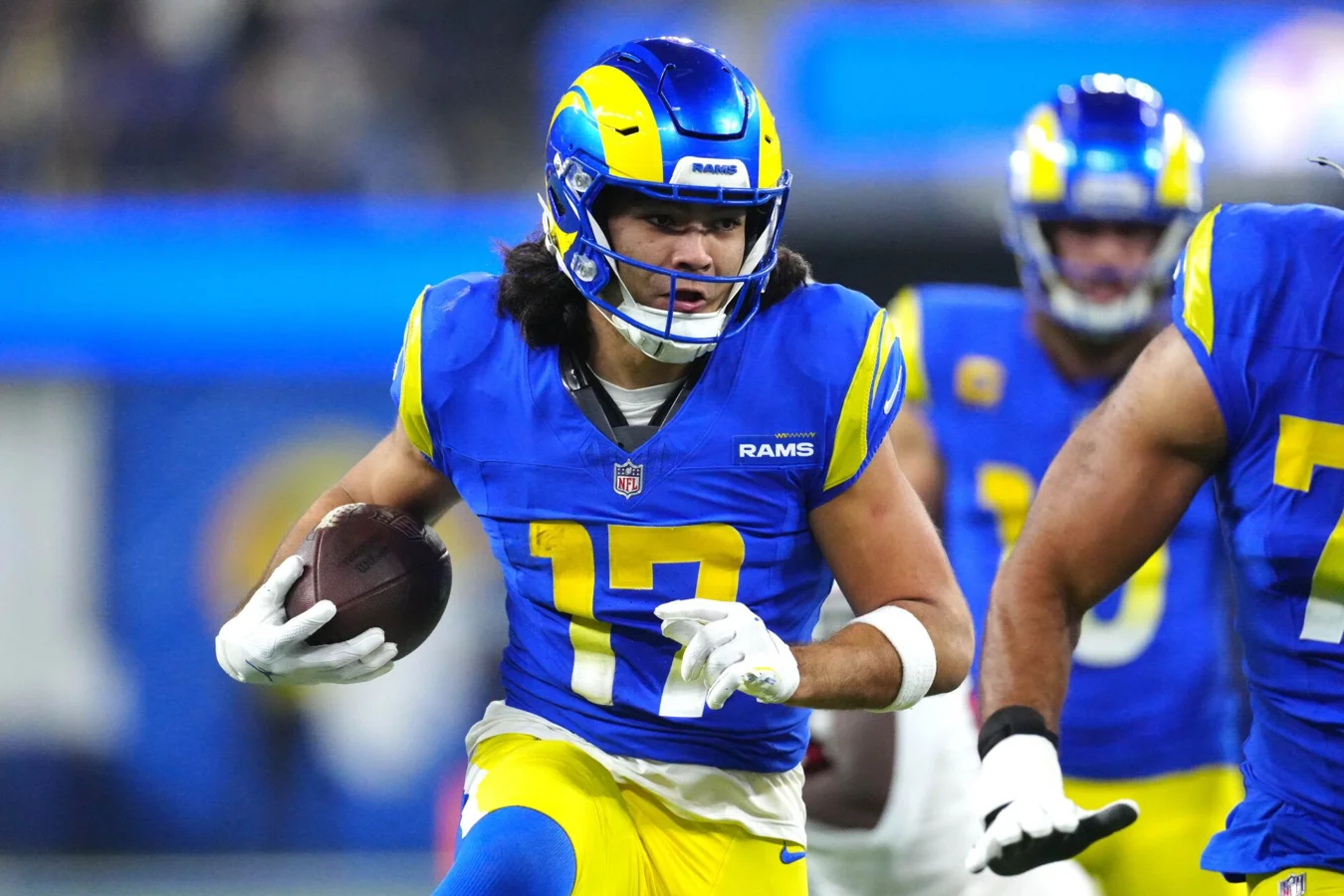

The Los Angeles Rams approach the 2025 season as strong NFC contenders, supported by a youthful core eager to build on recent success. Veteran quarterback Matthew Stafford remains central to their strategy, while rising talents like Puka Nacua and Kyren Williams continue to develop. Amidst this skilled group, a seventh-round rookie, Konata Mumpfield, has the potential to carve out a significant role resembling the breakthrough that Nacua experienced two seasons ago.
Examining Konata Mumpfield’s Chances to Rise
The Rams’ offensive weapons feature standout receivers such as Puka Nacua and Davante Adams, bolstered by the offseason arrival of Adams, which was hailed as a top free agency move. Stafford’s recent contract extension commits him to leading this dynamic unit as he pursues a second Super Bowl appearance before concluding a Hall of Fame-worthy tenure. Within this framework, Mumpfield looks to emulate Nacua’s rookie-year surge and quickly become an impactful piece in Sean McVay’s offense.
Mumpfield draws attention for his exceptional route-running skills, a quality highly valued in the Rams’ passing scheme that Stafford thrives in. Analyst Jacob Infante noted,
“The Los Angeles Rams have their top two wide receivers lined up in Puka Nacua and Davante Adams. They signed Tutu Atwell to a one-year, $10 million extension, but he hasn’t lived up to his second-round billing. Seventh-round rookie Konata Mumpfield might not take the job right away, but he’s a route-running savant who could shine in practice.”
—Jacob Infante, PFSN writer
Comparing Mumpfield’s Path to Nacua’s Historic Start
During his last collegiate season at Pittsburgh, Mumpfield posted impressive stats, gaining 813 receiving yards and scoring five touchdowns in 12 games. Although drafted late at pick No. 242 by the Rams, his skill set suggests potential beyond typical expectations for such a selection. This mirrors Nacua’s rise, who, despite being chosen 177th overall, set a remarkable <a href=”https://www.buzzineintl.com/category/football/nfl/”>NFL rookie record with 1,486 receiving yards in his first year.
McVay’s offense relies heavily on receivers who excel at precise route-running and fit well within formations featuring three wideouts, particularly the 11 personnel grouping. Currently, Tutu Atwell occupies the WR3 spot in this setup, where Mumpfield could challenge for playing time and gradually establish himself in the rotation. The Rams’ emphasis on this type of receiver bodes well for Mumpfield’s prospects to follow in Nacua’s footsteps.
Implications for the Rams’ Offensive Future
Konata Mumpfield’s potential rise is significant for the Rams as they look to sustain momentum and deepen their receiving corps behind established figures like Nacua and Adams. Should he replicate Nacua’s breakthrough, the Rams would gain valuable depth and flexibility in a competitive NFC landscape. This development could play a critical role in keeping the Rams’ offense potent and unpredictable throughout the 2025 campaign and beyond.
Our Reader’s Queries
Q. Why does Puka Nacua cry?
A. The story is heartwarming: Puka’s father, Lionel Nacua, passed away from diabetes when Puka was just 11 years old. His dad hoped Puka would play in the NFL someday. Now, whenever Puka plays, he fondly remembers his dad and expresses his emotions.
Q. What is Puka Nacua’s nationality?
A. Nacua’s family background includes Samoan, Hawaiian, and Portuguese roots. As a baby, he was called “Puka,” a Samoan word meaning fat and chubby, because of his size. He was raised in Provo, Utah, and went to Orem High School in Orem, Utah.
Q. Is Puka Nacua an ethnicity?
A. Early life. Nacua comes from Samoan, Hawaiian, and Portuguese backgrounds. As a baby, he was nicknamed “Puka,” which means fat and chubby in Samoan, because of his size. He was raised in Provo, Utah, and went to Orem High School in Orem, Utah.
Q. What nationality is Puka Nacua?
A. Nacua comes from Samoan, Hawaiian, and Portuguese backgrounds. When he was a baby, he was given the nickname “Puka,” which means fat and chubby in Samoan, because of his size.