
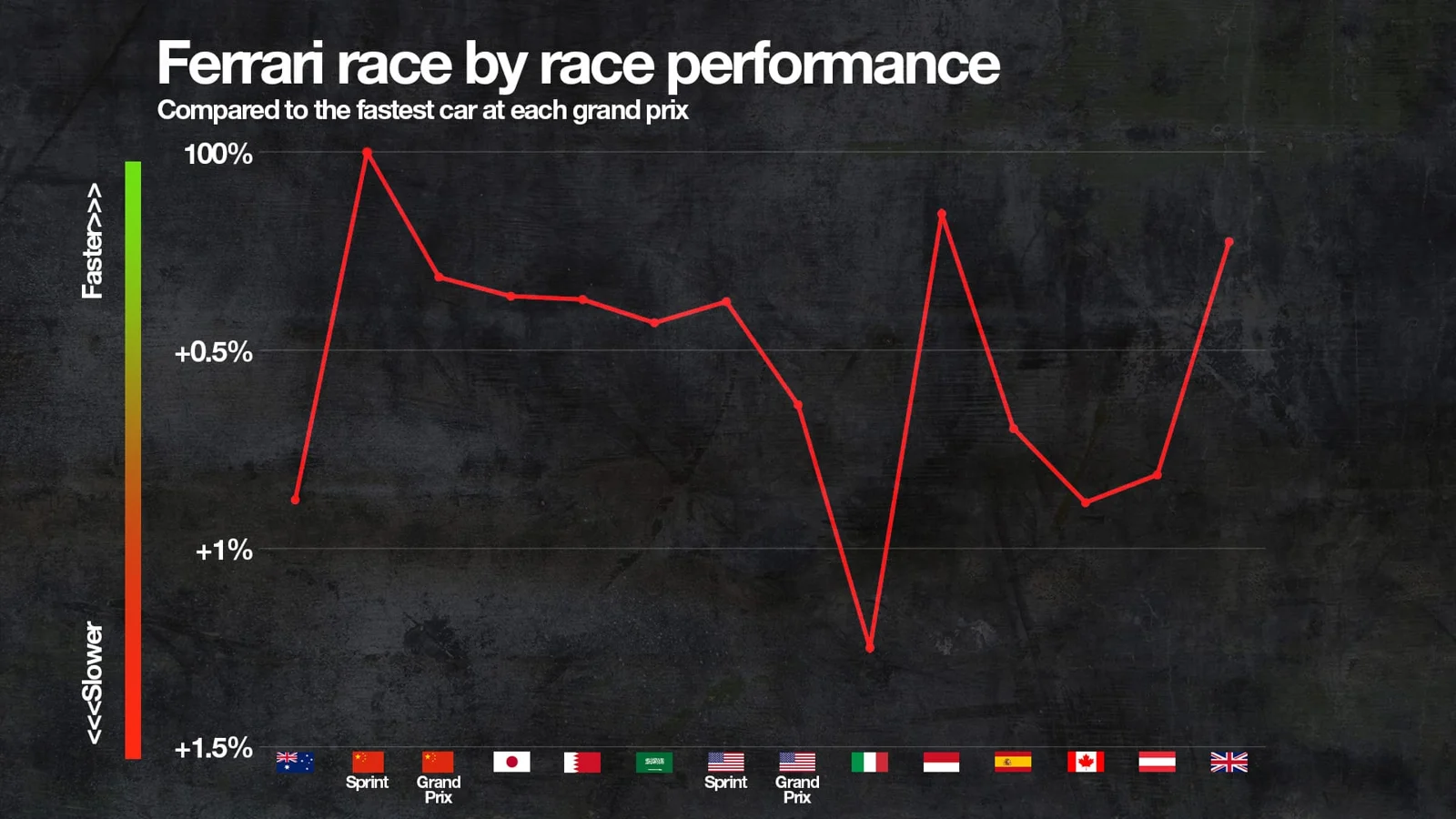

Ferrari is preparing a significant rear suspension upgrade at Spa following a floor enhancement introduced at Silverstone, as the team seeks to unlock the full potential of its SF25 car for the 2025 Formula 1 season. Expert Gary Anderson has highlighted these developments, which could mark a turning point in Ferrari’s challenging campaign.
The upgraded rear suspension features a lower mounting point for the front upper wishbone and promises to improve anti-lift characteristics. When combined with possible adjustments to the central damper, these changes could allow the SF25 to run at lower ride heights—an adjustment previously hampered by issues such as the China plank-wear disqualification earlier this year.
Early Signs of Progress and Lingering Qualifying Challenges
Initial results from the Silverstone floor upgrade indicate gains in speed and handling for Ferrari, although the team still faces a notable 0.388-second average qualifying deficit behind McLaren this season. Driver Charles Leclerc has hinted at underlying technical difficulties affecting performance, especially during the critical final stages of qualifying.
Leclerc’s comments after Silverstone suggested unresolved complications, particularly in the quickest qualifying round (Q3), where the car appeared less competitive. These issues seem more linked to power unit behavior than to mechanical or steering problems.
Potential Causes Explored for Ferrari’s Speed Limitations
Two main theories have emerged to explain Ferrari’s unsteady performance on fast circuits. One theory suggests that engine internal temperatures fluctuate during sustained full-throttle periods, triggering automatic power adjustments to avoid overheating, which reduces peak performance. Another hypothesis focuses on battery drain during flat-out running, potentially limiting the car’s ability to deploy electrical power effectively during crucial laps.
Comparing Ferrari’s lap times between Q2 and Q3 reveals a troubling trend: the team is not gaining as much time as its rivals in the final qualifying rounds. This setback raises concerns about the SF25’s ability to consistently deliver maximum power output when it matters most.
What’s Next for Ferrari’s 2025 Title Bid?
As Ferrari works to resolve these technical bottlenecks and fully realize the SF25’s capabilities, forthcoming races will provide an important test of their progress. The team faces pressure to close performance gaps with competitors like McLaren and Red Bull and to prove they can contend for victories this season.
“The new rear suspension design boasts a lower mounting point for the front upper wishbone, promising to deliver an enhanced anti-lift effect on the car.” —Gary Anderson, F1 Technical Analyst
“Leclerc’s cryptic comments after the Silverstone qualifying session alluded to unspoken challenges faced by the team, particularly in the latter stages of qualifying rounds.” —Gary Anderson, F1 Technical Analyst
Our Reader’s Queries
Q. Is number 13 banned in F1?
A. Yes, using the number 13 is permitted. Pastor Maldonado chose #13 when the fixed number system started in 2014. Although some cultures see 13 as unlucky, F1 lets drivers decide.
Q. Which F1 driver has ADHD?
A. Lewis Hamilton, born in 1985, is a British Formula One driver for Mercedes. He previously drove for McLaren. He openly talks about having ADHD and shares his various interests and passions.
Q. Is 13 banned in F1?
A. F1 Driver Number Rules for Choosing a Number: Drivers can select a permanent number from 2 to 99, except 17, for their entire F1 careers.
Q. Which F1 drivers have ADHD?
A. Lewis Hamilton is a British racing driver, born in 1985, who competes in Formula One. He races for Mercedes and has also driven for McLaren. He openly talks about his experiences with ADHD and shares his wide range of interests and passions.