

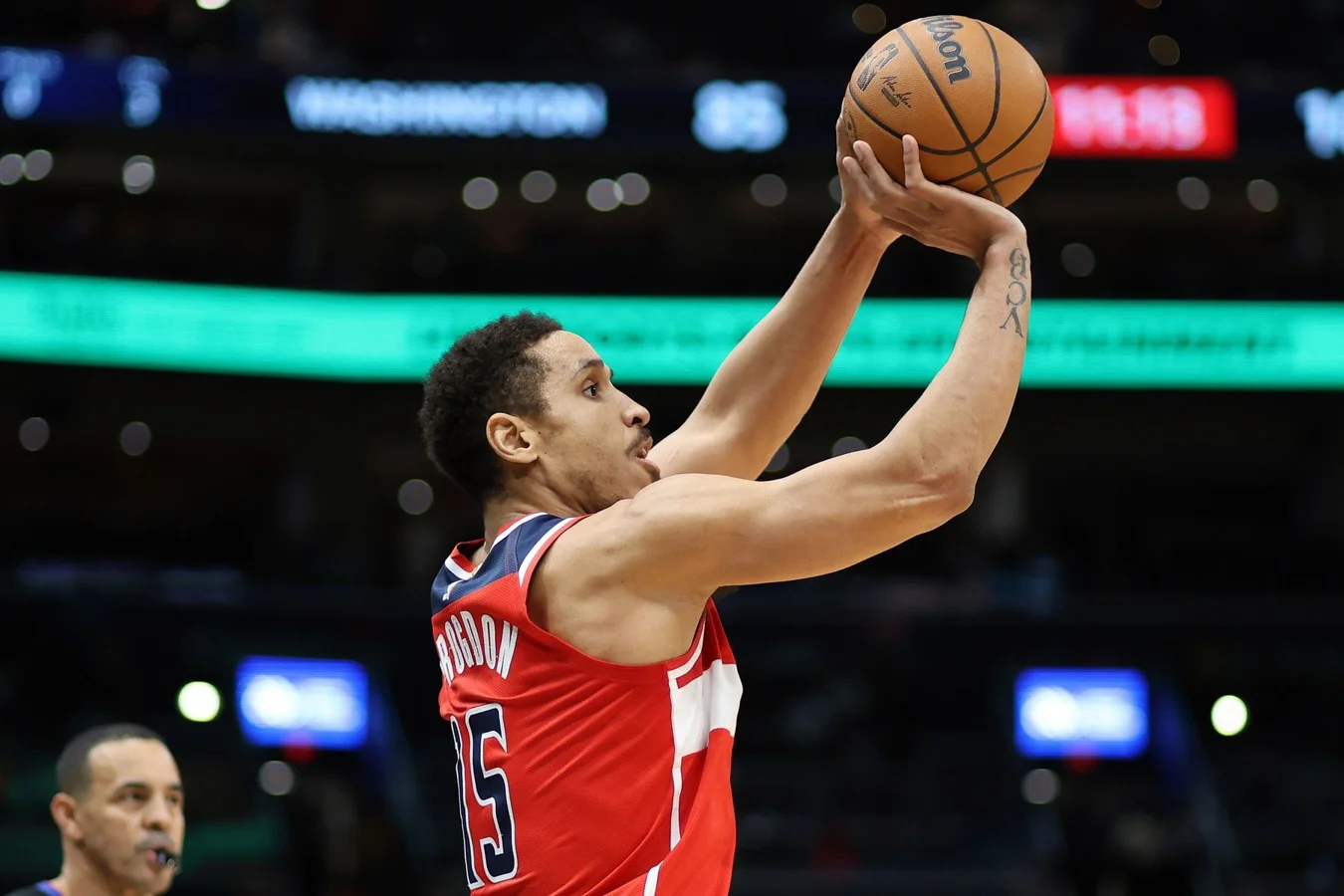
Malcolm Brogdon’s identity is deeply entrenched in African American history, shaping not only his persona but also his activism. Born into a family with a strong legacy of civil rights involvement, Brogdon’s great-grandfather was a pastor who advocated for justice, and his grandfather worked closely alongside Dr. Martin Luther King Jr. during the civil rights movement of the 1960s. This lineage provided Brogdon with a living history of struggle and perseverance that influenced his values well before he stepped into <a href=”https://www.buzzineintl.com/category/basketball/nba/”>NBA arenas.
Raised by his parents, Mitchell and Dr. Jann Adams, in Atlanta, Brogdon experienced a unique childhood where the family intentionally chose to live in inner-city neighborhoods rather than comfortable suburban areas. This decision was aimed at giving Malcolm and his brothers firsthand experience of inequality and systemic challenges. Brogdon reflected on this choice, saying,
“It was one of the best moves my parents ever made,”
highlighting how this upbringing fostered his empathy and understanding of privilege and community.
From a young age, Brogdon’s exposure to global issues further expanded his sense of purpose. Volunteering in Ghana at age 10 and Malawi at 14, he witnessed poverty that echoed the challenges faced by many in his own country. These experiences fueled his dedication to humanitarian causes, especially concerning education and access to clean water. His African American ethnicity, therefore, represents more than a demographic—it is a driving force behind his commitment to social change, particularly through his foundation’s work.
Malcolm Brogdon’s American Nationality and its Influence on His Activism
Born on December 11, 1992, in Atlanta, Georgia, Malcolm Brogdon is a proud American whose nationality is inseparable from his dedication to fighting domestic injustices. His parents, Mitchell—an attorney—and Jann Adams—a dean at Morehouse College—both American citizens, embedded strong Southern values and a sense of duty in him. Brogdon actively uses his platform to confront issues like voting rights and educational inequality, seeing nationality as a responsibility rather than a mere status.
Growing up near the King Center and Morehouse College, where his mother worked, Brogdon absorbed civil rights history from his surroundings. Reflecting on this, he shared,
“I grew up in this environment… you understand it’s special,”
illustrating how these landmarks deeply impacted his worldview. His activism is not merely symbolic; it is rooted in a profound hometown pride that drives his efforts both nationally and abroad.
Now a seasoned NBA player, Brogdon extends his American identity globally, organizing tours for teens at historically Black colleges and universities (HBCUs) in Indianapolis and speaking on policy issues. He insists, “We are transforming people’s lives,” emphasizing how he uses his voice where it matters most. His nationality motivates him to represent Atlanta’s legacy, even on international stages, linking his local roots to a global mission.
The Role of Faith in Malcolm Brogdon’s Life and Activism
Faith is a crucial cornerstone for Malcolm Brogdon, rooted in the African Methodist Episcopal (A.M.E.) Church tradition. His grandfather, Bishop John Hurst Adams, was both a spiritual leader and a civil rights activist who marched alongside Dr. Martin Luther King Jr., intertwining religious conviction with social justice. This heritage profoundly influenced Malcolm’s moral perspective and his approach to life’s challenges.
Although Brogdon keeps his personal religious practices private, he openly credits his faith for providing strength during difficult times. Named after Malcolm X, Brogdon instead found deep inspiration in Martin Luther King Jr.’s message of Christian nonviolence. He remarked,
“Dr. King… is the epitome of change,”
drawing a clear connection between King’s philosophy of love and service and his own efforts to fund clean water projects, support HBCUs, and combat systemic racism.
His spiritual beliefs manifest in tangible actions through the Brogdon Family Foundation, which combines faith and service by organizing civil rights tours for students. Brogdon also stated,
“My life passion is not basketball. It’s helping people,”
underscoring his focus beyond the court. He attributes the foundation’s success to “giving it all to God,” portraying faith not as passive worship but as an active, ongoing mission directed toward positive societal change.
Why Malcolm Brogdon’s Background is Central to His Off-Court Impact
Malcolm Brogdon’s story goes beyond basketball statistics; it is one of heritage, nationality, and faith converging to create a platform for meaningful activism. His African American ethnicity, rooted in a family tradition of civil rights activism, blends seamlessly with his American identity, which fuels his commitment to address injustices at home. Meanwhile, his faith in the A.M.E. Church tradition gives him a moral framework that drives his charitable ambitions and social advocacy.
Given his upbringing in Atlanta—a city foundational to civil rights history—Brogdon represents a modern link in a long chain of advocates for justice and equality. His choice to spotlight educational equity, voting rights, and clean water access reveals how his personal legacy shapes his purpose. The intersection of his bloodline, nationality, and religion offers insight into how he balances the pressures of professional sports with an urgent mission to uplift communities.
As Brogdon continues his NBA career and expands his activism globally, his story serves as a reminder that athletes can leverage their influence far beyond their sport. Through the Brogdon Family Foundation and personal advocacy, his ongoing work promises to inspire future generations to engage with social issues—making him one of the NBA’s most impactful players off the court today.
Our Reader’s Queries
Q. How did Malcolm Brogdon win the Rookie of the Year?
A. During his first season in the NBA, Brogdon topped rookies by averaging 4.2 assists and 1.12 steals per game. He was second among rookies in both three-point shooting at 40.4% and free throw shooting at 86.5%. Additionally, he ranked third in field goal shooting with 45.7% accuracy and was fourth in scoring, averaging 10.2 points per game.
Q. Is Malcolm Brogdon good?
A. Brogdon had his best year in shooting and it was also one of the most efficient in NBA history. He became just the eighth player to achieve a 50–40–90 season, meaning he shot 50% on field goals, 40% on three-pointers, and 90% on free throws. Brogdon also led the league with a free throw percentage of .928.