
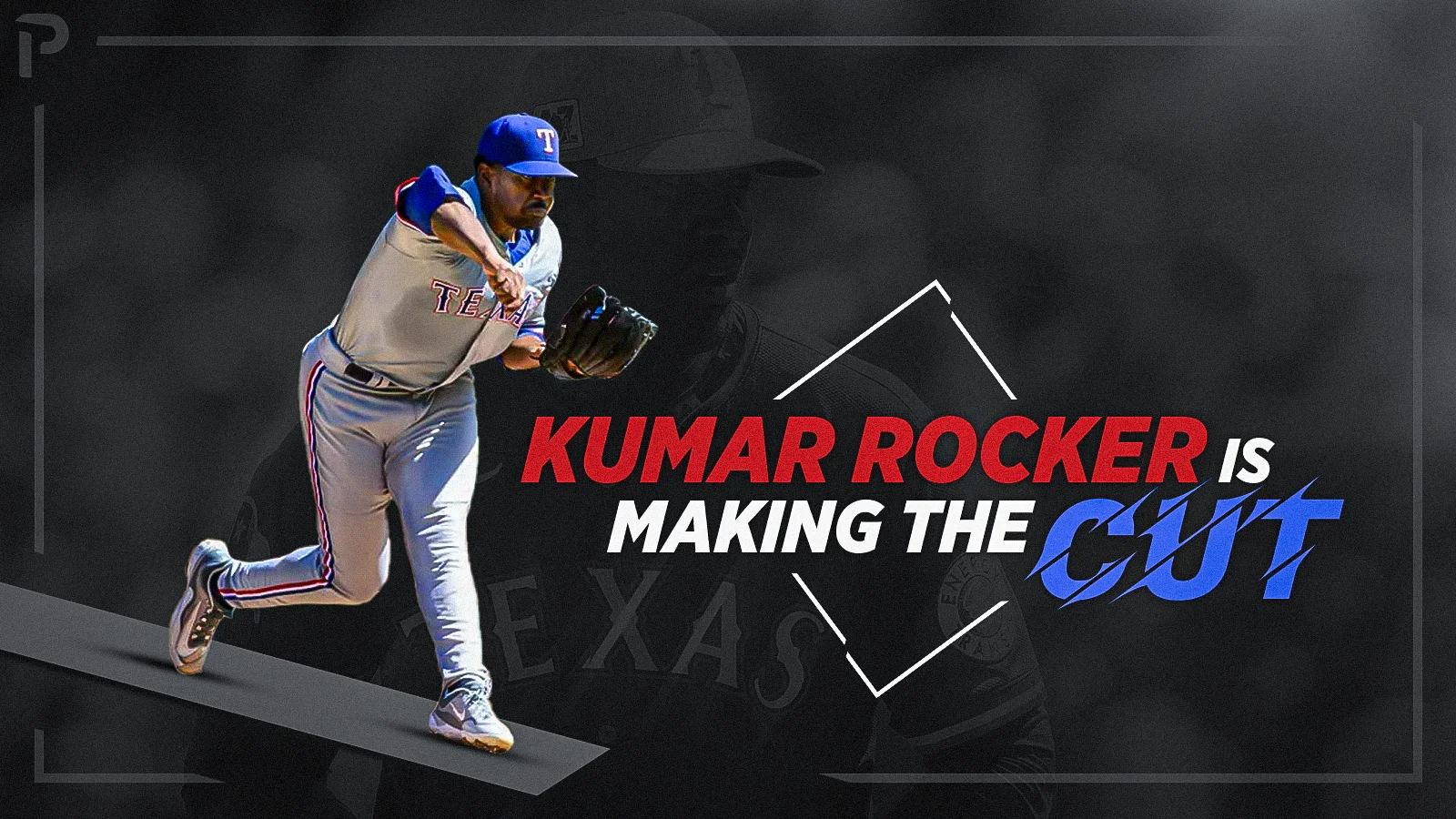

Kumar Rocker, widely recognized since his historic 19-strikeout no-hitter for the Vanderbilt Commodores in 2019, entered Major League Baseball with high expectations after being drafted third overall by the Texas Rangers in 2022. Anticipated to be a cornerstone of the Rangers’ starting rotation alongside Jack Leiter, Rocker’s projected 3.45 ERA and 18.8% K-BB rate for the 2025 season suggested a breakout year. However, through 12 starts and 55.2 innings, he has struggled to meet these benchmarks, posting a 5.66 ERA and a 12.2% K-BB, raising questions about his current approach on the mound.
This report examines Kumar Rocker pitching arsenal adjustments this season, focusing on the changes to his repertoire, factors contributing to disappointing performance so far, and possible strategies for improvement over the remainder of the season.
Major League Debut and Initial Performance Metrics
Rocker made his MLB debut late in the 2024 season, starting three games with decent outcomes: a 25.5% strikeout rate, 10.9% walk rate, and a 3.86 ERA across 11.2 innings. His ability to induce ground balls at a 51.5% rate, generating both misses and weak contact, inspired optimism for 2025. Various projection systems, including Steamer, THE BAT, and OOPSY, forecasted a sub-4.00 ERA season with a K-BB above 16%. Yet, Rocker’s 2025 campaign has shown a decline in effectiveness, with strikeouts dropping to 19.5% and walks improving to 7.3%, though not enough to reduce the ERA below 5.66.
Changes and Expansion in Rocker’s Pitch Arsenal
In 2024, Rocker primarily used three pitches: a four-seamer, slider, and sinker. This season, his repertoire expanded to six different pitches, adding a cutter, curveball, and changeup alongside his original fastballs and slider. A key feature of Rocker’s arsenal has been his “downer” slider, a pitch with a steep vertical drop that often fools hitters by causing swings to go over the ball. Last year, this slider maintained a 50% whiff rate, with 3.8 inches of vertical drop and 0.7 inches of arm-side movement at 84.1 mph. In 2025, however, the slider’s vertical drop decreased slightly while arm-side movement increased, lowering its whiff rate to 40.5%.
Fastball Usage Adjustments and Their Impact
Rocker has shifted the mix of his fastballs this season, reducing his four-seam fastball usage from 43% to 18% while increasing his sinker usage from 17% to 27%. Pitch quality models rate the sinker higher than the four-seamer, as the four-seamer’s “dead zone” movement pattern limits its effectiveness. The addition of the cutter has further diversified Rocker’s fastball offerings, allowing him to deploy multiple fastballs against both right- and left-handed hitters. According to FanGraphs’ Stuff+ and aStuff+ models, Rocker’s overall arsenal quality has remained stable from 2024 to 2025, though StuffBot assigns a drop in pitch quality from 52 to 43 on a 20–80 scale. Among his pitches, the cutter emerges as the highest-scoring offering with a 104 Stuff+ rating.
The Slider-to-Cutter Shift and its Strategic Rationale
Despite increasing his pitch arsenal, Rocker has drastically reduced the use of his highest-impact pitch, the slider, particularly following an injury-related break. Before the injury at the end of April, Rocker relied on his slider 38.1% of the time and didn’t throw the cutter in games, despite having worked on it during spring training. After his return on June 4, slider usage dropped sharply to 2.4%, while the cutter surged to 40.1%. This shift reflects a deliberate attempt to address performance challenges against left-handed hitters.
In his first five starts in 2025, Rocker struggled with left-handers, recording only a 10.4% strikeout rate and a 5.77 FIP, compared to a stronger 23.4% strikeout rate and 3.09 FIP against right-handers. His four-seam fastball and sinker generated low whiff rates (4.0% and 6.1%, respectively) against lefties early in the season. The cutter, with its glove-side break moving into left-handed hitters, provides an effective tool to induce weak contact or jams, increasing the complexity opposing hitters face by forcing them to consider three different fastballs in Rocker’s arsenal. Since June 4, the cutter has produced a 39.4% whiff rate against lefties, compared to 25% for the four-seam and 16% for the sinker.
Pitch Location vs. Effectiveness: Heatmap Insights
Heatmaps of pitch locations show a clear difference in Rocker’s command between his slider and cutter. While the slider has often drifted over the heart of the plate—one of the most dangerous zones for pitchers—the cutter has been placed more precisely down-and-away to right-handers and down-and-in to lefties. This accurate placement encourages hitters to chase pitches outside the strike zone, reflected by the cutter’s 42.4% chase rate compared to 30.5% for the slider, despite similar zone rates.
However, the heatmaps also reveal room for improvement in Rocker’s four-seam fastball and sinker location, which tend to cluster over the plate’s center. This is particularly concerning for the four-seamer, given its ineffective “dead zone” movement profile. Enhancing command by throwing the four-seamer higher in the strike zone could increase swing-and-miss rates, while targeting the sinker more inside to right-handers could generate weaker contact due to sharper approach angles.
Evaluation of Rocker’s Decision and Potential Future Arsenal Development
At first glance, removing a pitch as impactful as Rocker’s slider may seem ill-advised. However, considering the need for a more effective weapon against left-handed hitters, the cutter’s introduction offers a logical improvement. The cutter’s versatility allows it to be a swing-and-miss pitch against hitters of either hand, compensating for the four-seam and sinker’s weaknesses in these matchups. There remains curiosity surrounding the possibility of Rocker reintegrating the slider alongside the cutter in the coming months, presenting hitters with a more difficult task of differentiating between two similar but subtly distinct pitch types. Such layering of pitches could amplify “tunneling” effects, boosting Rocker’s strikeout potential.
Projections and Outlook for the Remainder of the 2025 Season
Projection models remain cautiously optimistic about Rocker’s potential to rebound this season. OOPSY forecasts improvements to a 23.3% strikeout rate, 7.5% walk rate, and a 3.90 ERA over the final two months. Statistical indicators also suggest positive regression for Rocker, as his current left-on-base percentage of 66.3% is below league average and his elevated home run-to-fly-ball ratio (16.1% overall, with 25% against right-handers since June 4) is expected to normalize closer to 10%. Maintaining control over his cutter while gradually reintroducing the slider offers a viable path to improved results.
Significance of Rocker’s Adjustments for the Texas Rangers’ Rotation
Although Kumar Rocker’s early 2025 performance has fallen short of expectations, his pitch arsenal alterations indicate he is actively adapting to the challenges of major league hitters. By expanding and refining his choices, particularly through the introduction of the cutter to combat left-handed batters, Rocker is positioning himself to enhance his effectiveness. If these adjustments continue to produce positive results, Rocker could solidify his role within the Texas Rangers’ starting rotation and fulfill the promise he has shown since his collegiate and minor league success.
Our Reader’s Queries
Q. How fast does Kumar Rocker throw?
A. His fastball usually reached 98 mph, sometimes hitting 99 mph. It had over 19 inches of vertical movement and 11 inches of sideways movement. The pitch was released from about 5.9 feet high and extended to about 6 feet.