
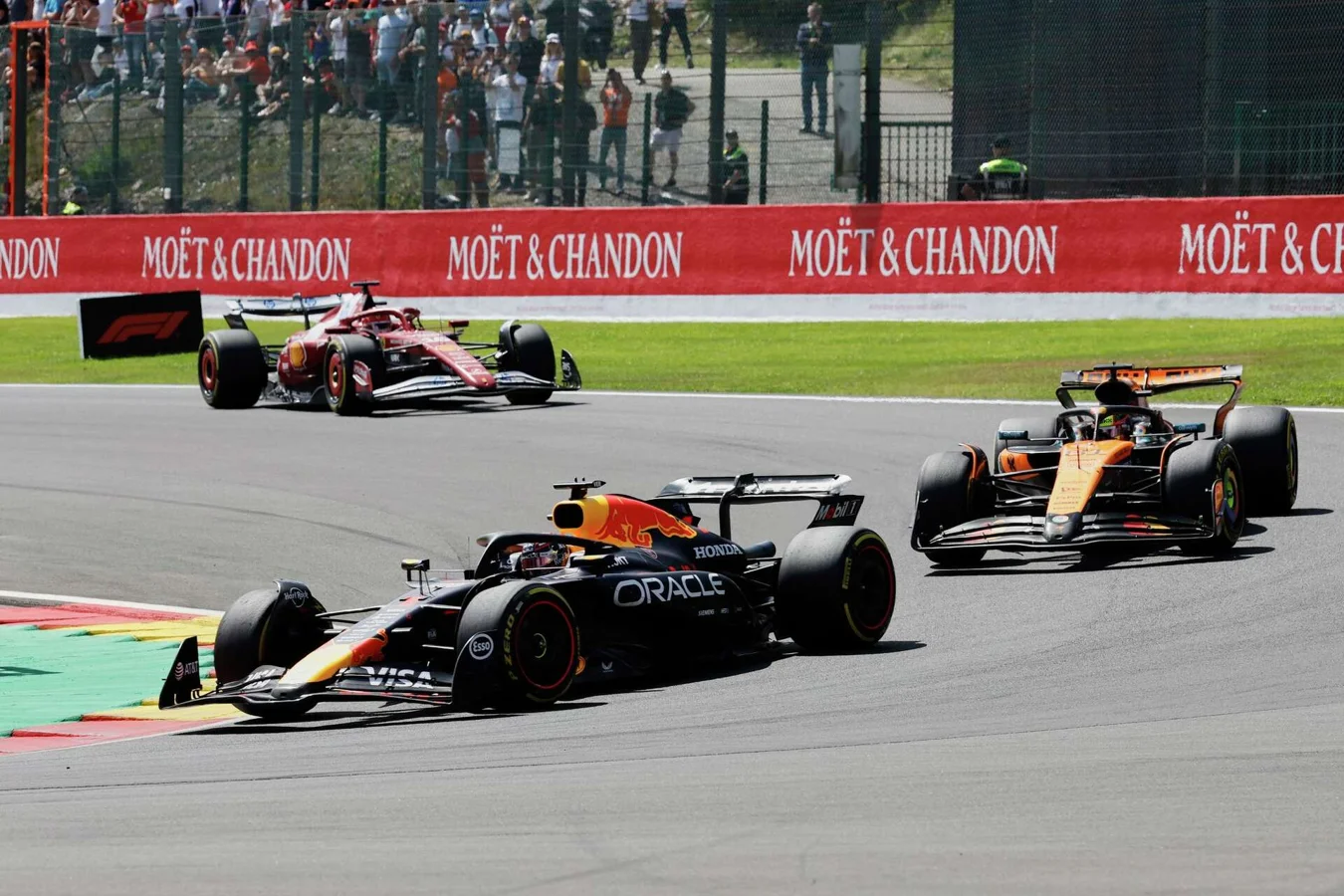

The Belgian Grand Prix sprint race highlighted the crucial role of downforce strategies, with Red Bull’s choice of a low-drag setup proving more effective than McLaren’s higher downforce configuration. On Saturday, Max Verstappen’s streamlined Red Bull RB21 secured victory, significantly aided by its ability to generate slipstream and maintain speed, especially along the Kemmel Straight, where he used the aerodynamic advantage to overtake polesitter Oscar Piastri.
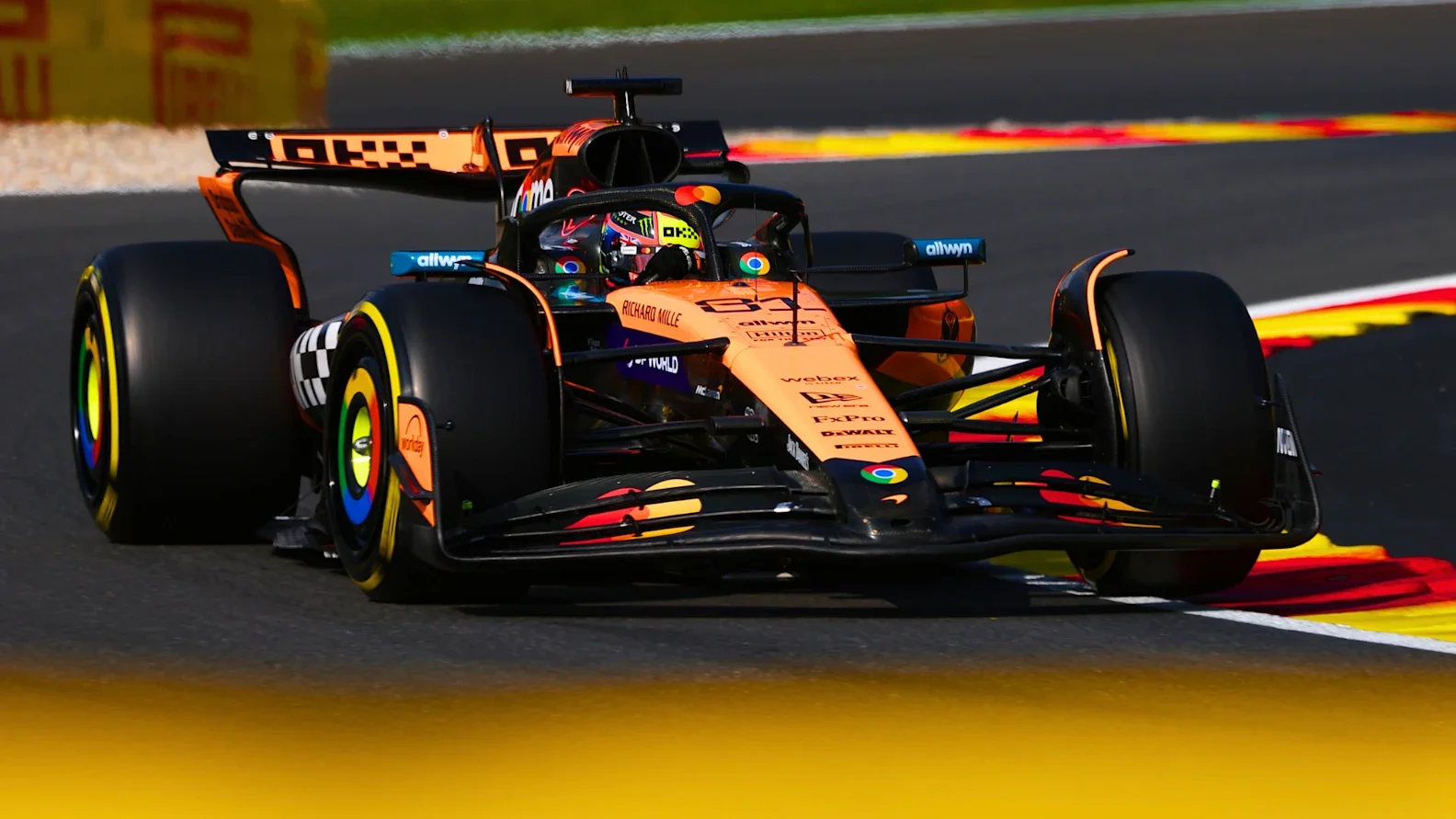
McLaren’s slightly higher downforce contributed to a 0.47-second qualifying deficit for Piastri compared to Verstappen, which put the Australian at a disadvantage in the closely packed sprint start. Despite Piastri’s attempts to pass at challenging corners like Turn 5 (Les Combes), Verstappen successfully defended his lead, balancing energy deployment and vehicle handling flawlessly throughout the race.
Anticipating Different Conditions for the Grand Prix
While the low-downforce setup favored the sprint, conditions expected for the main race on Sunday could call for adjustments. Two primary factors are influencing team decisions: tyre wear and the forecasted chance of rain. At Spa-Francorchamps, tyre degradation is generally moderate, but the race may require either a one- or two-stop strategy, putting a premium on managing tyre life through setup choices.
Increasing rear downforce slightly could reduce tyre sliding, thus preserving rubber over longer stints; however, too much wing reduces outright speed along the long straights, especially the Kemmel Straight, risking position loss. Teams use driver-in-loop simulators and sophisticated virtual race simulations to balance these trade-offs and optimize the wing settings for a potential dry race.
Rain Prospect Adds Complexity to Setup Decisions
Rain remains a central uncertainty heading into Sunday’s race. Wet weather requires higher downforce to improve stability, grip, and tyre temperature management in low-speed, slippery conditions. Acquiring the correct balance is critical, as adopting a wet-weather aerodynamic setup in qualifying could cost significant time and grid position if the rain does not arrive or remains light.
This creates a strategic gamble for teams: committing to a low-drag, low-downforce setup maximizes qualifying speed but risks poor race pace in wet conditions, while a high-downforce setup sacrifices qualifying advantage for improved performance in the rain. Teams must navigate this uncertainty and adjust their designs to find a suitable compromise between outright speed and control.
Teams Explore Middle-Ground Solutions Amid Uncertainty
Rather than choosing extremes, many teams are likely to seek a moderate increase in downforce to balance tyre conservation benefits with minimal speed loss. The precise amount of downforce to add will depend on evolving weather forecasts and ongoing data analysis. No team can finalize the optimal setup before Sunday’s conditions are clearer, making the situation highly fluid and sensitive to last-minute changes.
Red Bull Acknowledges Need to Adjust After Previous Wet Weather Setback
Max Verstappen and Red Bull Racing’s technical staff have acknowledged the risk of their sprint strategy looking to low downforce following recent difficulties, notably the wet race at Silverstone where the configuration proved disadvantageous. Red Bull advisor Helmut Marko confirmed the team’s intent to closely monitor the weather forecast, which currently predicts an 80% chance of rain.
“We’ll take another close look at the weather forecast,” Marko said to Sky Germany, “Right now, it’s saying an 80% chance of rain and, as we know from Silverstone, you win nothing in the wet with a low-downforce set-up.”
“So I think we’ll change to a higher downforce set-up, even if that means we won’t start right at the front. But in the rain, that’ll help in the race. It depends on what set-up the others go with, if someone maybe gambles. But yeah, it could be second or third row [on the grid]. It’ll be interesting.” —Helmut Marko, Red Bull Racing Advisor
The High Stakes of Aerodynamic Choices at Spa
The unpredictable nature of Spa-Francorchamps and its variable weather make the aerodynamic setup a critical strategic element in Sunday’s race. Teams that correctly anticipate the rain and adjust their downforce accordingly will gain an advantage in grip and tyre performance, while those prioritizing straight-line speed risk falling behind if conditions worsen.
Ultimately, the F1 Belgian GP downforce strategy will be a delicate balance between maximizing pace on the straights and ensuring sufficient grip and tyre longevity around the challenging circuit. The successful approach will not only impact the race outcome but also influence how teams refine their setups and strategies for future events under similar conditions.
Our Reader’s Queries
Q. Is number 13 banned in F1?
A. Yes, the number 13 is permitted. Pastor Maldonado picked #13 when the permanent numbers started in 2014. While some see 13 as unlucky, F1 lets drivers decide.
Q. Which F1 driver has ADHD?
A. Lewis Hamilton’s ADHD and dyslexia have impacted both his racing career and personal life. His journey shows a new way to view success in F1 and highlights the importance of recognizing learning differences.
Q. Is 69 allowed in F1?
A. Rules for F1 Driver Numbers: Drivers can select a permanent number ranging from 2 to 99, except for 17, for their entire F1 career.