
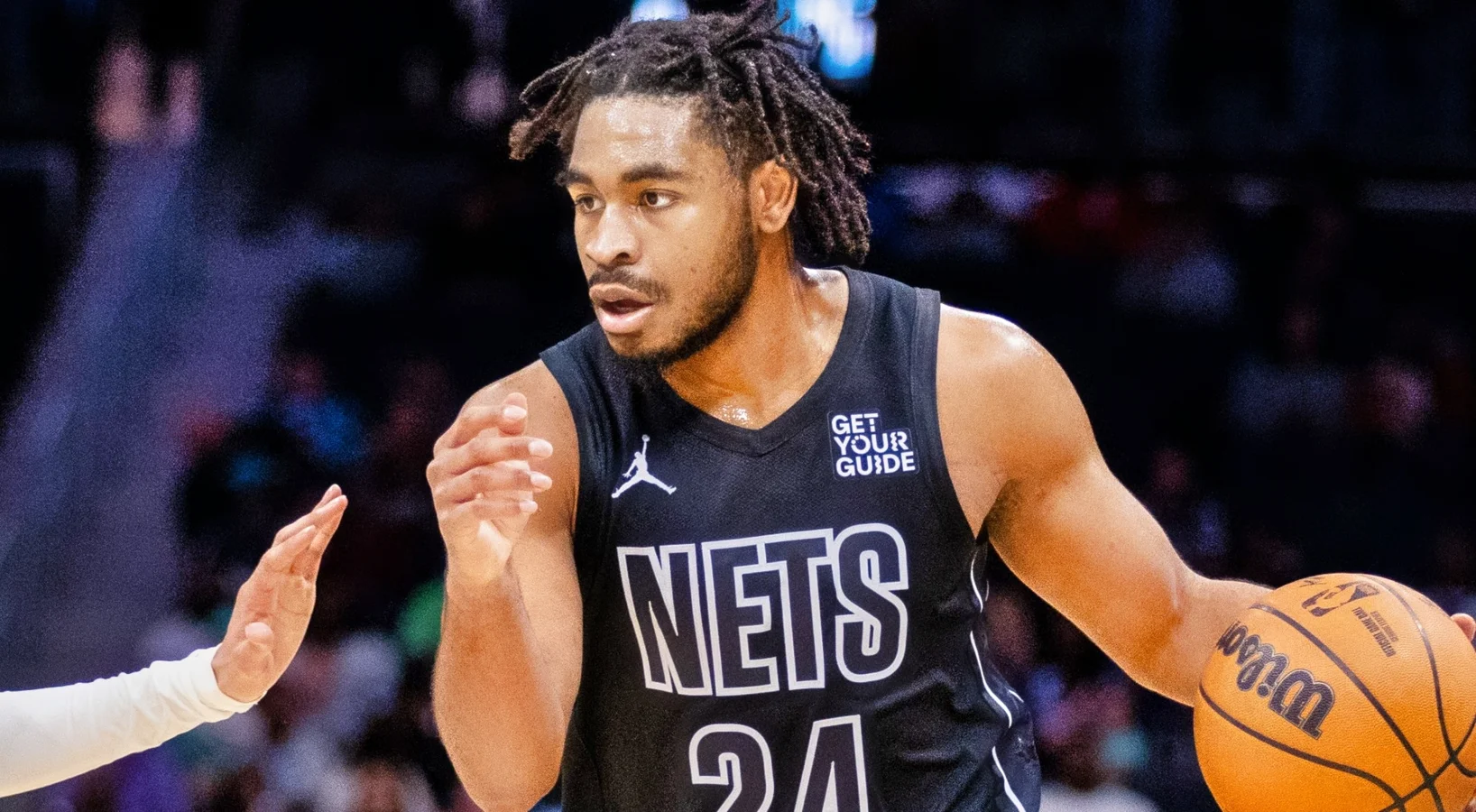

The Cam Thomas nets contract situation remains unresolved as of now, with both sides facing a critical decision about their future together. Despite ongoing discussions, the possibility exists that Thomas and the Brooklyn Nets may part ways, as contract talks continue without a clear resolution.
Thomas is still classified as a restricted free agent, which complicates the negotiation process. Behind closed doors, millions are at stake—not only for the team but especially for Thomas personally. While much of the negotiation remains private, several important details have emerged publicly that shed light on the current deadlock.
It is known that the Nets proposed a two-year deal to Thomas, reportedly around $14.1 million per year, consisting of the mid-level exception with a team option in the second year. Meanwhile, Thomas has removed all his posts from Instagram and chosen to train at the players’ union gym in Manhattan rather than the team’s HSS facility in Brooklyn. He also opted not to attend the summer league in Las Vegas, signaling a growing distance between player and franchise.
Perspectives on Responsibility: Neither Side Clearly at Fault
The challenges in this negotiation partly stem from external conditions affecting the market for young talent like Thomas. The 2021 NBA Collective Bargaining Agreement negatively impacted the draft class’s leverage, reducing bargaining power for players such as Thomas, Josh Giddey, Jonathan Kuminga, and Quentin Grimes. With the Nets uniquely positioned as the only team possessing legitimate cap space, they are essentially competing with themselves when determining how much to invest in Thomas’s contract.
Given Thomas’s injury history—missing most of the last season due to a hamstring issue and playing just 73 games over two years—the Nets have reason to be cautious. Yet, the player’s value remains clear, and the team must weigh how to align their financial commitment with their broader strategic plans.
Brooklyn Nets’ Philosophy and Their Investment in Homegrown Talent
Since Sean Marks took charge of the Nets’ basketball operations, he has emphasized treating players fairly and building the team through homegrown talent. Thomas, as one of Brooklyn’s own draft picks, exemplifies that philosophy, standing as the team’s most reliable scorer. Despite criticisms of his defensive shortcomings and his high-volume shooting style, Marks’s approach suggests that the Nets should nurture and retain him as part of their foundational core.
An April comment from Marks highlights this philosophy:
I do think it’s important to have some guys under contract that you control of the contracts…you drafted them, you develop them and they got to their 2nd contract under your watch. Those days are probably gone of going and getting 2 or 3 max free agents,
he said. This insight reflects the value of developing and retaining players like Thomas rather than solely pursuing expensive free agents.
For many Nets fans, Thomas represents a rare bright spot, a player who consistently brings energy and scoring prowess to the court. Although the franchise remains strong with its coaching, draft capital, and New York City market allure, the game is undeniably about star power—and Thomas is currently the closest to a household name in the Brooklyn roster.
Market Dynamics and Comparisons to New York Sports Figures
The contract standoff evokes parallels with other high-stakes New York athletic negotiations, such as that of Saquon Barkley with the Giants. Like Barkley, Thomas is a local talent who excites the fan base despite the team’s overall struggles. Barkley’s eventual large contract followed a record-setting season and a Super Bowl victory, emphasizing that performance can decisively influence negotiations.
While not a direct comparison of their athletic achievements, the situations share similarities in that both Thomas and Barkley exist in competitive New York markets where teams must decide whether to invest heavily or risk losing their star players. The Giants failed to capitalize fully on Barkley’s value, a cautionary tale illustrating the risks the Nets face in their dealings with Thomas.
Thomas’s eight 40-point games and record as the youngest player to score 40 points in three consecutive games underscore his offensive capabilities. For a young, inexperienced Nets team, he remains a key attraction and contributor.
Evaluating Fit: Is the Issue Philosophical or Market-Driven?
Should Thomas depart, it may indicate he does not fit within the strategic vision of Sean Marks and head coach Jordi Fernandez. Marks has described the style the Nets are building: fast-paced, decision-driven basketball where players are versatile, able to guard multiple positions, and engaged in rapid ball movement.
Brooklyn’s recent 2025 draft selections emphasize this direction, focusing on tall, versatile players, many from international backgrounds, aligned with a FIBA-style approach. Fernandez’s system values unpredictability created by ball movement over isolation scoring.
J.J. Redick corroborated this perspective, saying in March,
With Jordi, I feel like I’m watching a FIBA team, you know? And that’s a real compliment.
Within this framework, Thomas’s advanced scoring ability could be considered a “superpower,” as Fernandez called it, but his reliance on isolation play and defensive limitations contrast sharply with the team’s goals. Nonetheless, some within the organization believe there is a role for him, as indicated by an anonymous Nets coach who shared:
We love Cam. We think he’s one of the best scoring guards in the league, and an underrated playmaker. We’ll see what happens, but our feelings about Cam as a player and person have never wavered. We love him,
—Keith Smith quoting Nets coach.
Statistical Highlights and Player Comparisons
Before his injury setbacks, Thomas led the NBA in points per possession on isolation plays (1.13), ahead of stars such as Shai Gilgeous-Alexander (1.10), Jalen Brunson (1.07), Kyrie Irving (1.06), James Harden (1.06), Luka Doncic (1.06), and Jayson Tatum (1.01). This demonstrates his elite scoring efficiency when the offense isolates him.
Despite this, the Nets are drafting four combo guards—Egor Demin, Drake Powell, Nolan Traore, and Ben Saraf—who will likely compete with Thomas for minutes. Only Traore fits the traditional point guard mold, while Thomas, at 6’3″, occupies a similar versatile guard position.
Although Thomas has not accepted the Nets qualifying offer and the October 1 deadline draws near, there is still no official indication from the Nets as to their final decision.
The Complexity and Significance of the Contract Decision
The situation is far from simple, and though it could be labeled as “business,” it carries substantial cultural weight for Brooklyn’s identity. The team prides itself on loyalty to its players and developing talent from within, and resolving Thomas’s contract amicably would reinforce that commitment to fans.
If Thomas remains dissatisfied with the terms yet continues with the Nets, tensions could arise, possibly leading to an eventual parting under less favorable circumstances. For his career progression and the franchise’s future, a swift resolution is in both parties’ best interests.
The ongoing impasse raises the question of whether Brooklyn should solidify this relationship or prepare to move forward without their promising scorer. Either outcome will shape the Nets’ rebuilding path and influence their competitiveness in upcoming seasons.