
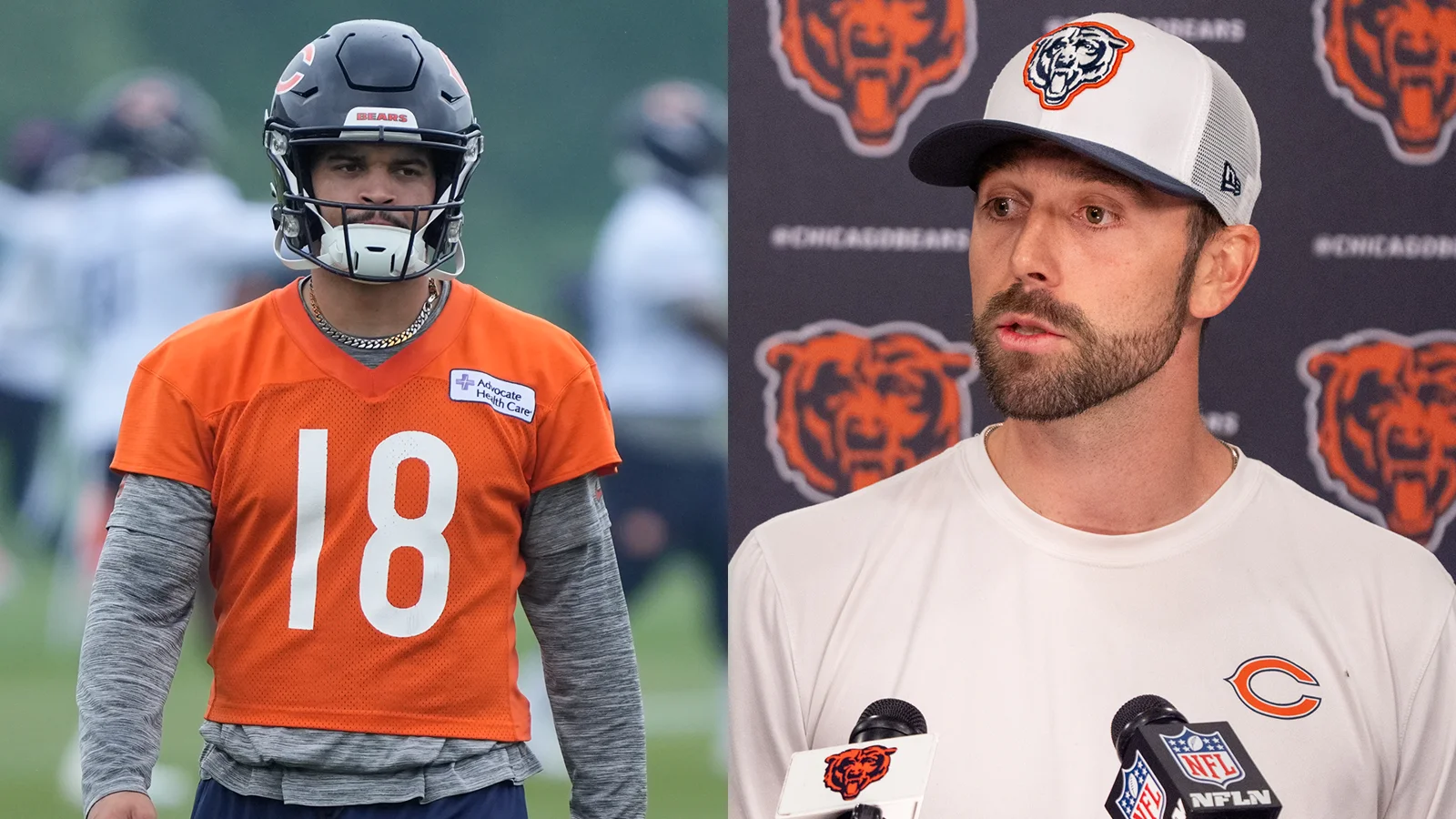

Chicago Bears quarterback Caleb Williams is facing intense scrutiny during the early stages of training camp as new head coach Ben Johnson implements a demanding development strategy. Johnson’s plan, shaped over two years of preparation before taking this head coaching role, deliberately challenges Williams to accelerate his learning and improve under pressure.
Johnson’s evaluation began by dissecting Williams’ performances from the 2024 season, his college years at Oklahoma and USC, and even recalling encounters when Johnson saw Williams play as a defensive coordinator in the NFC North. Despite recognizing Williams’ prodigious talent in his throws, Johnson identified clear areas needing refinement, particularly in presnap anticipation and decision-making.
“I saw a guy with immense potential. Every week he made throws that made you drop your jaw a little bit. Hell, I experienced it when I was standing on the sideline when he played against us,”
Johnson said.
“But what you also see is a lack of anticipation at times, which—that comes with reps—you gotta do things over and over again. That’s not abnormal for a rookie quarterback.”
Johnson continued,
“And it’s some of the presnap stuff he could improve on, the shifts, the motions. There were times when his eyes weren’t quite in the right spot. Even though I hadn’t been in the building, you kind of know where he should be looking and it wasn’t that way. That’s where we’ve been pretty hard on him since we’ve been in the building.”
The Intense Learning Environment at Bears Camp
The challenges Williams encountered were visible in his early throws during a recent practice session in Lake Forest. His first attempt was a hurried throwaway under pressure, followed by a rushed pass with no receiver coverage, and a risky throw nearly intercepted for a defensive touchdown. These moments, while rough, are intentional components of Johnson’s method to push Williams through “trial by fire.”
These throws happened during the Bears’ “Wake Up” period, designed to simulate game-like pressure with aggressive defensive tactics. This session is crafted not just to test Williams’ physical execution but to impose a mental demand on his presnap activities, or as Williams refers to it, P.S.P. (presnap procedure).
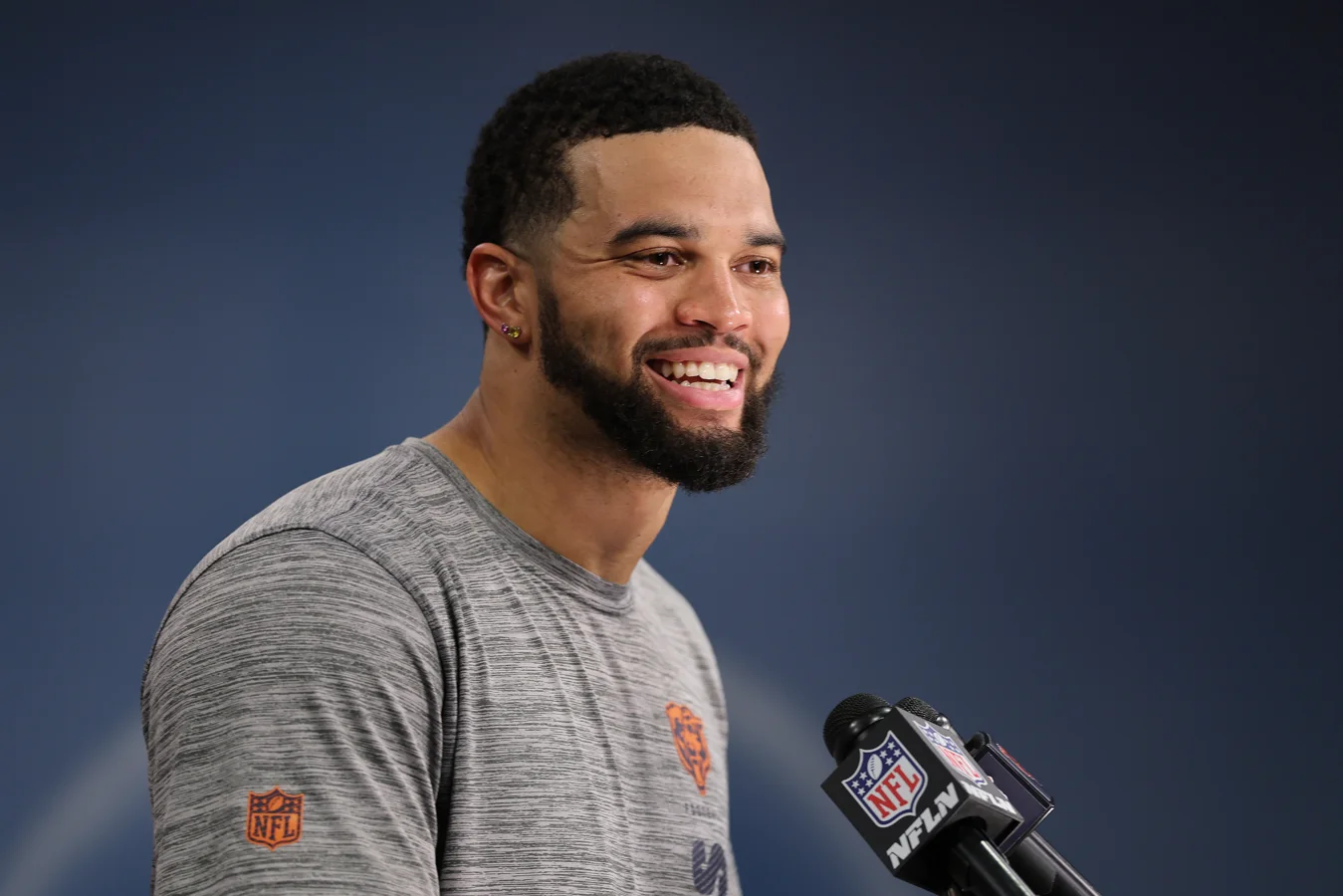
The Bears staff knows the quarterback’s presnap checks and adjustments are critical for success, recognizing that Williams’ ability to process and communicate under these conditions won’t instantly be flawless. By increasing the quantity and complexity of these reps, they aim to speed up his maturation while gathering valuable insights about his current capabilities.
“That’s where we’ve been pretty hard on him since we’ve been in the building, being consistent and true to his thought process, presnap,”
Johnson confirmed.
Long-Term Vision and Measured Progress with Williams
Johnson’s rigorous approach means Williams will continue to endure difficult moments, which will be scrutinized heavily in a city with demanding fans still healing from disappointments with previous first-round draft quarterbacks Mitchell Trubisky and Justin Fields. However, the team remains patient, understanding this process must unfold methodically.
Once the Bears’ coaching staff and front office collect enough data on Williams’ development and growth in practice, they plan to refine the offensive scheme to harness his strengths, adapting it to both his and the team’s current abilities. This careful tailoring will eventually define the identity of Johnson’s offense in Chicago.
“Right now, Ben’s just testing to see, how much can I give this kid, what is the retention level, how much in the presnap operation can he handle in terms of the motions and making those calls at the line of scrimmage, the protections,”
said Bears GM Ryan Poles after practice. “Going back to last year, there’s some things he never did in college that’s a part of this game, that a lot of rookies have to go through. There’s a lot of verbiage, a lot of things at the line of scrimmage. It’s just getting those things down.
“This is a different system, but I’ve seen a huge improvement from last year to this year just in terms of the operation. Ben’s system, there’s a lot there. So I think it’s just overload him now, figure out what he can do, and go from there. And then build it year after year after year.”
When asked about the long-term forecast for the offense, Johnson admitted the plan remains fluid.
“I’ll be honest with you, I don’t know that we’ve sat down and talked through any minutiae like that,”
he said.
“We’re just focused on the entirety of it, and getting better in every little area right now.”
The final product is still uncertain, yet the Bears hope the challenging early days will yield a more polished quarterback ready for the rigors of the NFL season.
Vikings’ Quarterback J.J. McCarthy’s Steady Rise Through Opportunity
J.J. McCarthy, the Minnesota Vikings’ young quarterback, faces a different yet equally intense developmental track. After missing much of his rookie season due to knee surgeries, McCarthy has seized a full offseason and training camp workload, amplified by the Vikings’ unsuccessful attempts to retain veterans Sam Darnold and Daniel Jones as insurance.
The Vikings initially sought to re-sign Darnold or extend Jones, hoping to provide McCarthy a smoother transition on a veteran-laden team coming off a 14-win season. When those efforts failed, McCarthy was thrust into a position where the coaching staff could dedicate complete focus and reps to him from the start.
Head coach Kevin O’Connell praised McCarthy’s work ethic and leadership, noting that the quarterback took every first-team rep and emerged as a respected figure among peers.
“He’s got an unbelievable way of connecting with guys in a way where it doesn’t feel like he’s trying to be anybody that he’s not,”
O’Connell remarked. “He’s authentic. He’s himself. He’s had experience throughout his football career, leading from a younger age. It might be different now with some guys that are as accomplished as a Justin Jefferson, experienced as Ryan Kelly. He understands there’s an enthusiasm and an enjoyment to playing quarterback for the Minnesota Vikings that he wants to make sure he shows the guys.
“That’s infectious.”
Technically, McCarthy’s development also showed in his improved ability to execute a variety of throw types. Previously criticized for relying heavily on “fastball” style throws in college, McCarthy has expanded his repertoire to include off-speed passes necessary to navigate the tighter windows seen in professional defenses.
O’Connell acknowledged,
“He was able to not only check those boxes but knock it out of the park from the work he put in. Everyone’s aware of the work the quarterback’s putting in, any NFL quarterback. The growth from that time to now is just a guy that has time on task with his teammates, with his coaches, in this building, working toward something, not working away from the injury. That’s in the past now.”
McCarthy entered camp in strong shape, ready to build on a good first day and prepared for the unpredictable challenges ahead in his second NFL season.
Lions Move Forward Confidently Despite Previous Defeat
The Detroit Lions appear focused on progress despite a bitter loss to the Washington Commanders at the end of last season. Quarterback Jared Goff’s candid reflection revealed no bitterness but acceptance of the opponent’s superior performance in a turnover-heavy game that ultimately decided the outcome.
“It’s pretty obvious,” Goff said.
“They played better than we did, took care of the ball and gave themselves a chance. They found some takeaways. We had some turnovers. We couldn’t catch up after that. It was too little too late. Thought we fought well. We did fight back. I tip my cap to them. They were better than us.”
The Commanders dominated a 4–0 turnover margin, crucial in building and maintaining their lead. Despite this loss, the Lions maintain confidence in the team’s direction as they adjust to offseason changes, including the departure of coordinators and the absence of key offensive lineman Frank Ragnow.
Still, Detroit retains significant talent, with offensive line stalwarts Taylor Decker and Penei Sewell anchoring protection schemes, and key leaders such as Amon-Ra St. Brown and Alex Anzalone present in the locker room. The roster includes rising stars like Aidan Hutchinson, Brian Branch, Jameson Williams, Sam LaPorta, and Alim McNeill, whose growth signals a promising future.
The Lions’ organizational direction under coach Dan Campbell and GM Brad Holmes remains steady, suggesting that the previous season’s setbacks are viewed as isolated rather than indicative of the team’s overall trajectory.
Packers’ Transition Phase Focuses on Internal Growth and Emerging Talent
The Green Bay Packers are in a period of cautious rebuilding and internal improvement as they transition fully from the Aaron Rodgers and Brett Favre eras. With 26-year-old Jordan Love now established as the starting quarterback, the franchise is balancing youth and experience under a relatively new coaching and management regime.
The Packers have improved consecutively under Love, moving from an 8–9 record in Rodgers’ last year to 11–6 in Love’s second start, reflecting solid progression amid a clean transition. Historically, similar transitions have led to significant success, as Rodgers’ third year as a starter coincided with the Packers’ Super Bowl XLV victory in 2010.
The team’s roster includes promising young wide receivers such as Dontayvion Wicks, Romeo Doubs, Jayden Reed, and Christian Watson, who is expected to return from injury by October. Additionally, the Packers’ recent drafts brought in Matthew Golden and Savion Williams, further bolstering the receiving corps along with tight ends Tucker Kraft and Luke Musgrave, both of whom exhibit notable upside.
The key question for Green Bay remains identifying which of these players will develop into their primary offensive weapon in the years ahead. There are high hopes that Kraft and Wicks, in particular, will take that step forward as the team continues to adjust its identity and pursue success.
Our Reader’s Queries
Q. Was Caleb Williams number 13?
A. He was one of six quarterbacks picked in the first round, matching the 1983 draft record for most quarterbacks selected. Because Keenan Allen already had the number 13, which was his college number, Williams chose to wear number 18, the number he had in high school. This decision was announced less than 30 minutes after he was drafted.