
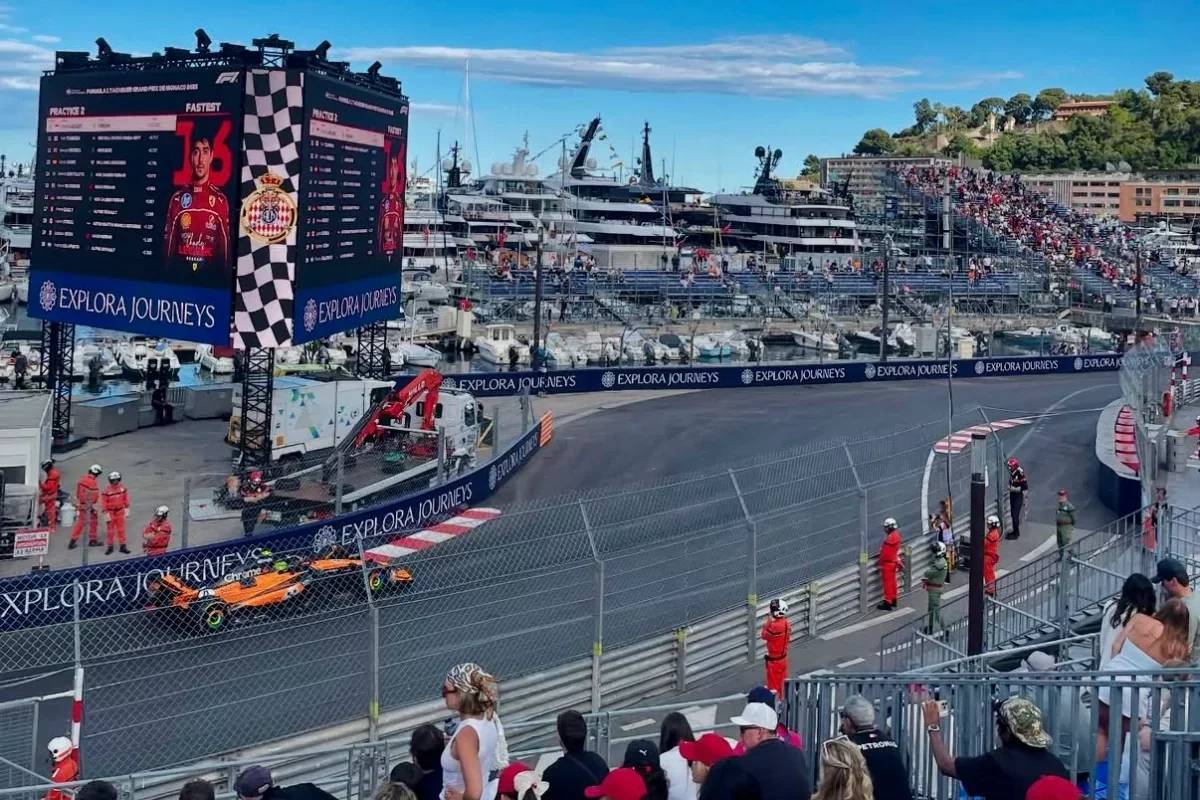

James Vowles, team principal of Williams, revealed his surprise at the news that the mandatory two-stop strategy for the Monaco Grand Prix will likely remain in place for 2026, following this year’s controversial introduction. The F1 Monaco GP two-stop strategy was initially trialed to encourage more strategic variation during the race on Monte Carlo’s narrow streets, where overtaking is notoriously difficult.
FIA’s Objective Behind Mandating Multiple Pitstops
The FIA introduced a requirement for teams to use three different tyre sets, effectively forcing a two-stop pit strategy, with the intention of disrupting the usual procession and increasing the excitement and unpredictability of the race. However, the measure had an unintended effect at the front of the grid as some teams, including Williams and Racing Bulls, managed to manipulate the regulation by coordinating their cars to strategically back up the field and open a pitstop window for their lead car.
Mixed Reactions to the Strategy and Its Effects
This coordinated tactic triggered debate within the paddock, as it compelled one driver to markedly reduce their pace, running several seconds slower per lap, in order to benefit the teammate ahead. Vowles, despite benefiting from this tactic in terms of points, expressed discomfort with the strategy, saying it conflicted with his values about authentic racing competition.
“For the record, we weren’t the first to do it. We had to do it in reaction to the field,”
—James Vowles, Williams Team Principal
“I didn’t like it. It’s the most uncomfortable I’ve felt. I like going out there and fighting for points on merit rather than having to game the system in order to achieve it.”
“I think the arguments that are being made were, ‘Was it a better show irrespective of that?’. I can’t answer that question. I think that’s for the fans to answer. My personal feeling is, I don’t like the lack of clean racing that occurs as a result of it.”
FIA Remains Open to Alternative Solutions for Monaco
Nikolas Tombazis, FIA single-seater director, sounded cautious regarding the continuation of the two-stop strategy for Monaco in 2026, emphasizing that the rule is not yet finalized and inviting teams to come forward with better ideas. Speaking exclusively to Autosport, Tombazis stressed the need to address the underlying challenge of making the Monaco GP more engaging without resorting to problematic tactics.
“First of all, we don’t think that what we saw this year is necessarily the thing to repeat or the thing to aim for. There is an issue to be addressed,”
—Nikolas Tombazis, FIA Single-Seater Director
The current regulations continue to mandate the two pitstops for Monaco, but with the race still a year away, proposals from the teams are encouraged. Tombazis indicated that the FIA remains open-minded regarding improvements and is awaiting constructive solutions to enhance the spectacle.
“This is one of the topics that will be discussed with the Sporting Advisory Committee and the F1 Commission in the next few meetings.”
Implications for Teams and the Future of Monaco Race Strategy
The decision to maintain the two-stop requirement represents an ongoing struggle within Formula 1 to balance safety, sporting integrity, and entertainment value, especially at a circuit like Monaco where overtaking opportunities are minimal. The 2026 regulation continuation suggests the FIA is prioritizing strategic complexity, but also highlights the contested nature of this approach.
Williams’ reaction illustrates the tension teams feel between exploiting regulations to maximize points and adhering to the pure spirit of racing. Fans and stakeholders alike remain divided over whether such rules improve or detract from the viewing experience. Further discussions in the Sporting Advisory Committee and the F1 Commission may lead to refinements or alternative approaches ahead of the next season’s Monaco event.