

Malik Nabers, the New York Giants wide receiver and former LSU standout, has quickly established himself as a first-round fantasy football contender after less than 18 months in the <a href=”https://www.buzzineintl.com/category/football/nfl/”>NFL. Selected sixth overall by the Giants, Nabers’ rookie season, which included 109 receptions, demonstrated a high ceiling that fantasy owners are eager to capitalize on. With the 2025 draft approaching, the key question remains: is Nabers’ fantasy football ceiling sufficient to secure a first-round selection, or should managers look elsewhere?
Comparing Nabers to Elite Wide Receivers in Early Career
Many fantasy analysts and fans have begun positioning Nabers alongside elite receivers with proven track records. When isolating his LSU tenure, Nabers outperformed notable peers; he surpassed Odell Beckham Jr.’s career-high target count, caught more passes per game than Ja’Marr Chase in any of Chase’s first three NFL seasons, and averaged 6.4% more PPR points per game than Justin Jefferson in their rookie years. These metrics affirm Nabers’ impressive early production but raise the question of whether his progression will match or exceed the transcendent talent of Jefferson and Chase.
The Giants’ 2024 strategy prioritized Nabers as a focal point, emphasizing volume to maximize his impact rather than chasing big-play upside. This reminds observers of the Cincinnati Bengals’ approach with Chase, who initially saw a high average depth of target (aDOT) but improved efficiency after adjusting to a more controlled route tree and target distribution.
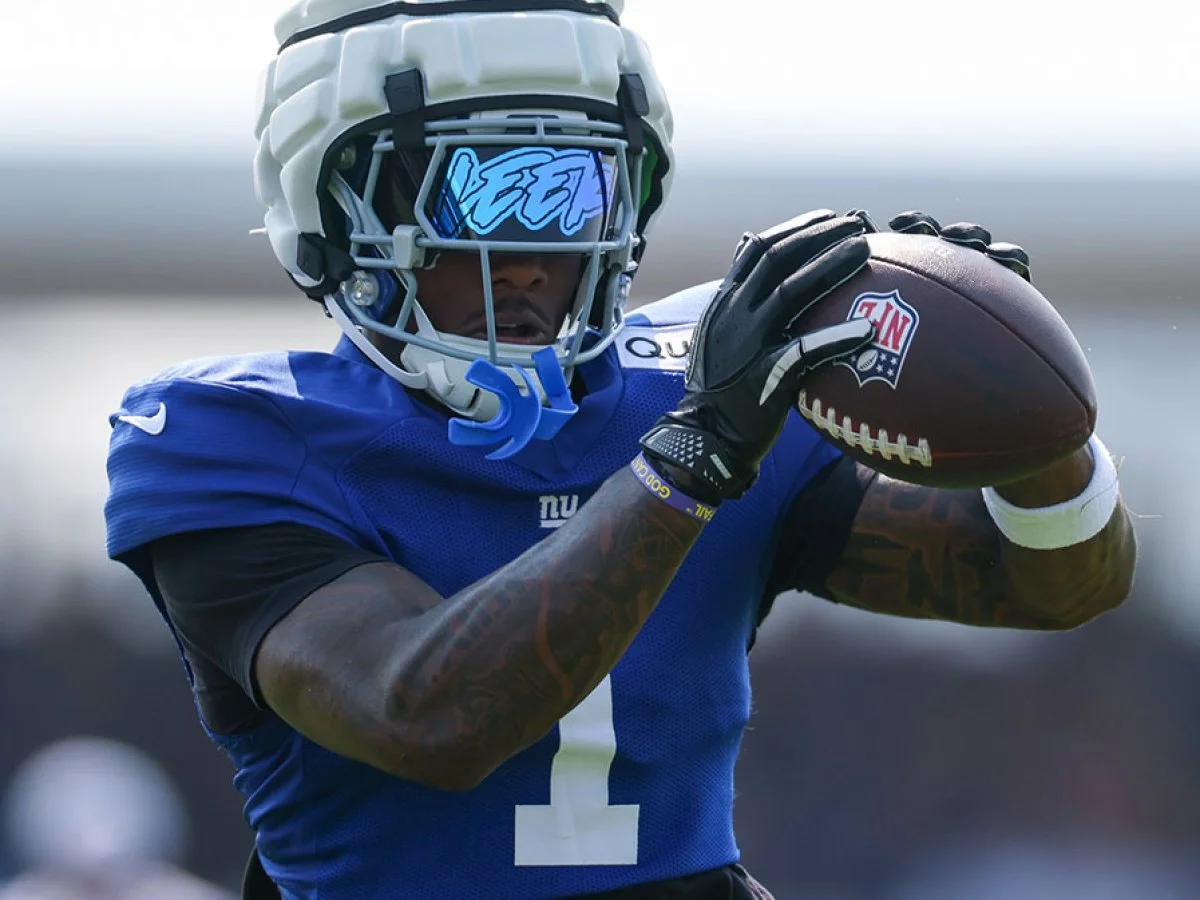
Offensive Coordinator Mike Kafka’s return hints at a similar offensive blueprint that could sustain Nabers’ volume share in 2025. However, while Nabers’ role provides a solid baseline or “floor” for fantasy production, his ceiling remains to be fully tested.
Evaluating the Upside: Can Nabers Reach Elite Consistency?
Nabers’ per-game numbers lag behind the two receivers he is often compared to, with 4.61 fantasy points per game versus Chase’s 7.62 and Jefferson’s 7.59 in 2024. Despite commanding a 49.4% target share—the highest among the three—Nabers’ production relative to expectation was negative (-1.6%), contrasting with Chase (+112.6%) and Jefferson (+73.5%). This discrepancy suggests that while he attracts many targets, the efficiency and scoring output have not yet matched those elite benchmarks.
Further scrutiny shows Nabers finished 2024 with the fourth-most unrealized air yards, totaling 876. This partly reflects the New York Giants’ quarterback situation, with Russell Wilson, noted as the most efficient deep-ball passer in 2024, completing just over half of deep throws. Yet, Nabers’ ability to consistently convert downfield opportunities remains a crucial element for his fantasy ceiling.
Malik Nabers finished with the fourth-most “unrealized” air yards in 2024 (876). New Giants QB Russell Wilson was the most efficient deep ball passer in 2024, completing 27-of-50 (54%) of 20+ air yard throws for 851 yards, 8 TDs, 2 INTs Here are some of Nabers’ unrealized yards: pic.twitter.com/2NTt3oY7Ba
— Dan Schneier (@DanSchneierNFL)
Despite the impressive target share, sustaining such a volume is challenging, especially given the relatively limited offensive talent surrounding Nabers on the Giants. Any decline in target share, paired with inconsistent quarterback play expected from rookie Jaxson Dart, adds another layer of uncertainty to his projection.
Contextualizing Nabers’ Role in a Developing Offense
The Giants’ offense currently revolves heavily around Nabers, and his usage rate may be one of the highest in the league. However, fantasy managers are cautious about relying on volume alone without consistent efficiency and a more productive passing game. History shows that even elite receivers like Justin Jefferson faced skepticism until they demonstrated stability and the ability to produce despite instability at quarterback.
Nabers’ path to becoming a top overall wide receiver is possible but not guaranteed, given his single year of NFL production and the transitional phase for New York’s quarterback position. His comparison to Jefferson aligns more with their youth and opportunity rather than a clear, immediate trajectory towards elite status.
Balancing Hype Against Draft Value
The eagerness to draft Nabers early stems from his clear talent and appeal as a focal point in the Giants’ offense. Fantasy owners envision a version of Jefferson who can overcome a lower-powered supporting cast through skill and volume. Yet from a pragmatic draft perspective, the question is whether he offers enough immediate upside to justify a first-round investment over players like Amon-Ra St. Brown or Nico Collins, who also carry high upside in more stable offenses.
The pressure to justify first-round picks in dynasty or redraft leagues often hinges on a player’s demonstrated consistency. Managers must weigh Nabers’ current numbers, projected target shares, and his quarterback situation in 2025. Given the challenges, taking him earlier than some of these other options may represent a notable risk.
The Outlook for Malik Nabers in Fantasy Football’s 2025 Landscape
Malik Nabers holds significant promise as a high-volume receiver capable of producing standout fantasy seasons, especially if the Giants’ offense evolves positively under Mike Kafka and Jaxson Dart. However, his current production metrics, the efficiency questions, and confidence in surrounding talent suggest a cautious approach to investing a first-round pick based purely on potential.
Fantasy managers looking for a player with a stable floor might view Nabers as an attractive choice, but those seeking a proven ceiling or more established reliability could lean toward other high-upside receivers. Ultimately, Nabers’ 2025 campaign will be decisive in confirming whether his fantasy football ceiling justifies early selection or warrants a more strategic approach later in the draft.