
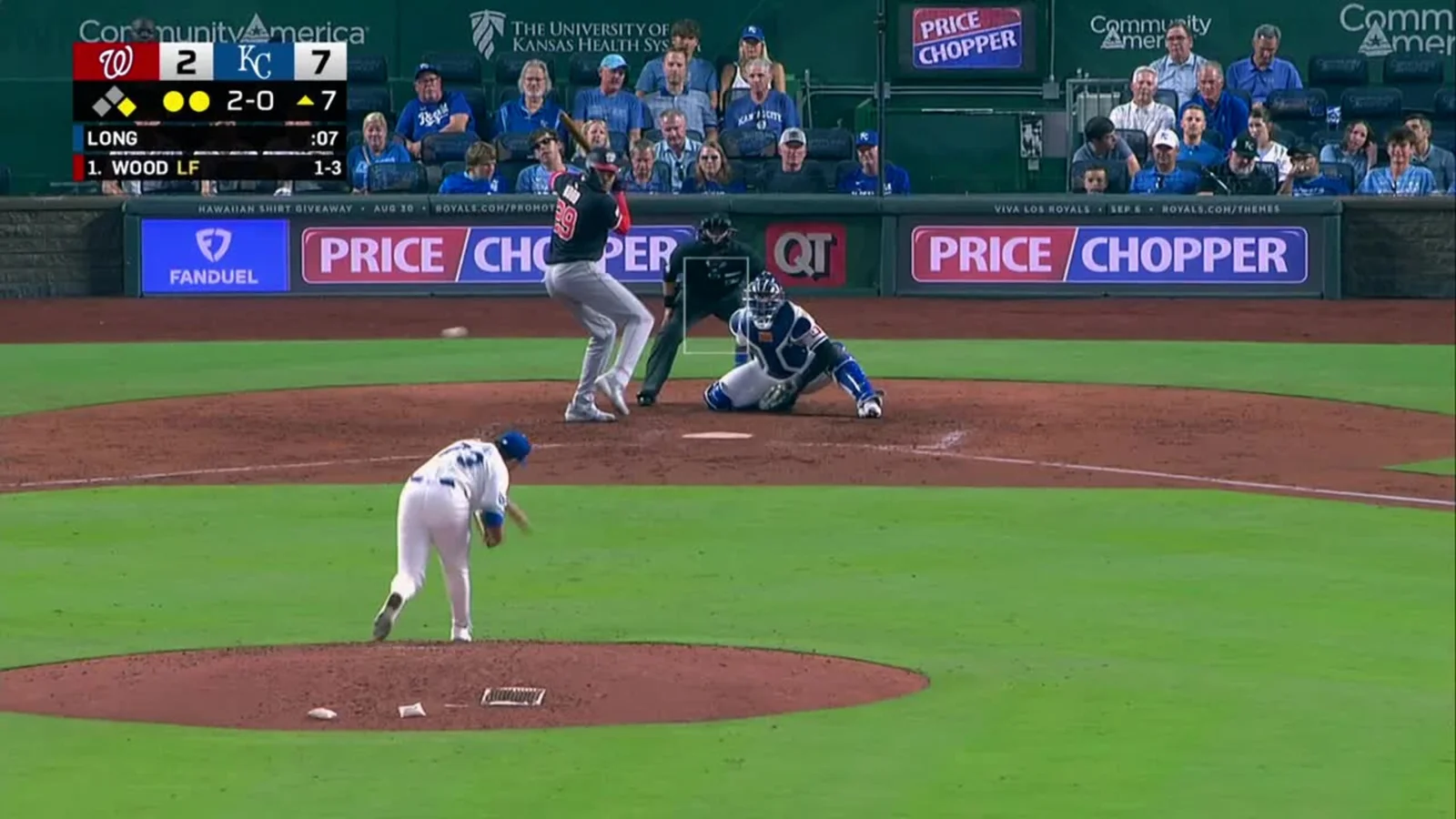

Washington Nationals outfielder James Wood recorded the hardest hit baseball of his career on Tuesday night, with a double struck at 118 miles per hour during a game against the Kansas City Royals. Despite the Nationals falling 8-5, Wood’s achievement stands out as a significant milestone in his development as a powerful hitter. This event took place amid the Nationals’ ongoing season, emphasizing Wood’s growing impact on the team’s offensive efforts.
The Statcast tracking system, introduced in Major League Baseball in 2015, records data such as exit velocity, which measures the speed of a baseball after contact. Wood’s double in the seventh inning not only marked his personal best but also became the second-hardest hit baseball in Washington Nationals history during the Statcast era. Nationals Communications confirmed the data but did not specify which player holds the top spot; however, Wood now ranks with two of the three hardest hit balls in franchise history.
Breaking Free from a Slump with Consistent Performances
Wood’s 118 mph double helped break a difficult slump that began after the All-Star break, during which his batting averages dropped significantly. Prior to this game, he slashed .130/.221/.174 over 18 games post-break with no home runs and only two runs batted in. His turnaround started on a recent road trip, highlighted by a home run that ended a month-long drought in a win over the San Francisco Giants.

In his last four games, Wood has gone 8-for-19, adding seven RBIs and scoring five runs, with an impressive slash line of .333/.355/.600 over seven games. This recent surge signifies his resilience and determination to regain the form that earned him an All-Star nod and a spot in the Home Run Derby earlier in the season. Overall, Wood has maintained a solid performance this year, batting .264 with a .354 on-base percentage and 25 home runs, contributing 78 RBIs up to this point.
Career Milestones and Background
James Wood’s progress has been remarkable since his Major League Baseball debut last July, when he was promoted from Triple-A Rochester. Early in his career, Wood joined an elite group of players by achieving at least 33 home runs, 101 walks, 110 singles, and 34 doubles within his first 180 games. This rare feat places him alongside Hall of Famer Ted Williams and Juan Soto, the latter of whom was involved in a trade that brought Wood to Washington.
Originally drafted in the second round of the 2021 MLB draft by the San Diego Padres, Wood rose through the ranks after his time at IMG Academy in Bradenton, Florida. He became part of a high-profile trade in 2022 when the Nationals acquired him along with other players in exchange for Juan Soto and Josh Bell. Bell, who also returned to the Nationals this season, represents part of a complex roster reshuffling that aims to rebuild the team’s competitive edge.
Implications for the Nationals Moving Forward
Wood’s recent performances and career-best exit velocity highlight his potential as a cornerstone for the Nationals’ offense. Despite the setback against the Royals, his ability to deliver powerful hits and drive in runs provides hope for the team’s continued growth. As Wood works to sustain his momentum, Washington’s fans and management will closely watch how his contributions influence the team’s playoff aspirations and overall season trajectory.
With two of the top three hardest hit baseballs in franchise history credited to Wood, his presence signals a promising future both for himself and the Nationals as they navigate a challenging season. Continued improvements at the plate could make Wood a crucial factor in the team’s success and a fan favorite in the coming years.
James Wood’s Hardest Hit Ball Earns Recognition
James Wood’s 7th inning double was hit at 118.0 mph, the hardest hit ball of his career and the second hardest hit ball in Nationals history during the StatCast era (2015-pres.). Wood now owns two of the top three StatCast era exit velocities in Nationals history. pic.twitter.com/l5pG9BDjKv
— Nationals Communications, Nationals Communications on X