
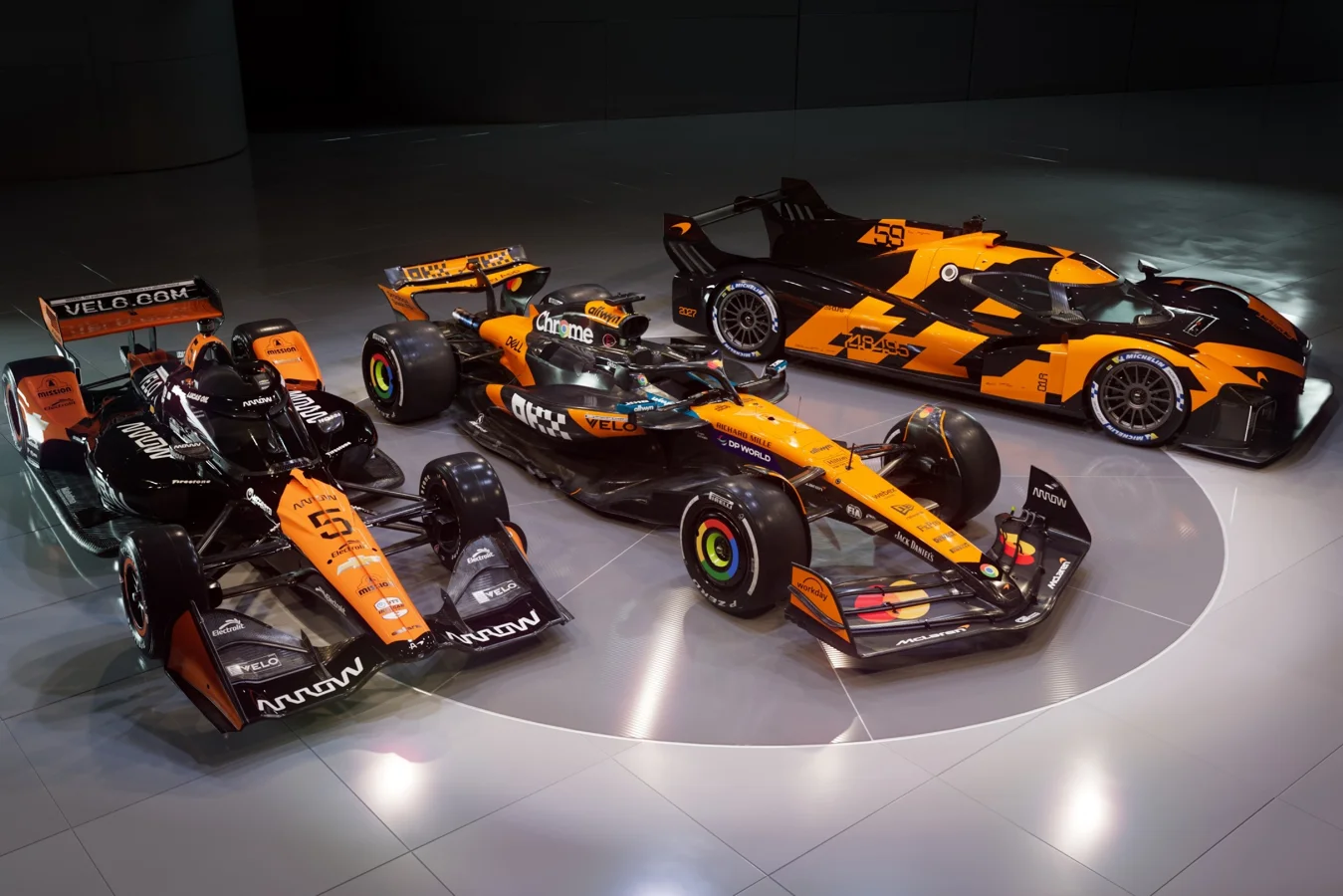

McLaren is on track to build on its 2024 success with the introduction of its 2025 F1 car, targeting continued dominance in the championship by embracing cutting-edge engineering and strategic development. The McLaren 2025 F1 car innovation represents a deliberate step forward, crafted to capitalize on the momentum created by the team‘s 11 wins in 14 races during the current season.
A Rapid Rise to F1 Dominance
After a fiercely contested 2024 season, where McLaren narrowly edged out Ferrari for a Constructors‘ title not seen since 1998, the team now looks set for a more decisive campaign in 2025. The current season’s near-perfect record dwarfs last year’s six victories, placing McLaren drivers Lando Norris and Oscar Piastri in prime contention to succeed Lewis Hamilton as the team’s next world champion. This turning point wasn’t accidental; rather, it reflects years of calculated planning and organizational change within McLaren’s structure under CEO Zak Brown and team principal Andrea Stella.
The McLaren Technology Centre, home to the team’s engineering efforts, was reassessed thoroughly to ensure its considerable talent translated into on-track success. This evaluation led to the extension of key personnel such as aerodynamic expert Peter Prodromou and the recruitment of external innovators, including former Red Bull designer Rob Marshall, both critical to shaping the 2025 challenger, the MCL39.
Recognizing 2025 as the final season under the current technical regulations and with the significant rule changes looming in 2026, McLaren made a strategic decision to innovate boldly rather than wait for the next era. While many teams opted to focus on 2026 development to regain competitiveness, McLaren committed to a progressive and ambitious approach for the MCL39, aiming to build on and surpass its current competitive edge.
At some stage during the 2024 season, we thought that in 2025 we really needed to take a step forward, because we had seen that the top four teams were very, very close to one another, which means that there was a lot of variability in the outcome of a race weekend,
said Andrea Stella during the Hungarian Grand Prix.
That also meant that if you do a little extra effort and you can clear this group, then you may actually compete for very important results on a pretty regular basis.
Strategic Embrace of Engineering Risks
McLaren’s approach to the 2025 car centered on front-loading innovation before the 2026 aerodynamic work period began, freeing resources for the next season if the MCL39’s revolutionary design succeeded. This required extraordinary confidence in the team’s engineering capabilities, especially since many solutions adopted had never been attempted previously by McLaren.
At the same time, we thought, if we are in a good position in 2025 with a strong car, we can release the pressure a bit on ’25 and focus more on ’26. Based on these we decided to go for quite a lot of innovation on the 2025 car, the MCL39, which we have innovated in ways that require quite a bit of courage and commitment, because in some areas we were leaning on the edge of what was our engineering knowledge.
These design choices, kept largely confidential but widely debated, pushed the boundaries of McLaren’s technical knowledge and demanded trust in the Woking engineers’ ability to balance aerodynamic promise with practical implementation.
The team is currently in a position where we can take this sort of engineering risk, and then we will learn along the way,
Stella explained.
You commit to that risk and you trust that you will develop the right engineering, the right processes to actually deliver on some solutions that, for instance, may look good aerodynamically, but actually implementing them on the car may be something that we have never done before.
With this objective in mind, we have innovated pretty much every single area and gained efficiency. And I think results we see on track is the result of this is one extra reason for the entire team to be proud of what we have achieved.
Refined Aerodynamics and Technical Enhancements
The design team’s clever packaging of the MCL39 substantially broadened aerodynamic development opportunities, leading to a car that excels in efficiency—one of McLaren’s historical challenges. This advancement also enhanced tire management during race stints, particularly under hot conditions. However, some aerodynamic compromises initially led to reduced front-end responsiveness in qualifying, which notably affected Lando Norris early in the season but has since improved.
Subsequent updates to the floor and wing components further extracted downforce without incurring additional drag, transforming the MCL39 into a versatile competitor. McLaren’s car now competes strongly across a wider range of circuits, most notably excelling on tracks with medium-speed corners, a shift from its earlier specialization.
The car’s adaptability explains McLaren’s dominant performances on Bahrain and Miami circuits, contrasted with closer contests against Red Bull’s Max Verstappen and Ferrari at high-speed venues like Suzuka and Imola. Mercedes’ George Russell capitalized on Montreal’s challenges as his “hunting ground,” though McLaren consistently ranks among the top three in various track conditions.
Andrea Stella clarified that the team’s aim was not explicitly to create an all-rounder but rather to perfect fundamental design aspects such as cooling efficiency, downforce generation, and tire interaction, resulting in consistent performance across diverse conditions.
We didn’t really think about like: ‘Oh, we want the car to be multi-purpose and good at every single circuit’,
Stella stated.
We just wanted to go for the fundamentals in terms of cooling efficiency, generating as much as downforce as possible in an efficient way, trying to have a good interaction with the tyres. And this kind of seems to pay off, also in terms of versatility and being very consistent car in multiple conditions.
At the same time, when we go into the details, we will see that if we take corners like at the high-speed level of Silverstone, we don’t have the best car. Red Bull and Ferrari may be better than us. Or if we go to a low-speed circuit with kerbing, like in Canada, we were not the best car. So, there are some areas of the range where we are not the quickest. But I think overall, having invested in the fundamentals, we seem to have created a pretty robust package.
Maintaining Momentum and Looking Ahead
Although the team acknowledges it will not dominate every race, particularly at circuits such as Las Vegas—which was dominated by Mercedes last year—McLaren’s stable performance creates a significant championship advantage. This security became evident by the Spanish Grand Prix after a technical directive on flexing front wings, a topic that generated much debate, failed to drastically affect the team’s performance.
Further developments, like the floor upgrade introduced at Spa, demonstrate McLaren’s commitment to refining its cars and not resting on its laurels. Planned improvements to rear wing efficiency aim to bolster competitiveness on lower downforce tracks such as Las Vegas.
For Formula 1 enthusiast observers, McLaren’s clear early lead offers an exciting prospect: a sustained internal championship battle between Norris and Piastri, two highly talented drivers poised to deliver a thrilling title fight. This internal rivalry promises to revive the excitement of a genuine championship challenge, which has been notably absent since the intense 2021 season.
With the technical groundwork firmly established in Woking, McLaren’s future success will depend on the drivers’ ability to maximize the potential of the innovative MCL39, while maintaining the team’s cohesion and focus under leaders Andrea Stella and Zak Brown.