
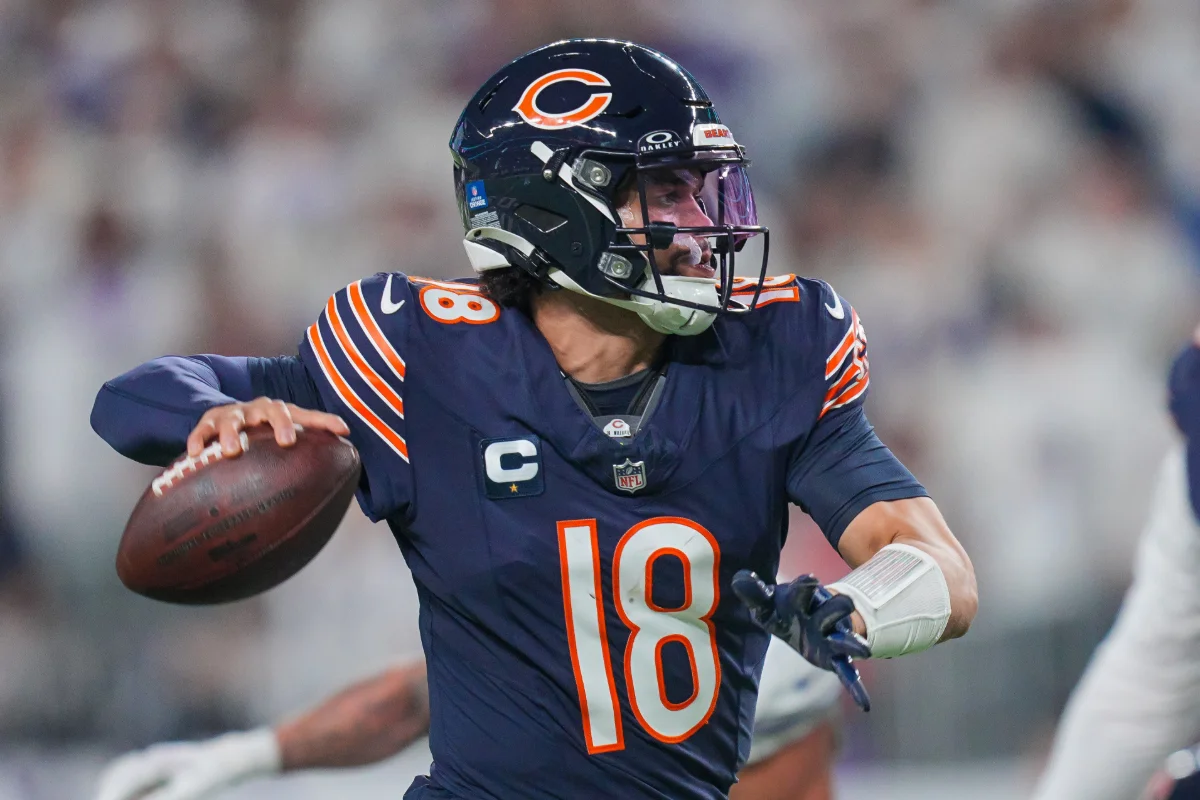

During recent team drills at Halas Hall in Lake Forest, Illinois, second-year quarterback Caleb Williams faced a tough test against the Buffalo Bills’ strong defense, revealing ongoing issues in both his performance and the offensive line’s protection. The Bears’ offensive front, particularly the left tackle position, struggled significantly, committing multiple false starts and penalties, which disrupted the flow and limited Williams’ ability to execute effectively. These troubles spotlight why a cautious approach is vital when evaluating the Caleb Williams Bears fantasy outlook for the upcoming season.
Across approximately 40 plays in 11-on-11 drills, the Bears’ first-string offensive line showed considerable fragility, with at least five false starts and a holding penalty resulting in four sacks allowed. This troubled performance repeatedly put Williams under pressure, hampering his chances to demonstrate growth or confidence. First-year head coach Ben Johnson has acknowledged the line’s instability and is determined to find a consistent starter at left tackle but admitted the team has yet to identify a reliable lineup.
Offensive Line Troubles Highlighted by Head Coach Ben Johnson
Coach Johnson emphasized the need for a clear lead on the offensive line, stressing the importance of stability for success throughout the lengthy season.
“We want one guy to clearly come out and say, this is his job. We haven’t gotten that yet from our crew,”
Johnson said before practice.
“I’d love to have just five guys start on the offensive line for all 17 plus games, but that’s just not reality … and if one guy’s not performing up to snuff, then we’ll find someone else that can.”
The urgency around resolving these line issues is intensified by the lack of options at quarterback. Caleb Williams remains the team’s starter, but he is far from a finished product, making the offensive line’s role in his development even more critical.
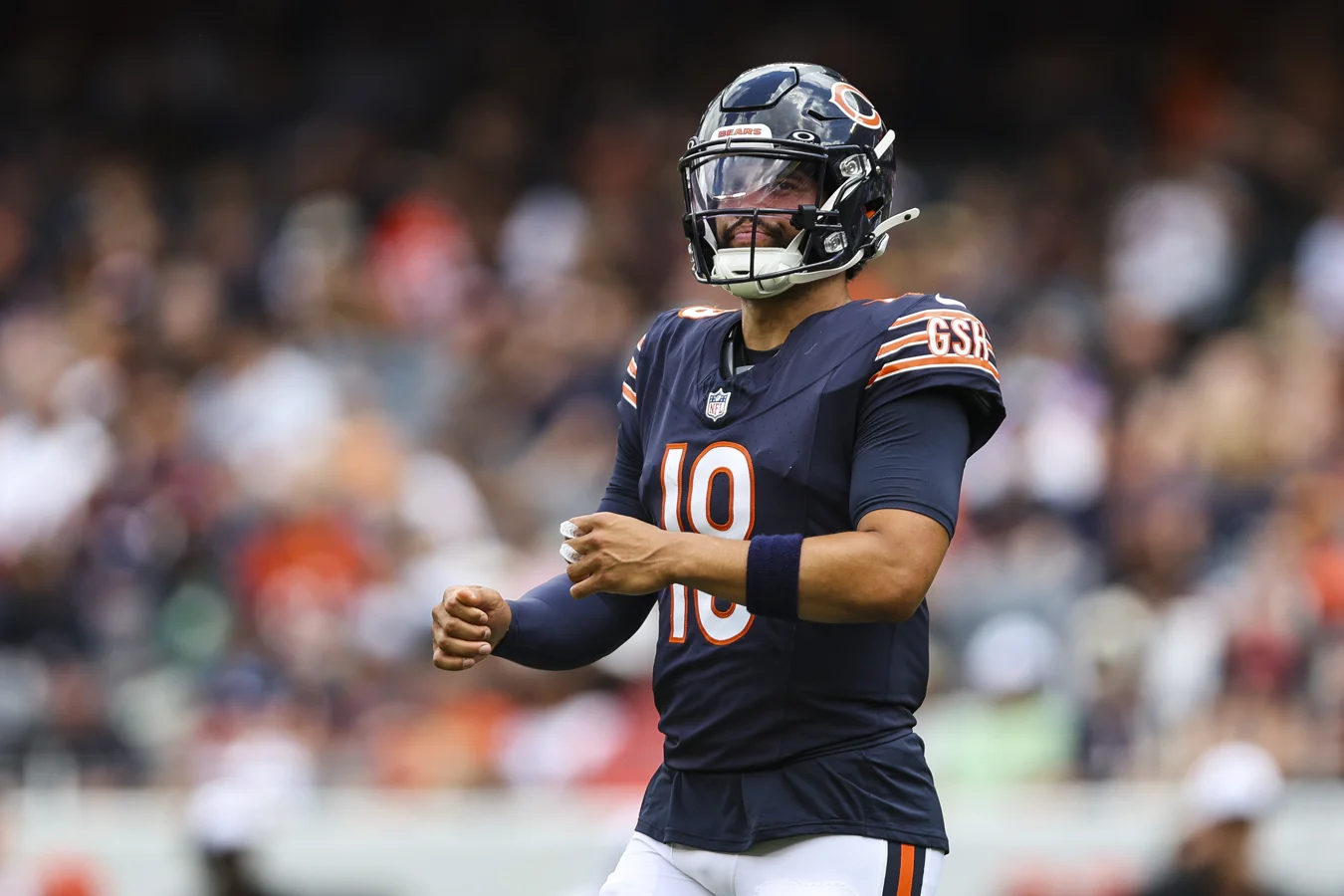
Caleb Williams’ On-Field Performance Displays Growth but Falls Short of Expectations
Williams showed some composure in practice, avoiding turnovers and demonstrating decent command of short routes, predominantly targeting throws within 10 air yards. However, he shied away from aggressively challenging downfield coverage when pressured, with his only deep attempt ending in a contested double coverage scenario. While this outing was an improvement from some previous practices, it still reflected a lack of confidence and the need for continued refinement.
Coach Johnson identified mechanical issues as a factor limiting Williams’ accuracy, particularly involving foot alignment.
“It always starts with the feet for a quarterback. And if you’re not aligned properly from the ground up, then you’re going to have inconsistencies with your target,”
Johnson explained.
“… I think he’s got a very clean he’s got a beautiful throwing motion. I mean, that was ingrained into him at a young age, and I think that still shows up. So there’s nothing mechanically wrong, but it’s just all about the alignment and getting out in front of the target.”
Williams is adapting to Johnson’s offense in his first year running it, but these mechanical challenges could slow his progress and limit the Bears’ offensive ceiling until improvements occur.
Comparative Fantasy Outlook: Where Williams Ranks Among Quarterback Peers
Considering the current inconsistencies, fantasy managers are advised to view Williams cautiously as a No. 2 quarterback option. His upside trails several other emerging and established quarterbacks, including Drake Maye, Brock Purdy, Trevor Lawrence, and J.J. McCarthy, who each appear poised for more significant fantasy impact this season. Without a reliable offensive line to offer protection and a marked advancement in his development, Williams may struggle to unlock the nexus of potential around him.
Wide Receivers Show Potential but Depend on Williams’ Growth
The Bears’ receiving corps, particularly Rome Odunze, possesses strong upside, highlighted by the promising connection demonstrated during practice. Odunze scored twice in team drills—once on an over route for a touchdown from a precise Williams throw, and again by converting an underthrown ball near the goal line into another score. He also made several aggressive downfield efforts, including a 15-yard gain on a post route and a near catch on a deeper corner route, illustrating his ability to create separation and catch contested balls.
D.J. Moore, considered a potential key short-area weapon, did not showcase his deep-threat capability in this session. His targets were limited to short routes such as shallow crosses, hitches, and quick outs, aligning with the team’s effort to have Williams release the ball quickly to avoid pressure. While Moore lined up occasionally in the backfield and received a carry, these touches were modest in impact. Despite this, Moore’s recent history of scoring and target volume supports his reliability as a low-end No. 1 or solid No. 2 fantasy wideout.
Notably, the gap between Odunze and Moore in fantasy rankings has narrowed, with Odunze edging higher due to his developing role and playmaking potential. Both remain outside the top 50 players in PPR and standard formats, reflecting the uncertainty surrounding their production levels amidst offensive line and quarterback concerns.
Tight End Position Holds Promise with Some Reservations
Rookie tight end Colston Loveland showed flashes of impact, including a highlight-reel reception on a laser-accurate throw from Williams gaining over 20 yards. However, Loveland’s participation was limited during red zone drills, as he was seen working separately with the JUGS machine after practice, possibly indicating limited snaps or a cautious approach in his early career.
Given this, fantasy owners should be wary about relying heavily on Loveland early on and consider additional tight end options for depth. His rookie year forecast resembles that of Dalton Kincaid—numerous impressive moments without the volume to match—making Kincaid a potentially more reliable target despite his own uncertainties.
Running Back Group Features Clear Lead but Multiple Contributors
D’Andre Swift solidified his status as the lead running back, though he shared reps with rookie Kyle Monangai during the early portion of practice and latterly with Deion Hankins, an undrafted rookie from Texas State. Backup rusher Ian Wheeler also saw some action, while Roschon Johnson was absent. This distribution reflects normal practice rotations and an expected shared workload during the season.
Swift is viewed as a quality low-end No. 2 fantasy running back, with upside tied closely to his involvement in the passing game. Monangai warrants attention as a late-round selection given his demonstrated physicality and effectiveness in pass protection and receiving, provided he remains healthy. However, contributors like Luther Burden, who displayed strong athleticism and route-running ability with the second team, likely require patience before seeing significant game-time opportunities. Veteran receiver Olamide Zaccheaus remained entrenched with the starters, suggesting Burden will need time to climb the depth chart.
Offensive Strategy Reflects Coach Johnson’s Complex Play Design Approach
Ben Johnson’s offensive scheme is marked by a significant use of motion, shifting formations, and varied personnel groupings, including multiple tight end sets. These tactics aim to force opposing linebackers and safeties into pre-snap discipline challenges, leveraging strategic advantages. The complex play designs showcased against the Bills reveal Johnson’s emphasis on outsmarting defenses, though execution will remain crucial to avoid self-inflicted errors.
Outlook: Cautious Optimism Amid Uncertain Development
The Bears enter the season with palpable potential on offense but face critical hurdles that temper enthusiasm, especially regarding Caleb Williams Bears fantasy outlook. The quarterback’s ongoing mechanical and decision-making refinements, combined with the offensive line’s ongoing instability, form significant barriers to maximizing the team’s skill talent. While players like Odunze and Swift offer intriguing upside, their fantasy success is contingent on better protection and more consistent quarterback play.
Until visible progress emerges in these foundational areas, fantasy managers should maintain guarded expectations for Williams and the offensive unit, considering him more as a developmental No. 2 quarterback option rather than a reliable starter. The coming weeks of camp and early-season performances will be decisive in clarifying the Bears’ offensive trajectory and fantasy viability.