
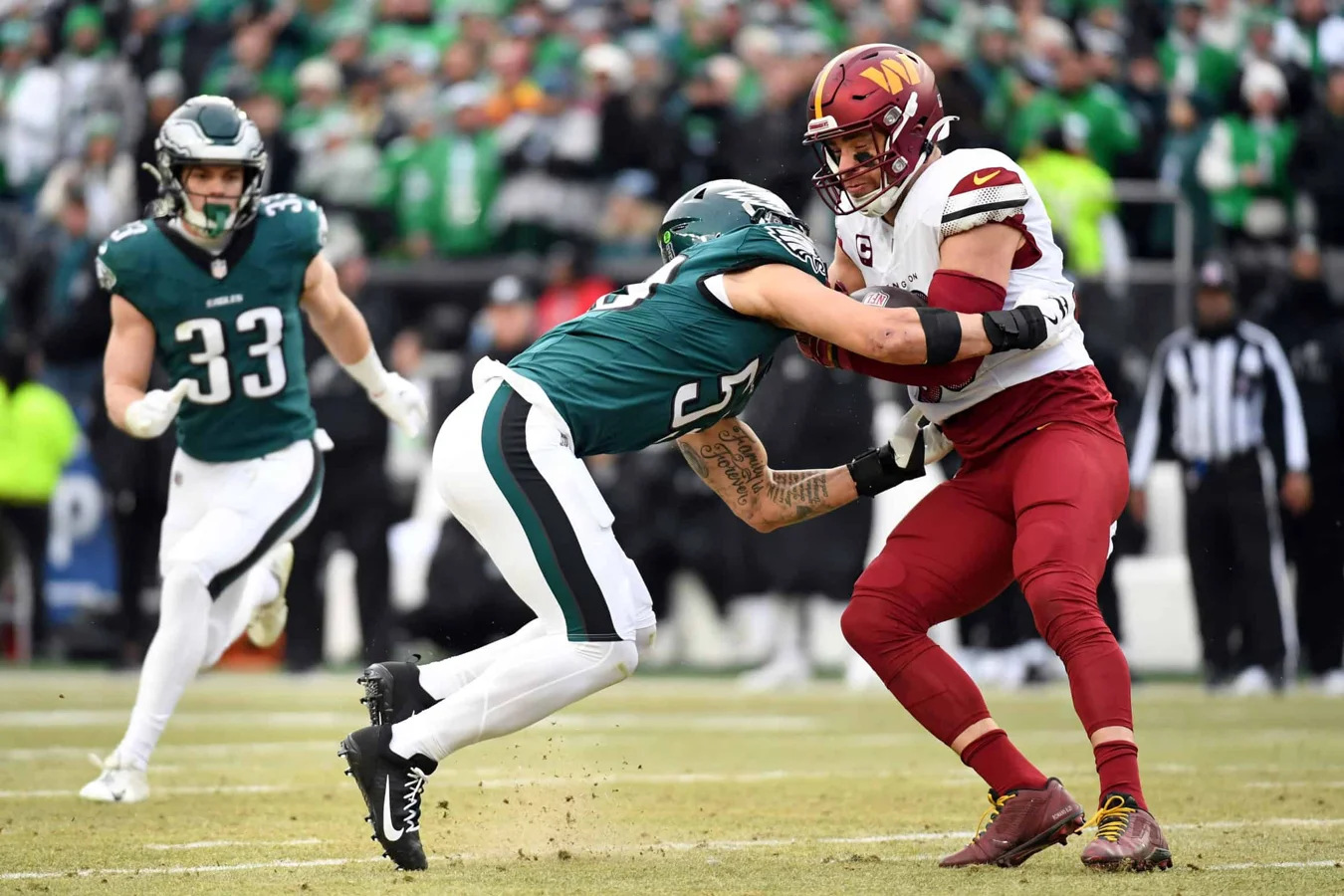

Zach Ertz, the 34-year-old tight end for Washington, remains a notable figure in fantasy football despite entering the later stages of his career. His 2025 fantasy outlook centers on balancing his proven reliability against challenges from age, injury history, and new offensive competition. Ertz’s consistency last season made him a valuable option for fantasy managers, but upcoming changes could alter his role and output.
Recapping Ertz’s Unexpected 2024 Success
In 2024, Ertz delivered strong statistics with 66 receptions, 654 yards, and seven touchdowns over 17 games, finishing as the eighth-ranked tight end in total PPR points. His performance exceeded many expectations, especially for a player considered past his prime. However, much of that success was closely tied to Washington’s limited receiving options, which forced the offense to rely heavily on Ertz as a dependable target.
The team‘s receiving depth was shallow. While Terry McLaurin remained the primary wide receiver, secondary options failed to contribute significantly. Austin Ekeler missed several games due to concussions, and rookie Ben Sinnott recorded only five catches across the season. This lack of alternatives undeniably elevated Ertz’s role within the offense.
Analyzing Ertz’s Target Distribution and Efficiency
During 2024, Ertz captured an 18% share of the team’s targets, second only to McLaurin. This volume solidified his standing as a key target, particularly near the end zone, where his 30.9% target share ranked him second among all NFL tight ends. He was a favored choice for quarterback Jayden Daniels on scoring opportunities, underscoring his integral role in the red zone.
Despite his consistency, Ertz’s efficiency metrics revealed limitations. With a yards-per-route-run ranking of 23rd and low yards-after-catch statistics compared to other tight ends, he proved to be steady but not explosive. This suggests that while he can be counted on to make catches, his ability to generate significant yardage after the catch is limited.
Impact of Deebo Samuel’s Arrival on Ertz’s Role
Washington’s acquisition of Deebo Samuel introduces new competition that threatens to reduce Ertz’s target share. Samuel’s skill set overlaps with Ertz’s, especially on short and intermediate routes, where Ertz found much of his success in 2024. Samuel’s youth and speed give him a strong advantage in converting smaller gains into longer plays, which may lead to Ertz losing opportunities that once helped maintain his fantasy value.
Considering the Effects of Age and Past Injuries
Zach Ertz turns 35 in November, an age at which tight ends often experience a decline in production. Historical data suggests tight ends perform at approximately 63% of their peak fantasy value at this stage, and Ertz’s injury history adds further concern. His record includes three reported concussions, an ACL/MCL tear, and a significant quad injury that sidelined him for ten games in 2023.
These health risks combined with natural age regression create uncertainty about his durability and ability to sustain high-level performance throughout the season. Fantasy managers should weigh these factors carefully when considering him as a core option.
Projected Fantasy Contribution for the 2025 Season
Forecasts for Ertz’s 2025 season estimate around 61 catches, 595 yards, and nearly five touchdowns. These numbers position him as a reliable second-tier tight end (TE2), capable of steady contributions without being a league-winner. In dynasty leagues, he ranks approximately as the 16th tight end, while in seasonal formats, he sits near the 22nd position.
Washington’s decision to re-sign Ertz to a one-year contract worth $6.25 million, with almost $6 million guaranteed, signals the team’s intent to keep him involved. His familiarity with the offense and rapport with Jayden Daniels provide a stable foundation. However, the arrival of Samuel and the development of Ben Sinnott could reduce his opportunities and lower his ceiling.
The Influence of Offensive Coordinator Kliff Kingsbury’s System
Kliff Kingsbury’s role as Washington’s Offensive Coordinator might benefit Ertz, as tight ends in his system saw an increased target share—21% in 2024 compared to his previous tenure in Arizona. This continuity and offensive chemistry could help Ertz maintain a steady volume, leveraging his experience in the scheme and connection with Daniels.
Still, Kingsbury’s system improvements do not guarantee a significant boost for Ertz, especially given his age and a reshaping receiving group. The offensive upgrades might enhance overall production but potentially favor younger, quicker players.
Strategic Considerations for Fantasy Drafts Involving Ertz
Fantasy managers targeting Zach Ertz in 2025 should approach him as a dependable but modest option. He is best considered as a late-round draft choice—between rounds 10 and 12—with the intention of using him as a secondary tight end or insurance policy for riskier starters. While unlikely to deliver flashy performances, his steady role could provide valuable depth.
Expecting a repeat of his 2024 output is unrealistic. Instead, anticipate a solid if unspectacular presence, akin to a utility player who fills gaps effectively without being the star. This tempered expectation aligns with his overall profile entering the season.
Balancing Veteran Experience with Emerging Challenges in 2025
Zach Ertz’s outlook for 2025 fantasy football embodies a complex mix of reliability, physical limitations, and increased competition. His veteran status and proven chemistry with the quarterback make him a safe and experienced option. However, the combined impact of aging, injury concerns, and the presence of Deebo Samuel and Ben Sinnott place notable constraints on his fantasy potential.
In dynasty leagues, Ertz’s value is minimal except as a source of veteran leadership. In standard seasonal formats, he provides a viable TE2 choice who occasionally could have a strong game but should not be relied upon to carry a team to a championship. Drafting Ertz at value is advisable, but fantasy managers should prioritize younger, higher-upside targets when given the chance.