


As fantasy football drafts approach for the 2025 season, identifying potential breakout stars remains a popular focus. However, avoiding players likely to underperform, especially those with inflated expectations like James Cook, is just as crucial. Concerns about James Cook fantasy football busts arise amid questions about his role in Buffalo’s offense and possible declines in production.
Evaluating James Cook’s Role and Recent Performance
James Cook secured a four-year, $48 million contract with the Buffalo Bills on August 13, 2024, guaranteeing his status as the team‘s lead running back. Despite this commitment, several factors suggest his fantasy prospects may not meet expectations in 2025.
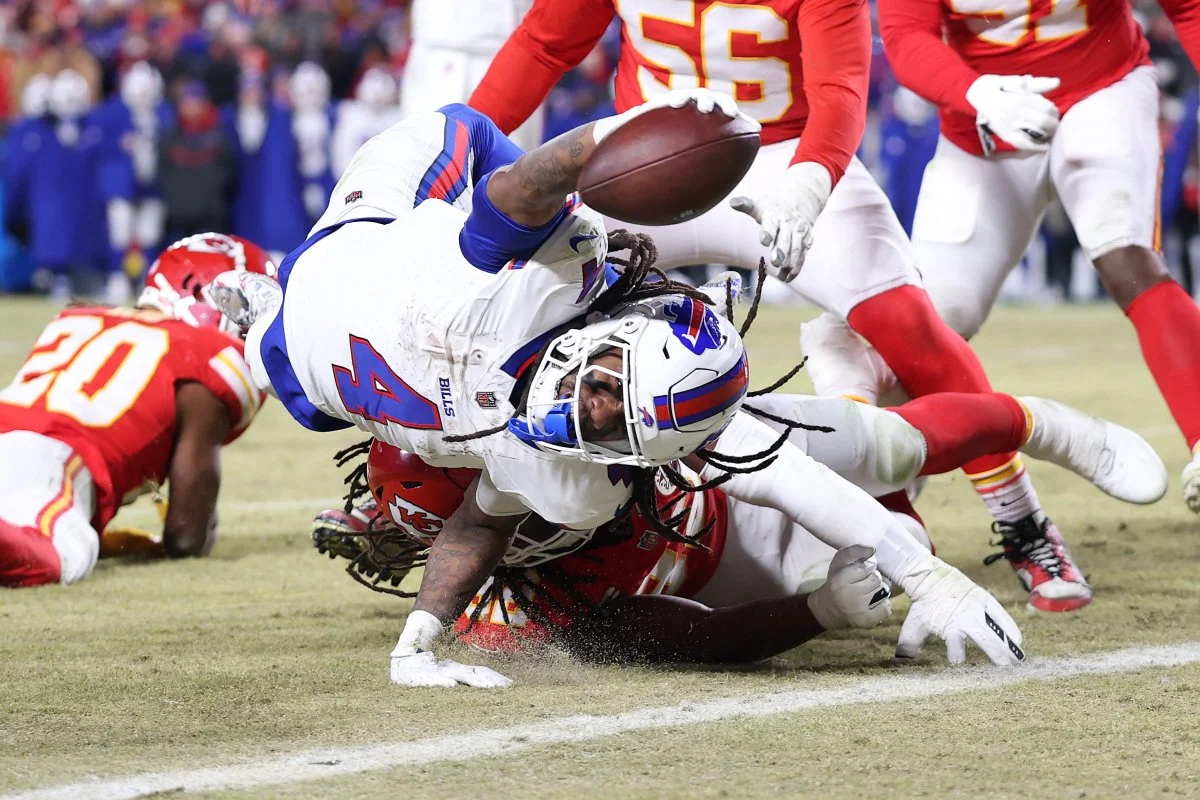
In 2024, Cook ranked as the RB11 in PPR points per game, averaging 16.7. He rushed 207 times for 1,009 yards and 16 touchdowns, while also collecting 32 receptions out of 38 targets for 258 yards and two receiving touchdowns. Although Cook was second among all skill players in total touchdowns with 18, he failed to crack the top 10 running backs overall due to diminished volume, particularly in the passing game.
Buffalo’s offense utilized a situational three-back system in 2024, with rookies Ray Davis and Ty Johnson earning meaningful snaps alongside Cook. Davis impressed as a rookie, increasing his potential role in the offense for 2025, while Johnson maintained a 40% snap share during crucial playoff games when all three backs were healthy. Thus, Cook faces competition for touches, which may limit his upside despite his lucrative contract.
Other Notable Fantasy Bust Candidates for 2025
Jared Goff’s Uncertain Fantasy Value Amid Team Changes
Detroit Lions quarterback Jared Goff has experienced his most consistent performance over the past three years under offensive coordinator Ben Johnson, with an average completion rate of 68.1% and solid passing stats. However, fantasy success has eluded him, as his only top-12 finish at quarterback since 2022 was a QB7 ranking in 19.1 points per game.
For 2025, the Lions face significant changes, including replacing their offensive coordinator with John Morton, who has limited play-calling experience. They also plan to revamp the interior offensive line with two new starters—a recent sixth-round pick, Christian Mahogany, and second-round rookie Tate Ratledge. Goff lacks rushing upside, so being drafted as the QB10 at his current ADP is risky considering these uncertainties.
Kyren Williams Faces Efficiency Challenges Despite High Usage
Los Angeles Rams running back Kyren Williams entered 2024 after finishing as the RB2 in PPR points per game in 2023. He greatly increased his workload, carrying the ball 316 times for 1,299 yards and 14 touchdowns while catching 34 passes for 206 yards and three receiving touchdowns. However, his points per game dropped to RB10, mainly due to declining efficiency.
Williams recorded just 4.2 yards per touch and ranked low in breakaway runs, signaling that his volume was high but his playmaking was limited. The Rams’ drafting of Auburn running back Jarquez Hunter hints the team might seek more explosive plays from their backfield. If Williams’ workload decreases, his fantasy value could diminish sharply, given his dependence on volume production.
Tyreek Hill’s Declining Production and Offseason Concerns
Wide receiver Tyreek Hill endured a difficult 2024 season with a wrist injury, quarterback changes, and a struggling Miami Dolphins offense. He averaged just 12.8 PPR points per game—his lowest since his rookie year—and finished WR30 among qualifying receivers. His effectiveness was reflected in multiple metrics: WR49 in average target depth, WR25 in deep targets, WR64 in yards per target, and WR66 in yards per reception, culminating in the lowest yards per route run of his entire career.
Offseason developments worsened Hill’s outlook. Reported friction with quarterback Tua Tagovailoa and head coach Mike McDaniel, alongside trade rumors, signal instability. Despite being drafted as WR12, Hill’s age (31) and the fragile Dolphins offense create a precarious fantasy situation. While some improvement over 2024 seems likely, betting on him regaining his previous elite performance is risky.
Zay Flowers’ Limited Fantasy Ceiling Despite Steady Usage
Baltimore Ravens wide receiver Zay Flowers has been a reliable contributor since his 2023 first-round selection. Over two years, he has averaged 112 targets, 75.5 receptions, 958.5 yards, and 4.5 touchdowns per season. Nevertheless, his fantasy production has been inconsistent, failing to finish inside the top 30 receivers in PPR points and hovering around 12-13 points per game.
Flowers operates mostly as a short- to intermediate-range receiving threat who excels after the catch, but he struggles in the red zone. His career catches on five of 13 end zone targets over two seasons highlight this limitation. Baltimore’s offense emphasizes establishing the run with Derrick Henry and dispersing targets among multiple receivers, which caps Flowers’ upside amid Rashod Bateman’s continued rise. This trend is unlikely to reverse in 2025.
Dalton Kincaid’s Struggle for a Consistent Role in Buffalo’s Offense
Drafted by the Bills in the first round of 2023, tight end Dalton Kincaid has yet to secure a significant role in their passing game. In 2024, he ranked TE18 in PPR points with 7.8 per game, catching 44 passes on 75 targets for 448 yards and two touchdowns across 13 games. However, Kincaid has not been able to stand out among the team’s many receiving options.
Kincaid’s snap share and route participation have been modest compared to veteran Dawson Knox, who remains on the roster along with new addition Joshua Palmer. In 2024, Kincaid was ranked TE32 in snap share and TE27 in routes run, reflecting his status as a part-time contributor. Without a clear breakout in playing time, trusting him as a reliable fantasy asset remains questionable for the 2025 season.
What This Means for Fantasy Draft Strategy Moving Forward
While fantasy football drafts often emphasize targeting promising sleepers, recognizing potential busts like James Cook could be more impactful for a winning roster. Cook’s situation—with a high-profile contract, but a shared backfield and uncertain volume—exemplifies the tension between opportunity and efficiency that fantasy managers must balance.
The cases of other players such as Jared Goff, Kyren Williams, Tyreek Hill, Zay Flowers, and Dalton Kincaid reinforce the need to critically evaluate roles, supporting casts, and team changes. Many boast positive surface statistics but face underlying issues like inefficiency, limited roles, or an unstable team environment that could derail expectations.
Ultimately, avoiding players with concerning signals may prove as vital as chasing stars in 2025. As fantasy drafts draw near, careful consideration of these bust candidates aligned with the latest team developments and player usage patterns can prevent costly mistakes and improve chances of success.