
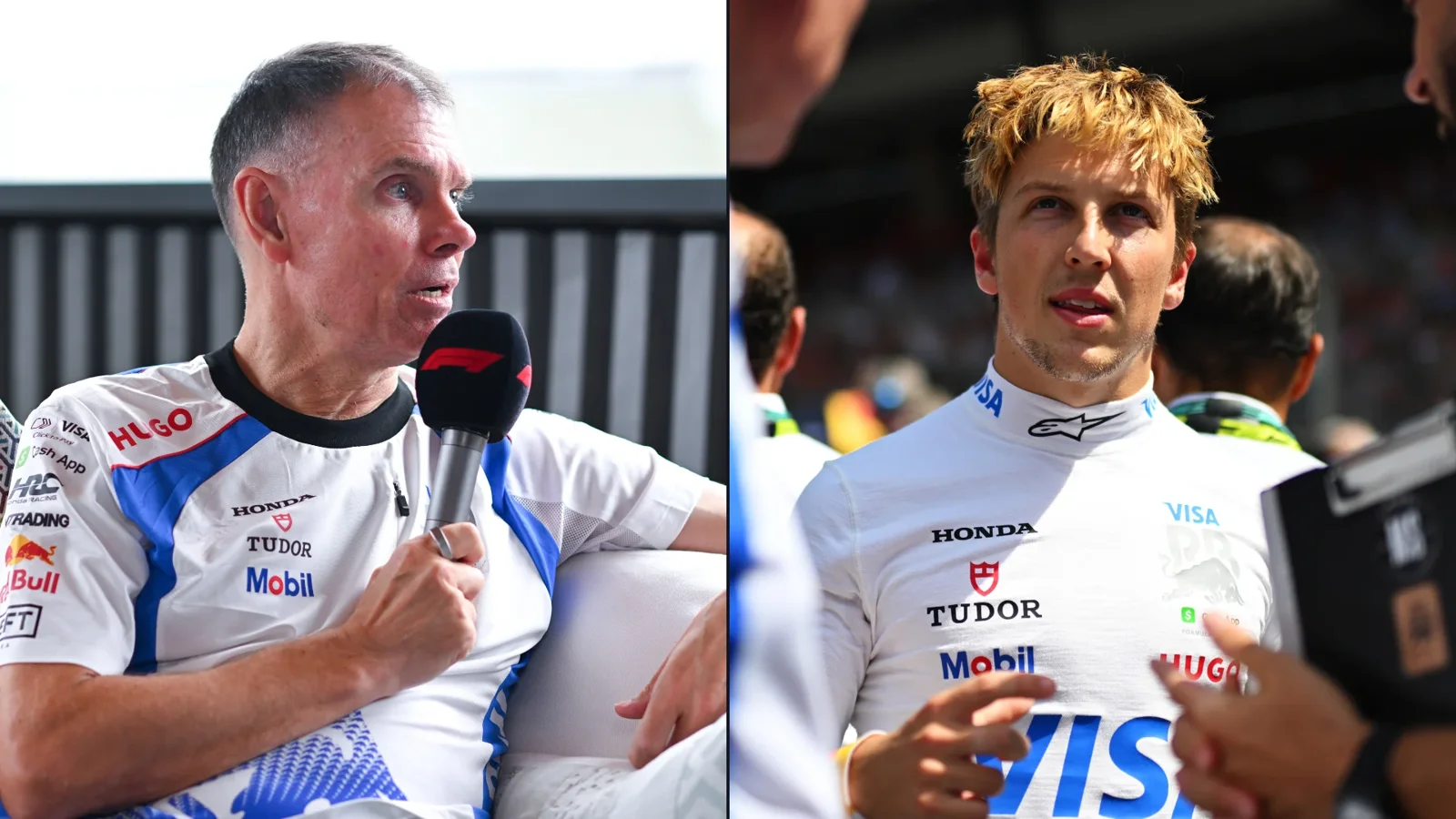

Liam Lawson’s F1 comeback battle has intensified after Red Bull Racing shifted him to their Racing Bulls second team early in the 2025 season. This move, announced in the spring, came as Red Bull chose to replace Lawson with Yuki Tsunoda in their main squad. Helmut Marko, Red Bull’s motorsport advisor, clarified that this change was not a demotion but a strategic decision aimed at helping Lawson regain form and confidence following early difficulties during pre-season testing and the race opener in Bahrain and Australia.
Challenging start slows Lawson’s momentum
Lawson’s difficulties began with a disrupted third practice session in Australia, which unsettled his confidence and contributed to a string of underwhelming performances. Marko noted,
“The change happened after a start that I’d say was rather unfortunate,”
referring to Lawson’s struggles during the initial events of the season. The negative cycle prompted Red Bull to act quickly to secure Lawson’s future by giving him an opportunity to rebuild with Racing Bulls, a team with a more manageable car than the RB21 he initially drove.
This reshuffle fueled speculation about whether Lawson would complete the season, especially with the emergence of Arvid Lindblad, a rookie in Formula 2 whose rapid progress suggested he might be fast-tracked to Red Bull’s main team. Adding to the pressure on Lawson were his early failures to score points and his inability to match the pace of his Racing Bulls teammate, Isack Hadjar, who quickly established himself as one of the best rookies in 2025.
Lawson stabilizes and shows promising signs in summer races
Despite a rocky start, Lawson has demonstrated improvement through the summer racing calendar, helping to quiet doubts over his future in Formula 1. Racing Bulls team principal Alan Permane praised Lawson’s performance during the Hungarian Grand Prix weekend, acknowledging the difficult transition but highlighting his progress. Permane explained,
“He’s done a great job, honestly. Two races at Red Bull, obviously, were very tough for him. He won’t thank me for saying this, but he definitely was a bit downbeat.”
Permane also detailed the difficulty Lawson faced jumping into a new car without prior testing, contrasting him with Hadjar, who had already impressed with multiple top-10 qualifying results and points finishes early in the season. Lawson’s slow adaptation was evident: in his first five races with Racing Bulls, he failed to reach Q3 or score, while Hadjar qualified in Q3 three times and scored points in Japan and Saudi Arabia.
Technical updates spark a turnaround
Lawson’s form began to improve starting from the Monaco Grand Prix, where consistent qualifying performances allowed Racing Bulls to implement strong strategies that benefited both drivers. A key factor behind Lawson’s resurgence was the introduction of front suspension upgrades developed with extensive simulator testing, which Permane said gave Lawson renewed enthusiasm and comfort behind the wheel.
Permane remarked,
“We saw in Spa again, he’s performing. You could see after that race… Monaco was a decent race for him, but Austria, he had a spring back in his step.”
This technical boost helped Lawson earn points finishes in Austria, Belgium, and Hungary, notably finishing ahead of Max Verstappen in Budapest by executing an effective one-stop strategy. Through this period, Lawson’s confidence visibly improved although he personally maintained that his self-belief was constant throughout the year.
Lawson addresses perceptions of his confidence
When confronted with assessments of his earlier form and morale, Lawson dismissed notions that he had been downbeat, stating,
“Look, everybody is going to have their own opinions and is going to make judgements when they see somebody. So that’s fine, but I know how I feel.”
His relaxed demeanor signals a more assured driver compared to the reserved figure seen in Red Bull overalls during the season’s early struggles.
Lawson admitted to subtle yet important changes that improved his comfort in the car since Austria, emphasizing the consistency he has found recently but also acknowledging the challenge of maintaining it over the long run:
“To be honest, nothing huge has changed, other than some small things in the car, and small things to me that have helped get me comfortable in the car… We just had a lot of small things through that first part of the year, and the consistency wasn’t there, and now it is, but also it’s very tough to keep that, so we need to try and focus on keeping that.”
Comparing Lawson’s and Tsunoda’s performances post-switch
Lawson’s resurgence gains further significance when compared to Yuki Tsunoda, who currently holds Lawson’s former spot at Red Bull but has faced his own difficult run. Since joining the main Red Bull team, Tsunoda has finished in the top ten only twice, with a points drought stretching back to Monaco. Lawson, by contrast, has made Q3 four times and frequently started ahead of Tsunoda on the grid, despite the latter having a technically superior car.
This contrast suggests that Lawson’s initial troubles were not solely due to his driving. Tsunoda’s ongoing struggles have kept the battle for Red Bull’s second seat uncertain, maintaining the possibility of Lawson earning a return later in the season.
Lawson remains focused on the present amid ongoing speculation
When questioned about his aspirations to rejoin Red Bull’s top team, Lawson emphasized his concentration on performance rather than future projections:
“It’s been so busy this year that I’m not really thinking about it. I’m focused on having some good races, obviously we’ve had some recently, but three of them isn’t enough over 12 races or however many it’s been, so we need to do more of this, and then we’ll see.”
Entering the summer break with 20 points, just two behind Hadjar, Lawson has effectively quelled some criticism suggesting his career might be faltering. With upcoming races on circuits where he holds prior F1 experience, he is poised to build on this platform during the second half of the season.
Lawson expressed optimism about the latter part of the year while also welcoming a break:
“Yeah, I think it’s obviously good to go to tracks that you’ve done in F1, and some tracks that I really enjoy as well coming up. So yeah, I think the second half’s going to be exciting, I’m looking forward to it, but I’m definitely also looking forward to a few weeks off.”
Red Bull’s future plans remain unclear amid driver challenges
Historically, Red Bull under Christian Horner has rarely allowed drivers who struggled in the main squad to return, even in cases such as Pierre Gasly, who won races and secured podiums with AlphaTauri but was not recalled. Yet the current situation with Tsunoda’s inconsistent results leaves uncertainty about whether that policy might be reassessed.
Insiders reveal that Laurent Mekies, who assumed a leadership role in July, is willing to give Tsunoda additional time, factoring in the performance gap caused by car specifications compared to Max Verstappen’s dominant RB19. During recent events in Spa and Hungary, Tsunoda demonstrated moments of improvement, including a qualifying lap close to Verstappen’s pace despite a Q1 exit. Nevertheless, Red Bull continues to weigh all options for its second seat going forward.
Lawson’s improved form could change the outlook for 2025 and beyond
While it would be premature to declare Liam Lawson’s return to Red Bull’s main team assured, his recent performances have revitalized his position as a serious contender. Marko’s suggestion that the early-season shift might prove a blessing in disguise appears increasingly plausible, as Lawson has arrested his downward trajectory and now holds a platform from which to await new opportunities within one of F1’s most competitive setups.
With limited alternatives currently available and uncertainty surrounding Tsunoda’s consistency, Lawson’s resurgence could prove pivotal in influencing Red Bull’s driver lineup decisions for the remainder of the 2025 season and perhaps into 2026.