
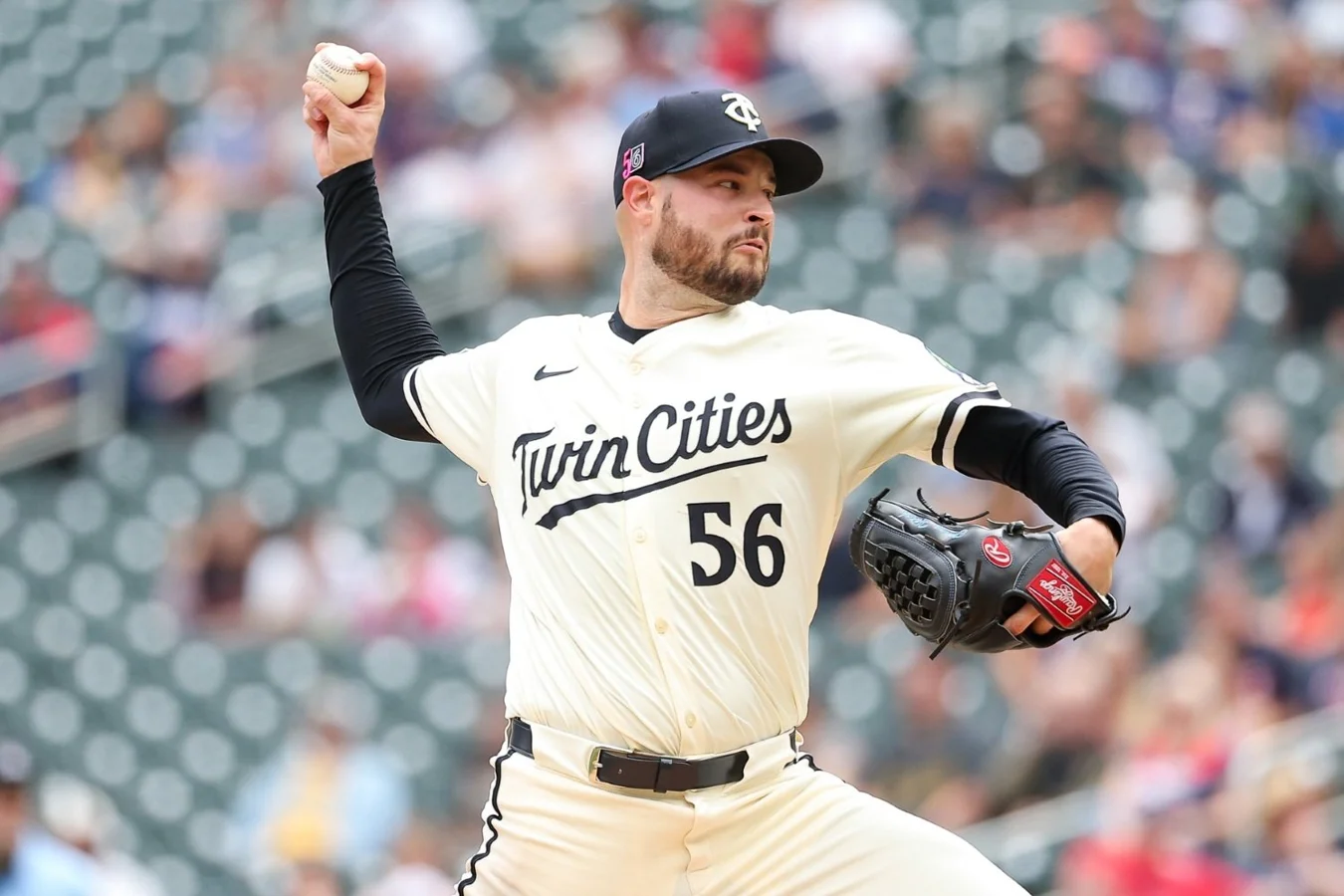

The Minnesota Twins have been reshaping their roster following a significant trade deadline, creating opportunities for fresh talent like Thomas Hatch to prove himself. Claiming Hatch off waivers gives the Twins a chance to add a player under team control for four more seasons, similar to how they have benefited previously from players like Willi Castro and Kody Clemens. Hatch’s journey is unique, and while it’s uncertain if he will reach similar heights, his evolving pitching profile makes him an intriguing candidate for the Twins.
From Prospect to International Starter
Thomas Hatch began the 2020 season as a starting pitcher with the Blue Jays’ Double-A team, ranking as their ninth-best prospect at the time. His role shifted mostly to relief appearances in the following years, and by 2023, the Blue Jays designated him for assignment. The Pittsburgh Pirates claimed Hatch but released him after that season. Initially signing for a Korean league stint, Hatch instead played in Japan‘s Nippon Professional Baseball (NPB) with the Hiroshima Carp in 2024, where he was transitioned back to a starting role and worked on expanding his pitch selection.
Development and Adaptation in the American Minors
Returning to the United States in 2025, Hatch signed a minor league contract with the Kansas City Royals, pitching as a starter for their Triple-A affiliate, the Omaha Storm Chasers. He earned recognition as their pitcher of the month in July, resulting in a major league call-up. However, he was released again at the trade deadline. His time in Japan and with the Royals allowed him to experiment with new pitches, including adding a true cutter and a sweeping breaking ball to his arsenal for the first time.

Six-Pitch Arsenal and Technological Insights
Hatch has developed a rare six-pitch mix, an unusual feature for someone who has spent time as a reliever but indicative of his background as a starter and his commitment to refine his craft. His focus on integrating baseball technology has been vital in this process.
“Coming back over here [from Japan], it was refreshing to get back in front of TrackMan, Edgertronics, where I could see the ball come out of my hand—pitch tracking, stuff like that,”
Hatch explained. Using tools like TrackMan has helped him enhance his cutter and changeup dramatically by increasing spin rates and movement.
Leveraging Technology to Maximize Pitch Movement
Technology has also provided Hatch with new biomechanical insights. He described,
“That’s one of the beauties of technology, is we’ve discovered that even supinators can get the ball to go arm-side. And even honestly, it’s easier than a pronator for the most part. Usually, pronators are good at ‘riding the ball.’ Not seam-shift changeups, but more so spin-based, because they can get to the inside of the ball, whereas [supinators] are using seam shift to get the ball to go arm side. Which we didn’t know prior to Hawkeye, TrackMan.”
This understanding allowed him to increase active spin, improving his breaking pitches. His changeup, which averaged just 6.4 inches of movement in 2023, now shows about 15 inches of break, while his cutter evolved into a genuine slider. Hatch discussed this evolution:
“It was weird: we called it a cutter, previous to me going to Japan, mostly just as a mental thing. It was a slider. But then I was like, ‘You know what? I need something hard going in to lefties.’ Because two-seams from right-handed pitching to left-handed hitters are not exactly the best pitch to throw, so [the cutter] really keeps people off of fastballs.”
Ongoing Improvements and Challenges with Command
Despite these advances, Hatch acknowledges his changeup remains a work in progress and a crucial piece of his pitching toolkit.
“I think the changeup is a kind of a work in progress at this point. That’s the missing piece, I feel like. We’ve been working on splits, changeups,”
he said. Statistically, Hatch has struggled to establish dominance, with a 5.17 FIP across three games with the Twins. Control issues persist as he walks too many batters and lacks consistent strikeouts, but improvements in pitch variety and movement suggest progress as he approaches his 31st birthday.
Twins’ Approach to Developing Data-Driven Pitchers
The Minnesota Twins have a noted history of successfully refining pitchers who are willing to tinker and use data to improve their performances. Hatch fits this mold perfectly, showing a commitment to evolving his pitch mix and mechanics. While his current role remains uncertain, especially as the Twins anticipate returns of key starters Pablo López, Simeon Woods Richardson, and David Festa, Hatch may find a niche as a versatile swingman or reliable back-end bullpen option.
Potential Impact and Future Outlook
Hatch’s ability to limit hard contact—ranking in the 85th percentile for average exit velocity allowed—paired with his high groundball rate, provides a foundation for success. His slightly below-average velocity raises questions about the impact of added speed, an area where the Twins have been known to help pitchers gain extra miles per hour. With the Twins needing to rebuild much of their bullpen for 2026, Hatch’s affordability and versatility could make him a valuable piece in their plans if his development continues to trend positively.