
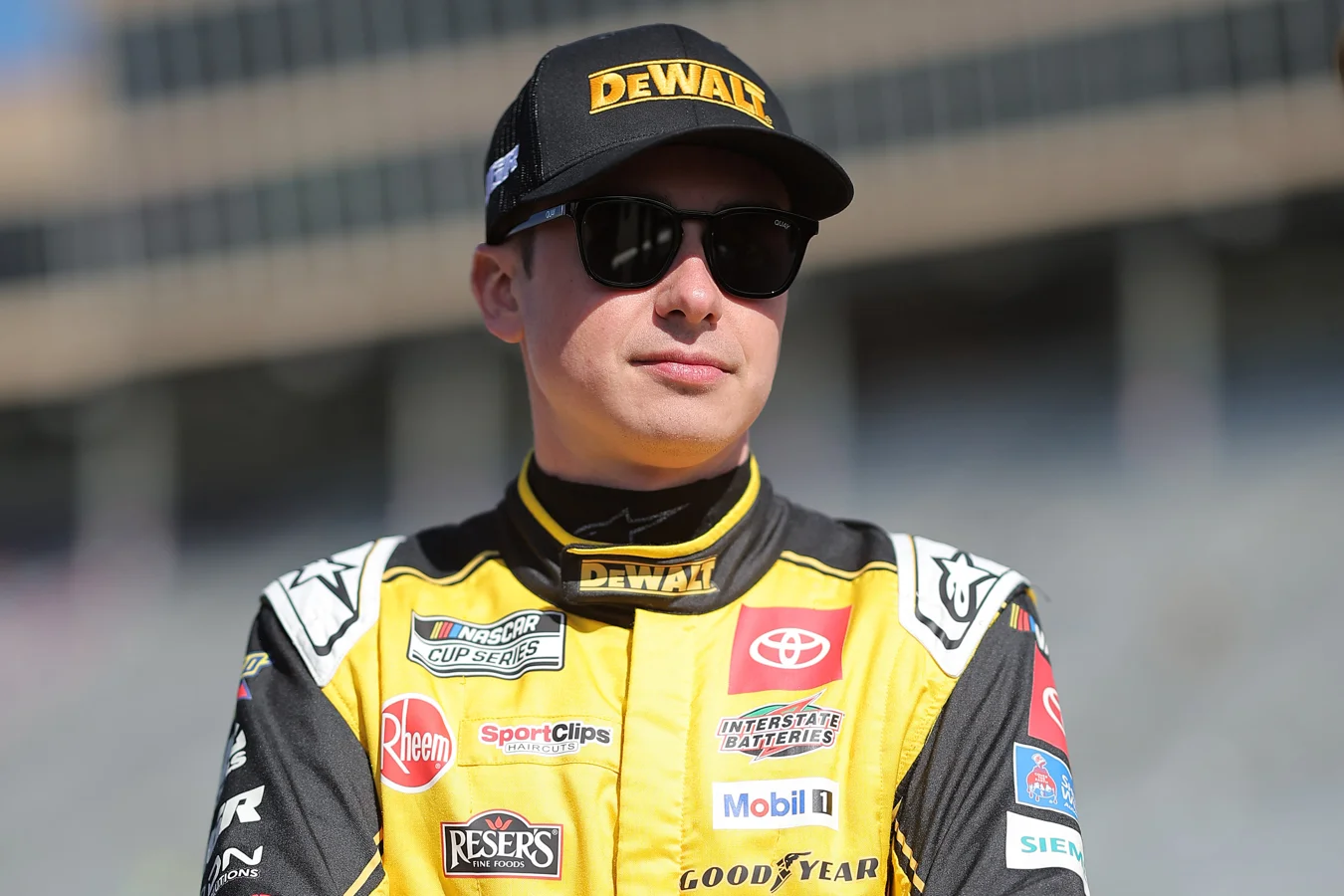

After finishing second at Watkins Glen on August 10, Christopher Bell has positioned himself sixth in the NASCAR Cup standings. This runner-up spot marked his third top-10 finish across the last six events, signaling a renewed momentum in his NASCAR Cup campaign. Bell began the season strong, securing three consecutive wins following a disappointing 31st-place result at the Daytona 500, yet has since struggled to return to Victory Lane. With the Cup playoffs scheduled to start on August 31 at Darlington, Bell’s recent performances suggest he is primed to make a significant impact.
A Lifelong Racer: Bell’s Early Years on Dirt Tracks
Born and raised in Norman, Oklahoma, Bell’s journey in racing began at just five years old, with his earliest exploits on dirt circuits running micro-sprint and midget cars. His persistence and skill earned him attention from Toyota Racing Development, an opportunity that paved his way into the NASCAR Truck Series in 2015. After several successful years, Bell advanced to the premier NASCAR Cup Series, joining Joe Gibbs Racing in 2021. His experience on dirt tracks shaped his aggressive driving style and provided a foundation for his racing career on asphalt.
Bell Recalls His First Racing Experience
In a recent interview with Sports Illustrated, Bell vividly recounted his initial encounter with racing at a dirt track thanks to his parents and his father’s friend, known as Uncle Will. Reflecting on the nerves he faced at age five, Bell said,

“When I was five years old my parents and my dad’s friend—I call him my Uncle Will—they took me to a dirt track in Oklahoma. And I remember getting to the racetrack and being super nervous. Like we had this planned out: They rented a car for the day; we ran all around town making sure that I had a fire suit, a helmet, shoes. But when it came to the time to race, I was super nervous. My mom actually had to bribe me to get in the car. Oh, my gosh. And then once I got in the car, man, it was it just game over. I was hooked. And that was my Welcome to Racing moment. Like that first time that I drove the car I said, Why would I want to do anything else? And I was a five-year-old kid at the time. It was just like the most surreal feeling and a moment that I’ll never forget for the rest of my life.” —Christopher Bell
When asked what his mother used as a bribe, Bell revealed she offered a video game, saying,
“She bribed me with a video game. I was a big into—I don’t know what it was—Nintendo 64 or whatever it was back in the day. She said, ‘You have to drive this car.’ And I did. I drove drove the car, and I fell in love with it.” —Christopher Bell
Growing Up with Racing as a Central Passion
Though Bell’s family had no prior involvement in motor sports—his father was a high school basketball coach—his racing path was largely influenced by Uncle Will, who was deeply connected to dirt track racing. Bell explained,
“My family was not into motor sports. It was my dad’s friend: I call him Uncle Will. His name is Will Orr. He raced and he’d been around racing his whole life. His kid raced at the dirt track there in Oklahoma City, and Uncle Will took me to a race and I became attached to it, and my love for it grew. And Uncle Will said, ‘Hey, look, you want to try and let him drive and see what happens?’ And that’s what led us out there and the rest of it is history.” —Christopher Bell
Bell acknowledged the challenges of breaking into racing, especially without direct family connections or easy access to resources, crediting Uncle Will for guiding his early development. Over time, what started as a hobby evolved into a family affair. Bell recalled that by his teenage years, he was often responsible for not only driving the race truck and trailer due to his mother’s road driving limitations but also serving as a bonding opportunity for the entire family.
“We started it out as just this hobby and this thing that their son enjoyed doing. And so, on the weekends, they would take me out to the dirt track and go race. And then it turned into something that we all enjoyed doing and spending a ton of quality time on, just traveling up and down the highway. I remember when I got into my teenage years my dad actually took a new job and was away from home a little bit, so my mom would take me racing—and she could not drive a truck trailer at all. So, I was 15 years old with my learner’s permit, and I was the one driving the truck and trailer to the track. It definitely became a family bonding thing, and it was an enjoyable time throughout my childhood, for sure. For all of us—for me and my parents.” —Christopher Bell
Choosing Racing Over Traditional Education
Bell’s dedication to racing became clear during his school years. While he enjoyed sports growing up—especially football and basketball, influenced by his father’s coaching career—the increasing demands of competitive school sports began to clash with his racing ambitions. He decided to pursue racing full-time, leaving high school during his sophomore year to focus exclusively on his career. He shared,
“When I got into high school and the talk was about, ‘What do you want to do in college? What are you going to do with your life?’ It became apparent that I didn’t really have desire to do that… I ended up dropping out of high school in my sophomore year, and I just kind of dedicated my life to racing. And I said, ‘You know what? I’m gonna make racing my job.’ And I never thought in a million years I’d be a NASCAR driver. I thought that I’d just be a professional dirt racer and I would make it happen.” —Christopher Bell
Key Opportunity and Climbing the Racing Ladder
Before entering NASCAR, Bell’s progress was fueled by a crucial partnership with Darren Ruston, who provided him access to superior equipment and engines, enabling Bell to showcase his potential against stronger competition. This break proved pivotal in establishing Bell’s reputation and opening doors for advancement. He noted,
“It was a man by the name of Darren Ruston. He was the one who gave me my first big break, and he has ties with NASCAR. His daughter was [former driver] Kenzie Russon. She’s actually married to [truck series driver] Daniel Hemric now… Darren Ruston gave me my first opportunity in great equipment, and his cars were superfast, he had great engines, and it allowed me to really showcase my talent.” —Christopher Bell
Bell took his first NASCAR start in 2015 after progressing through various dirt track levels, eventually earning a spot with Toyota Racing Development. This transition marked his entry into more prominent racing series, setting the stage for the future jump to NASCAR’s top divisions.
Adjusting to Asphalt Racing Challenges
Bell’s background on dirt tracks gave him a distinct advantage in speed once racing on asphalt began, due to his ability to control vehicles on slippery, unstable surfaces. Despite this, he acknowledged the complexity of adapting to the strategic patience demanded in asphalt racing’s longer format. He explained,
“As soon as I got into asphalt racing I was pretty fast right away… Dirt is—it’s hard to drive, right? Because the car’s sliding around and you’re constantly battling the car on the track. So, I think that allowed me to have speed on asphalt because asphalt has a lot more grip… The thing that was extremely hard for me when I got to the asphalt side was just the style of racing. Growing up, dirt track racing—like I did sprint car races, which are very short. They’re sprints, so you drive hard and you don’t really have to have patience or finesse. You’re just kind of all out all the time. And then when I got into the asphalt racing, the stock car stuff, it took me a while… These are not sprint races that we’re doing. They’re very long-distance races, and you can’t be all out all the time, otherwise you make mistakes and end up crashing out… just learning the discipline of racing on asphalt was hard, but going fast was easy.” —Christopher Bell
Understanding the Endurance Aspect of Cup Racing
Bell likened NASCAR races to endurance events, noting how race distances expand with each step up the racing hierarchy—from the Truck Series to Xfinity and then the Cup Series. He recalled his initial surprise at race lengths,
“The first time that I went truck racing I was like, Man, these races are so long! A truck race is 100 to 150 laps, most of the time. And I was like, This is just such a long race… Now here I am in the Cup series, where you do 500-mile races, and now truck races seem short. But I do remember that day that I went truck racing, and I was like, Man, these races are so long. How do you how do you do this?” —Christopher Bell
Advice for Aspiring Racers Pursuing NASCAR Careers
Bell encourages young drivers to distinguish themselves through performance and persistence, even without substantial financial support. His message is clear: consistent winning and standing out create opportunities in racing. He told Sports Illustrated,
“There is the narrative out there that you have to have money, you have to have financial backing in order to make it to the top. And I always say that it can be done without it—you just have to stand out from the rest. It’s very difficult to do that, but winners won’t be ignored, and winners won’t be denied. And if you continue to win at whatever discipline you’re in, and you stand out from the rest, there’s a likelihood of you getting an opportunity to move up. If you do move up, you’ve got to continue to stand out from the competition, and, you know, be a winner. So, my advice to kids growing up is if you want to make this your job, and you want to be at the top level, then you have to work at it and you have to win and keep after it.” —Christopher Bell
Life Beyond the Track: Hobbies and Personal Interests
Outside of racing, Bell enjoys activities centered around his home at Lake Norman near Charlotte, particularly wake surfing. He also has an appreciation for other sports like basketball and football, hobbies that complement his rigorous racing schedule. Though he once dabbled in golf, that interest has since diminished. Bell shared,
“I didn’t for a while. And now I’ve gotten a little bit older, and yeah, I have. I live on Lake Norman [near Charlotte] now and I love going out and wake surfing on my boat. I would say the lake is what takes up most of my time outside of racing. I love watching sports, love watching basketball, football. So, yeah, I got a couple of hobbies. I was into golf for a little bit, but I that tapered off.” —Christopher Bell
Favorite Racing Venues Reflect Dual Background
Bell values both his dirt racing origins and his current asphalt career, naming Eldora Speedway as his top dirt track and Bristol Motor Speedway as his preferred asphalt circuit. This blend reflects his versatile driving history and appreciation for diverse racing conditions.
“Yeah, I’ve always loved Eldora [Speedway]. Eldora is one of my favorites on the dirt side. And then on the pavement side, I’d say Bristol. I would say Eldora and Bristol are my two favorites.” —Christopher Bell
The Distinctive Nature of Dirt Racing
Highlighting the skill-based challenge of dirt racing, Bell pointed out how this style demands exceptional driver input regardless of car quality, unlike asphalt racing where equipment can mask deficiencies. On this, he explained,
“So, in my opinion, what makes dirt racing so great is that the driver matters, especially compared to asphalt racing. You have to drive the car, and you’re not gonna be fast if you don’t have the talent to drive the car. The car matters so much in asphalt racing that you can have a lesser driver in a really fast car and it makes him look good. But you go to dirt racing and it doesn’t matter how good your car is. If you’re not going to drive it, then you’re not going to perform well.” —Christopher Bell
Exploring Other Racing Disciplines
When asked about his interest in other forms of racing, Bell expressed appreciation for Formula 1’s global reach and schedule but remains content with his career in NASCAR. He emphasized his attachment to his dirt racing roots and current success, saying,
“I would say F1 definitely appeals to me. I love the worldwide schedule and just think it’s a neat thing. But I never aspired to be a NASCAR Cup Series driver, so, you know, I’m content, I’m happy. I love where I’m at. I loved where I was at, you know, 20 years ago when I was running dirt cars. So, I’m content. I’m happy. And whatever comes my way I’ll be, you know, happy to give it a whirl.” —Christopher Bell
Mark Beech’s Coverage of Christopher Bell and Racing
Mark Beech, a seasoned Sports Illustrated writer known for his work on NASCAR and other sports, has documented Bell’s career extensively. Beech’s background includes coverage of various sports and a deep understanding of racing dynamics, reflected in his insightful reporting on Bell’s rise in NASCAR.